

What is a Hydraulic Dual-Shaft Disperser? A Mixing and Dispersion Equipment for Medium to High Viscosity Materials
What is a Hydraulic Dual-Shaft Disperser? A Mixing and Dispersion Equipment for Medium to High Viscosity Materials
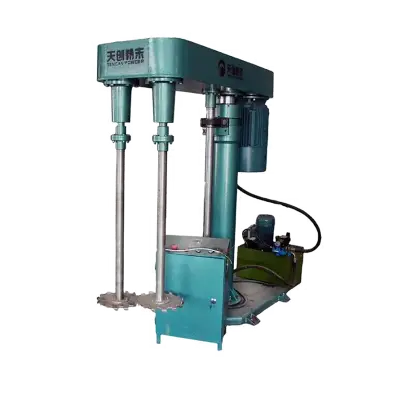
At its core, a hydraulic dual-shaft disperser is a specialized mixing and dispersion system designed for processing medium to high viscosity materials. Industries such as coatings, adhesives, inks, sealants, and chemicals use it to achieve efficient blending, dispersion, and homogenization of viscous formulations. Unlike single-shaft mixers, this equipment combines two independent agitation systems—a low-speed anchor agitator and a high-speed disperser—to handle challenging rheologies and ensure uniform particle distribution.
Core Function and Working Principle
The hydraulic dual-shaft disperser transforms raw materials from a lumpy, aggregated, or poorly mixed state into a smooth, homogeneous dispersion or paste. Its core working mechanism relies on the synergistic action of two independently driven shafts:
- Anchor Agitator (Low Speed): This large, wall-scraping agitator rotates at low speed (typically 10–50 rpm) to provide bulk flow, prevent dead zones, and continuously move material from the vessel walls into the mixing zone. It is equipped with Teflon or other polymer scrapers to ensure efficient heat transfer and eliminate buildup.
- High-Speed Disperser (High Speed): A high-tip-speed impeller (often a saw-tooth blade) rotates at speeds up to several thousand rpm, creating intense shear zones that break down agglomerates, wet out particles, and achieve fine dispersion. This impeller is typically mounted off-center to avoid interference with the anchor.
Both agitators operate independently via AC variable frequency inverters, allowing precise control over speed and torque for each shaft. The vessel is often jacketed for heating or cooling (e.g., 50 psig jacket) to manage exothermic reactions or temperature-sensitive materials. A hydraulic lift system raises and lowers the agitator assembly for easy cleaning, vessel access, and batch changes. The entire unit is designed for vacuum operation to remove air and prevent foam formation.
Key Components and Technologies
While the hydraulic dual-shaft disperser is a single product type, its performance depends on several critical components and optional features:
Mix Vessel and Discharge
The vessel is typically constructed from 316 stainless steel with a 100 grit finish (or finer) for easy cleaning and corrosion resistance. A flush-type bottom discharge valve (e.g., 2-inch) allows complete emptying without dead volume. Sight and charge ports in the cover enable visual inspection and ingredient addition under vacuum.
Agitator Design
The anchor agitator features Teflon scrapers that maintain contact with the vessel wall, ensuring all material is continuously mixed. The high-speed disperser shaft may be equipped with a single or multiple saw-tooth blades, with the option to adjust immersion depth via the hydraulic lift.
Control System
Each agitator is independently controlled by an AC variable frequency drive (VFD), enabling precise speed regulation. The hydraulic lift system is air/oil operated, providing smooth vertical movement. Optional features include a programmable logic controller (PLC) for recipe management, torque monitoring, and data logging.
Key Performance Indicators and Selection Criteria
When selecting a hydraulic dual-shaft disperser, consider the following metrics:
- Capacity Range: Units are available from 1 gallon to 2000 gallons. Choose a size that matches your batch volume and production scale.
- Viscosity Handling: These systems handle materials from 1,000 cP to over 1,000,000 cP. Higher viscosity requires stronger motors and reinforced anchor designs.
- Shear Rate Control: The high-speed disperser tip speed (typically 15–25 m/s) determines dispersion fineness. Adjustable speed allows optimization for different formulations.
- Temperature Control: A jacketed vessel with heating/cooling capability is essential for temperature-sensitive processes. Ensure the jacket rating (e.g., 50 psig) meets your requirements.
- Automation Level: From manual controls to fully automated PLC systems, choose the level that suits your process repeatability needs.
- Maintenance and Cleaning: Look for easy-to-clean features like polished surfaces, quick-disconnect couplings, and hydraulic lift for rapid access.
Application Areas and Selection Advice
Hydraulic dual-shaft dispersers are used across diverse industries:
- Coatings & Paints: For dispersing pigments, fillers, and resins into high-viscosity base materials.
- Adhesives & Sealants: For mixing silicone, polyurethane, epoxy, and acrylic formulations.
- Inks & Printing Pastes: For achieving fine pigment dispersion in gravure, flexo, and screen inks.
- Chemicals & Pharmaceuticals: For blending pastes, creams, and ointments under vacuum.
For small-scale R&D, a lab-sized unit (1–5 gallons) with manual controls is sufficient. For production, select a larger unit with PLC automation and vacuum capability. If your material is extremely viscous or shear-sensitive, consider a hydraulic dual-shaft disperser with a custom anchor design. Always consult the manufacturer for process testing to ensure optimal performance.
References
Product page: https://www.planetaryballmills.com/products/mixed-series/hydraulic-dual-shaft-disperser.html
Related Products
Get In Touch
Our professional team will reply to you within one business day. Please feel free to contact us!