

What is a Hydraulic Dual-Shaft Disperser? A High-Efficiency Mixing and Dispersion Equipment for Medium to High Viscosity Materials
Introduction
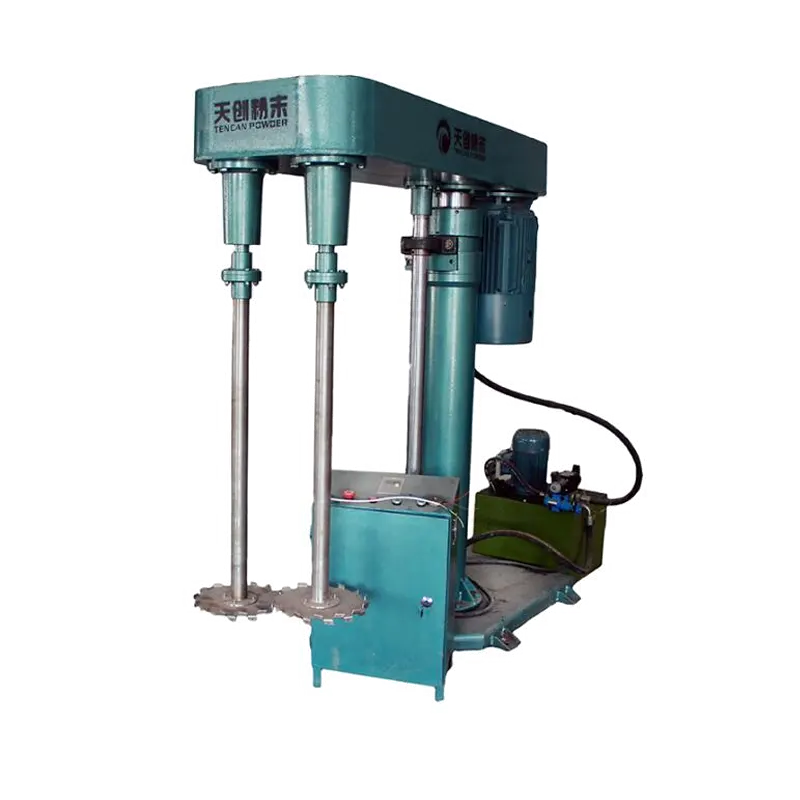
At its core, a hydraulic dual-shaft disperser is a specialized mixing and dispersion equipment used in industries such as coatings, adhesives, inks, pharmaceuticals, and cosmetics to efficiently process medium to high viscosity materials. Unlike single-shaft mixers, the dual-shaft design integrates two independently driven agitators—a low-speed anchor frame and a high-speed disperser disc—to deliver both bulk flow and intense shear in a single unit. This combination allows the machine to handle pastes, slurries, and viscous liquids that would be difficult to mix with conventional equipment.
Core Functionality and Working Principle
The hydraulic dual-shaft disperser transforms raw materials from a coarse, lumpy, or separated state into a uniform, finely dispersed mixture. The equipment features two concentric shafts: the outer shaft drives a low-speed anchor agitator that scrapes the vessel walls and moves the entire bulk material, while the inner shaft drives a high-speed toothed disc (or impeller) that generates intense shear, impact, and cavitation forces. These forces break down agglomerates, wet out powders, and create a stable dispersion.
During operation, the anchor agitator rotates at a relatively low speed (typically 10–60 rpm) to ensure continuous circulation of the viscous material from the vessel walls to the center. The high-speed disperser, operating at peripheral tip speeds of 15–30 m/s, creates a strong suction zone that draws material into the disc, where it is subjected to high shear. The two independent drives are usually controlled by AC variable frequency inverters, allowing precise adjustment of each agitator's speed to match the process requirements. The hydraulic lift system enables easy raising and lowering of the agitator assembly for cleaning, batch discharge, or vessel change.
Key Components and Technologies
A typical hydraulic dual-shaft disperser consists of several critical components that determine its performance and reliability:
Anchor Agitator
The anchor frame is designed to fit the contour of the mixing vessel, often equipped with Teflon scrapers to wipe the vessel walls and prevent material buildup. This ensures efficient heat transfer and complete mixing of high-viscosity materials.
High-Speed Disperser Disc
The toothed disc (or saw-tooth impeller) is the primary dispersion element. Its teeth create a high-velocity gradient that generates shear forces, breaking down particle agglomerates and promoting wetting. The disc diameter and tooth geometry are optimized for the specific viscosity range.
Hydraulic Lift System
An air/oil hydraulic cylinder provides smooth and safe lifting of the rotating assembly. This is essential for vessel access during cleaning, inspection, and batch changes.
Vessel and Jacket
The mixing vessel is typically made of 316 stainless steel with a polished interior (e.g., 100 grit finish) for easy cleaning and corrosion resistance. A jacket around the vessel allows for heating or cooling by circulating a thermal fluid, helping to control the process temperature.
Discharge Valve
A flush-type bottom discharge valve (e.g., 2-inch) ensures complete evacuation of the product without dead zones.
Key Performance Indicators and Selection Criteria
When selecting a hydraulic dual-shaft disperser, users should evaluate the following parameters:
Processing Capacity
Units are available in a wide range of working capacities, from 1 liter laboratory models to 2,000-gallon production-scale vessels. The batch size should match the production volume requirements.
Viscosity Range
These machines are designed for medium to high viscosity materials, typically from 1,000 to 100,000 cP or higher. The anchor agitator provides the bulk flow needed for heavy pastes, while the disperser handles the fine dispersion.
Speed Control and Automation
Independent variable speed control for each shaft (via AC inverters) allows precise tuning of the mixing profile. Some models offer programmable logic controllers (PLC) for recipe-based automation, improving repeatability.
Material of Construction
Wetted parts are often made of 316 stainless steel or other corrosion-resistant alloys. For food or pharmaceutical applications, a higher surface finish (e.g., 150 grit or better) may be required.
Maintenance and Cleaning
Features such as hydraulic lift, sight ports, and easy-access charge ports simplify cleaning and maintenance. The removable agitator assembly and flush-bottom valve reduce downtime between batches.
Applications and Selection Recommendations
Hydraulic dual-shaft dispersers are widely used in the production of paints, coatings, adhesives, sealants, printing inks, cosmetics, pharmaceuticals, and chemical intermediates. They are particularly suitable for processes where both high shear and bulk circulation are needed, such as pigment dispersion, emulsion preparation, and viscous paste mixing.
For laboratory or pilot-scale work, a compact model with a 1–5 gallon capacity and a single-phase power supply is often adequate. For production, choose a model with a capacity matching your batch size, and consider features like a heating/cooling jacket if temperature control is critical. When dealing with abrasive or corrosive materials, opt for hardened stainless steel or ceramic-coated components. Always verify that the motor power and torque are sufficient for the highest viscosity you expect to process.
References
Related Products
Get In Touch
Our professional team will reply to you within one business day. Please feel free to contact us!