
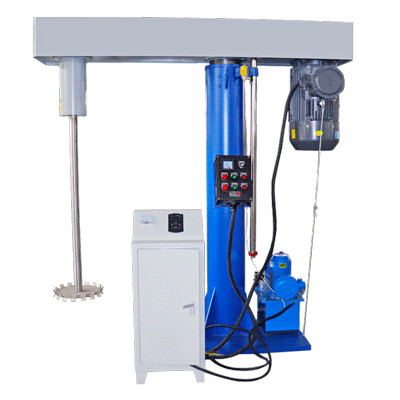
What is a Hydraulic Single Axis Disperser? A High-Performance Dispersing Device for Liquid-Solid Materials

Introduction
At its core, the Hydraulic Single Axis Disperser is a specialized mixing and dispersing device that industries such as paint, ink, chemical, cosmetics, and pharmaceuticals use to break down agglomerates and uniformly distribute solid particles into a liquid phase. This machine combines a high-speed rotating dispersing disc with a hydraulic lifting system, enabling precise control over the dispersion process and easy adjustment of the disc's immersion depth in the material. Whether in a laboratory formulation stage or small-scale production, this disperser provides the shear force and turbulence needed to achieve consistent product quality.
Core Function and Working Principle
The fundamental task of the Hydraulic Single Axis Disperser is to transform a mixture of solid and liquid components from a coarse, lumpy state into a fine, homogeneous dispersion. The core working principle relies on a specially designed dispersing disc mounted at the end of a rotating shaft. When the shaft rotates at high speed (typically several thousand revolutions per minute), the disc generates intense shear forces, centrifugal motion, and hydraulic cavitation. These forces break apart particle agglomerates and disperse them evenly throughout the liquid vehicle.
The hydraulic system serves a critical supporting role: it provides smooth, controlled lifting and lowering of the entire dispersing head. This allows operators to precisely position the disc at the optimal depth within the mixing vessel, compensate for changes in material volume, and easily raise the head for vessel changeover or cleaning. The hydraulic unit typically consists of an oil pump, cylinder, and control valves, delivering reliable force with minimal mechanical wear. Key adjustable parameters include rotation speed, disc diameter, and immersion depth, all of which influence the final dispersion fineness and product consistency.
Key Components and Technology
The Hydraulic Single Axis Disperser is built around several critical subsystems:
- Dispersing Disc – Typically made of stainless steel or wear-resistant alloy, with a toothed or serrated edge to maximize shear and turbulence. Disc diameter and geometry are selected based on the viscosity and volume of the material.
- Main Drive Motor and Speed Control – A variable-frequency drive (VFD) enables stepless speed adjustment, allowing operators to match the rotational speed to the process requirements. Higher speeds generate greater shear for dispersion, while lower speeds avoid splashing in thin liquids.
- Hydraulic Lifting System – A self-contained hydraulic unit powers a cylinder that raises and lowers the dispersing head. This system is designed for smooth, oil-damped motion, preventing sudden drops that could damage the vessel or cause spills.
- Control Panel – Modern units feature a digital display for speed, timer, and hydraulic control, often with programmable settings for reproducible batch processing.
These components work in concert to deliver efficient dispersion while maintaining operator safety and process consistency.
Key Performance Indicators and Selection Criteria
When selecting a Hydraulic Single Axis Disperser for your application, consider these critical performance metrics:
- Processing Capacity and Motor Power – Laboratory units typically handle 5–50 liters, while pilot and production models can accommodate 100 liters or more. Motor power (usually 0.75 kW to 15 kW) directly influences the maximum viscosity and throughput.
- Maximum Disc Tip Speed – The peripheral speed of the disc (often 15–25 m/s) determines the shear intensity. Higher tip speeds are needed for breaking down hard agglomerates but may cause excessive foaming in sensitive materials.
- Hydraulic Lift Stroke and Speed – A longer stroke (e.g., 400–800 mm) provides greater flexibility for different vessel heights. Adjustable lift speed allows fine positioning.
- Speed Range and Control Accuracy – A wide speed range (e.g., 0–3000 rpm) with precise digital regulation ensures repeatable results across different formulations.
- Material Contact Parts – Stainless steel (304 or 316) is standard for corrosion resistance; optional PTFE or ceramic coatings are available for aggressive chemicals.
- Ease of Maintenance – Look for quick-disconnect shaft couplings, easy-access hydraulic filters, and sealed bearings to minimize downtime.
Application Fields and Selection Recommendations
The Hydraulic Single Axis Disperser is widely used across multiple industries where liquid-solid dispersion is essential:
- Paints and Coatings – for dispersing pigments, fillers, and additives into resins or solvents.
- Printing Inks – to achieve consistent color strength and fineness in paste or liquid inks.
- Chemicals – for mixing powders into liquid chemicals, adhesives, or sealants.
- Cosmetics and Personal Care – for dispersing pigments in lipsticks, creams, or lotions.
- Pharmaceuticals – for preparing suspensions, ointments, and oral liquids.
- Food Processing – for homogenizing ingredients such as sauces, syrups, and flavor pastes.
For laboratory and R&D applications, a compact model with a small motor and manual hydraulic pump is sufficient. For production environments, choose a larger unit with a fully automatic hydraulic system and explosion-proof motor if flammable solvents are used. If you also require dry powder mixing before dispersion, consider integrating a V-type mixer or 3D mixer in your upstream process. For alternative dispersing methods, the high speed dispersing homogenizer offers similar capabilities with a different rotor-stator design.
References
- Hydraulic single axis disperser product page: https://www.planetaryballmills.com/products/mixed-series/hydraulic-single-axis-disperser.html
Related Products
Get In Touch
Our professional team will reply to you within one business day. Please feel free to contact us!