
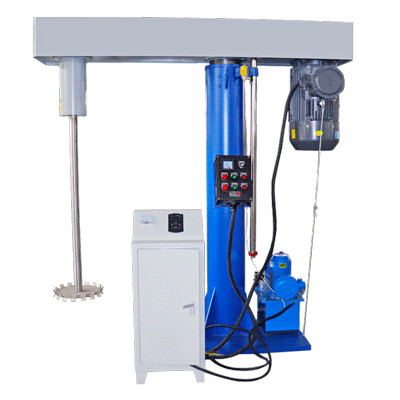
What is a Hydraulic Single Axis Disperser? A High-Performance Dispersion Equipment for Efficient Solid-Liquid Mixing and Homogenization

What is a Hydraulic Single Axis Disperser?
At its core, a hydraulic single axis disperser is a specialized piece of dispersion equipment that industries such as coatings, inks, adhesives, cosmetics, and chemical processing use to efficiently wet out, disperse, and homogenize solid particles into a liquid medium. Unlike simple stirrers, this machine combines a powerful motor, a precisely engineered dispersing impeller, and a hydraulic lift system to achieve high-shear mixing, deagglomeration, and uniform distribution of powders or pigments in a liquid phase.
Core Function and Working Principle
The hydraulic single axis disperser transforms a mixture of solid particles and liquid from a lumpy, agglomerated state into a smooth, homogeneous dispersion. The core working mechanism involves a high-speed rotating impeller (often a saw-tooth or toothed disc) that is lowered into the mixing vessel by a hydraulic lift system. As the impeller rotates at speeds typically ranging from 1000 to 3000 rpm, it creates a strong suction vortex that draws material from the top down into the blade. The high shear forces generated at the teeth of the impeller break up agglomerates and force the liquid into the particle interstices, effectively wetting the solid surfaces.
Key process parameters include impeller tip speed (typically 15-25 m/s for effective dispersion), immersion depth, and processing time. The hydraulic lift allows the operator to easily raise and lower the dispersing head for positioning, cleaning, and batch handling. The machine can be equipped with a variable frequency drive to precisely control the rotational speed, ensuring optimal shear for different formulations. The final dispersion quality depends on the balance between rotor speed, viscosity of the medium, and particle size of the solids.
Key Components and Critical Technologies
The hydraulic single axis disperser consists of several essential parts:
- Dispersing Impeller: Usually a high-tensile steel toothed disc designed to generate intense shear and turbulence. The design of the teeth (shape, number, angle) directly influences the dispersion efficiency.
- Hydraulic Lift System: Allows smooth vertical movement of the dispersing head. This is crucial for easy vessel change, cleaning, and adjusting the impeller position relative to the batch level.
- Drive Motor: A high-power motor (often 1.5 kW to 75 kW or more) with variable frequency drive for speed control. The motor must deliver consistent torque across the speed range.
- Control System: Modern units include digital displays for speed, timer, and sometimes torque monitoring. Advanced models may offer programmable recipes.
Compared to simple stirrers or paddle mixers, the hydraulic single axis disperser provides much higher shear intensity, making it suitable for deagglomerating even the most stubborn pigment clusters. It is also more flexible than a dual-shaft disperser, offering a simpler, more economical solution for many dispersion tasks.
Key Performance Indicators and Selection Criteria
When selecting a hydraulic single axis disperser, users should consider the following metrics:
- Power and Speed Range: Higher power allows handling higher viscosity batches. Speed range should match the required tip speed for your formulation (typically 1000-3000 rpm for lab units, up to 1500 rpm for production).
- Lifting Stroke and Capacity: The hydraulic lift must be able to raise the head sufficiently to accommodate different vessel sizes. Ensure the stroke length matches your typical batch volume.
- Impeller Diameter and Material: The impeller should be sized proportionally to the vessel diameter (typically 1/3 to 1/2 of vessel diameter). Stainless steel is standard for corrosion resistance.
- Control Features: Variable frequency drive for continuous speed adjustment, digital display, and optional timer are essential for reproducibility.
- Safety and Maintenance: Look for emergency stop, overload protection, and easy access for cleaning. The hydraulic system should be sealed to prevent contamination.
Application Areas and Selection Advice
The hydraulic single axis disperser is widely used in:
- Paints and Coatings: Dispersing pigments, fillers, and additives into resin or solvent.
- Inks and Printing: Homogenizing carbon black, colorants, and binders.
- Adhesives and Sealants: Mixing powders into liquid polymers.
- Cosmetics and Personal Care: Dispersing active ingredients, pigments, and thickeners.
- Chemical and Pharmaceutical: Preparing suspensions, emulsions, and pastes.
For laboratory R&D, a compact lab disperser with 0.5-2 liter capacity is ideal. For small-scale production, a hydraulic single axis disperser with 5-50 liter capacity offers good flexibility. For large-scale manufacturing, choose a production model with a robust hydraulic lift and high-power motor. If your process requires simultaneous high-speed dispersion and low-speed mixing, consider a hydraulic dual-shaft disperser.
References
Related Products
Get In Touch
Our professional team will reply to you within one business day. Please feel free to contact us!