

What Is an Automatic Electric Tablet Press? A Benchtop Machine for Tableting
What Is an Automatic Electric Tablet Press?
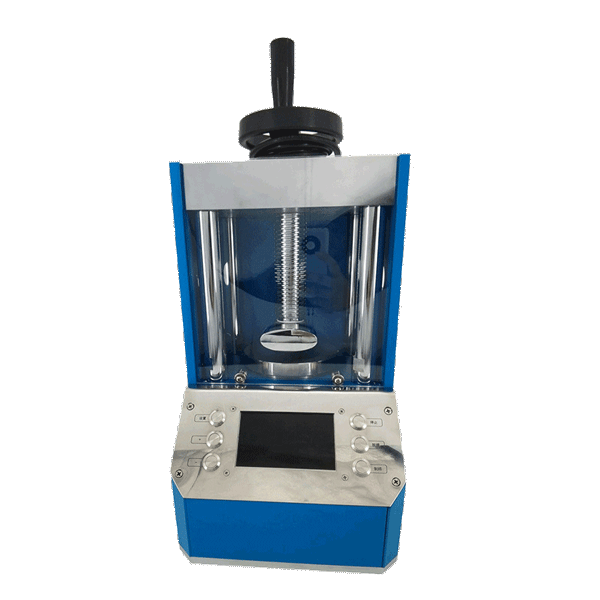
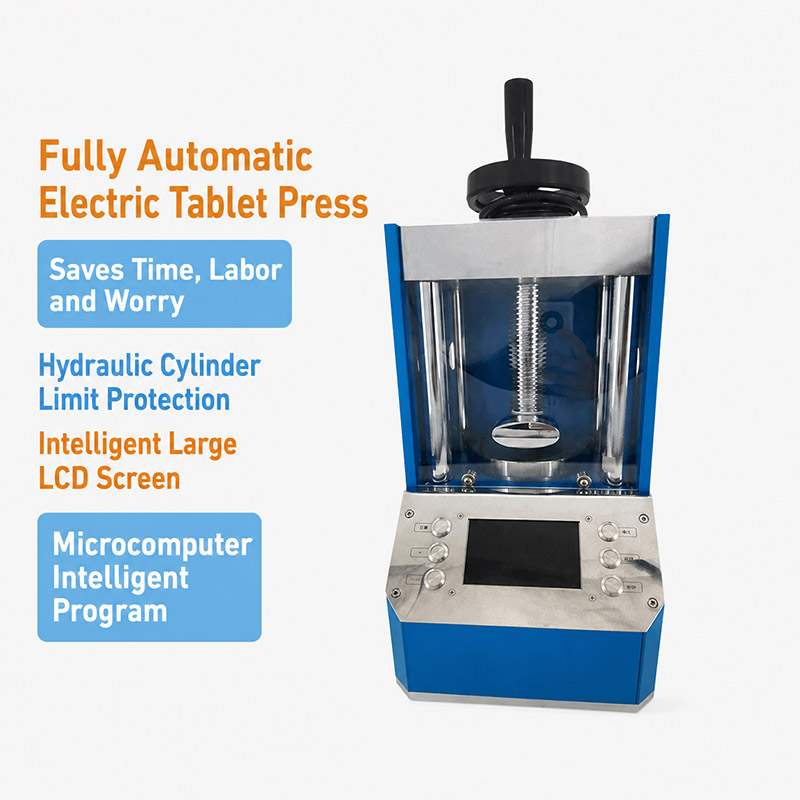
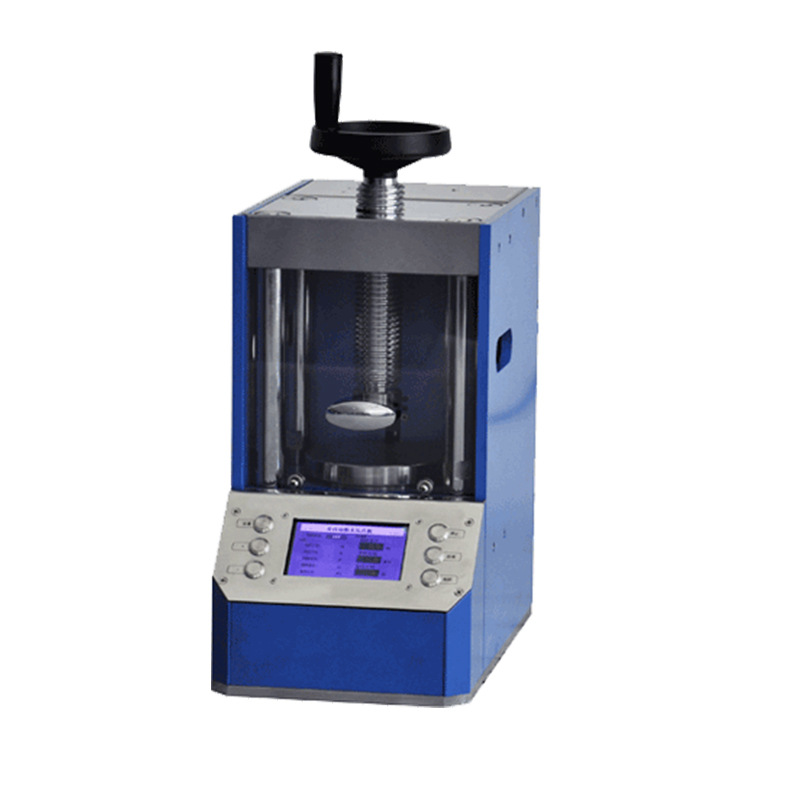
In simple terms, an automatic electric tablet press is a compact compression machine that laboratories, pilot plants and small production units use to turn loose powders or granular blends into solid tablets with a repeatable shape, weight and hardness. The word "automatic" describes how the machine works: die filling, powder metering, punch movement, compression and tablet ejection are all carried out by an electric motor and a control system rather than by a hand-operated lever. The word "electric" separates it from hydraulic bench presses and from purely mechanical hand presses. The practical result is a machine that behaves like a miniature version of an industrial tablet press — it can repeat the same compression cycle again and again with the same settings, which is exactly what is needed when a formulation is being developed, a powder blend is being screened, or a small batch of shaped samples is required for research and testing.
Core Function and Working Principle
The basic function of the machine is a transformation of state: a loose, air-filled powder bed is converted into a dense, mechanically stable compact. This is a fundamentally different operation from milling, mixing, drying or sintering. No material is removed and no heat is intentionally added; instead, the powder particles are forced into close contact, rearranged, deformed and, in many formulations, bonded together by a binder or by cold welding. A tablet press therefore does not change what a material is — it changes how that material is packed and how strongly its particles hold onto one another.
To achieve this, the machine is built around three essential parts. The die is a precision bore that defines the tablet's diameter and holds the powder during compression. The lower punch closes the bottom of the die and sets how deep the powder sits. The upper punch descends into the die to apply pressure. Around these parts sit a hopper or feed shoe that delivers the powder, an ejection mechanism that lifts the finished tablet out of the die, and a control system that coordinates the whole sequence, often called a compression cycle.
Stage One: Filling and Metering the Die
In the first stage, the lower punch is positioned at a defined depth inside the die, leaving an empty cavity of a known volume. Powder flows from the hopper, usually through a feed shoe that slides across the die table, and fills that cavity. Because the volume of the cavity is fixed by the punch position, fill depth is the first and most important control over tablet weight: a deeper cavity accepts more powder and produces a heavier tablet, while a shallower cavity produces a lighter one. For filling to be accurate, the powder must flow reasonably well. Blends with poor flow tend to fill unevenly, which later shows up as tablet-to-tablet weight variation. This is why granulation, the addition of a glidant, or simple pre-conditioning of a powder often matters as much as the press settings themselves.
Stage Two: Compression and Dwell
Once the die is filled, the excess powder is scraped away and the upper punch descends. As the punch moves down, the powder bed is first rearranged — particles slide past one another and fill the voids between them. Then, as pressure rises, the particles begin to deform elastically and then plastically, and brittle particles may fracture. The contact area between particles grows, inter-particle bonds form, and the compact develops mechanical strength. In an electric press, the punch is driven by a motor through a cam, eccentric or screw mechanism, so the compression force and the speed of descent are set by the controller rather than by the operator's arm.
One parameter that is easy to overlook but has a large effect on tablet quality is dwell time: the length of time the powder spends under maximum pressure. Dwell time controls how completely the material can deform and how much air can escape from the compact. If the punch rises too quickly, air trapped inside the tablet expands and can cause capping or lamination, where the tablet splits horizontally or its top separates. Programmable electric presses allow the compression profile, including dwell and decompression, to be tuned so that difficult powders can be compacted without cracking.
Stage Three: Ejection and Elastic Recovery
After compression, the upper punch withdraws and the lower punch rises to push the finished tablet out of the die. Ejection is a critical moment: friction between the tablet and the die wall means that a considerable force may be needed to release the compact, and that friction can scratch the die or damage the tablet's edges. Formulators manage this with lubricants such as magnesium stearate or with carefully polished die surfaces. Once ejected, the tablet may still undergo a small amount of elastic recovery, springing back slightly in thickness. This is why tablet thickness is usually measured after a short settling period, and why the same formulation can give slightly different results on two different machines.
Main Types and Configuration Choices
Tablet presses are commonly grouped in two ways: by how much of the cycle is automated, and by how many compression stations they contain. Understanding both classifications helps a buyer match a machine to the work at hand.
Manual, Semi-Automatic and Fully Automatic Electric Presses
A manual press uses a hand lever or handwheel to generate force. It is inexpensive and gives the operator direct tactile feedback, but it is tiring, slow and hard to reproduce, because two operators will rarely produce identical tablets. A semi-automatic machine motorizes part of the cycle while the operator still loads and unloads material. A fully automatic electric tablet press motorizes the entire sequence, from powder feed to ejection, so that the same program can be repeated indefinitely. For formulation development, quality control samples and small-batch production, the automatic electric type is usually the best compromise between reproducibility and bench-top footprint.
Single-Punch and Rotary Configurations
A single-punch press has one die and one pair of punches. It produces one tablet per cycle, which makes it ideal for research, small batches and expensive or scarce materials — a few grams of an experimental powder are enough to produce a meaningful set of samples. A rotary press carries many punch-and-die stations on a rotating turret, so several tablets are compressed simultaneously and output rises dramatically. Rotary machines dominate industrial production, but they need much larger quantities of material to fill and stabilize, and their tooling changes are more complex. The automatic electric bench-top press belongs to the single-punch family and is generally used upstream of, or alongside, larger rotary equipment.
Tooling, Dies and Tablet Shape
The tablet's geometry comes from the tooling, not from the press body, so a flexible press is one that accepts a wide range of dies. Round, oval, oblong, square and special-shaped dies are all possible, as are flat, concave and bevelled punch faces. Deep concave tooling may need a higher compression force to reproduce the shape accurately, while very thin tablets demand tighter control of fill depth. For multi-layer or core-containing tablets, additional feeding and alignment features are required, which is why buyers should confirm the available tooling range before choosing a machine.
Core Components and Key Technologies
Although the principle of tableting is simple, the reliability of an automatic electric press depends on a handful of well-engineered subsystems. Knowing what these are makes it easier to judge build quality and to plan maintenance.
The Motor and Drive System
The motor and its transmission determine how much force the press can deliver and how smoothly it delivers it. A geared motor driving a cam or eccentric produces a predictable force curve; a screw-driven system delivers high force at low speed. Whatever the mechanism, the important characteristics are stable speed under load, minimal backlash and overload protection, so that a jammed die does not damage the punch. Variable-speed drives let the operator trade speed for consistency, since running slowly usually improves weight uniformity.
Punch, Die and Feed Assembly
The punch and die set is the heart of the machine. Tooling is normally made from hardened steel or, for abrasive or metal-sensitive powders, from ceramic or carbide. Clearances between punch and die are kept very small so that powder cannot escape sideways, and surface finish matters because friction at the die wall directly affects ejection force and tablet quality. Above the die, a hopper and feed shoe distribute the powder, while an adjustable scraper or leveller determines how much material finally stays in the cavity.
Control System, Monitoring and Safety
Modern automatic electric presses use a digital controller, often with a touch screen or keypad, to set compression force, cycle speed, fill depth and ejection depth. Stored recipes let a laboratory reproduce a set of conditions months later, which is essential for traceability. Safety features typically include interlocked guards, emergency stop buttons and, in some designs, force or pressure monitoring that flags an abnormal cycle. Where the press is programmable, data such as compression force or cycle count can often be recorded, which supports documentation for internal reports and audits.
Cleanability and Wear Parts
Because powders are messy and cross-contamination is a real risk in a shared laboratory, the parts that touch material should be easy to remove and clean. Look for tooling that can be swapped without special tools, surfaces that tolerate solvents, and seals that resist fine dust. Wear parts are usually the punches, dies and seals; keeping spares on hand shortens downtime considerably.
Key Performance Indicators and Selection Points
When comparing automatic electric tablet presses, a few measurable indicators matter far more than catalogue gloss. The following sections summarize what to look for.
Throughput and Tablet Size Range
Output is usually quoted as tablets per hour or per minute, but the realistic figure depends on tablet size and on the material being pressed. A press that can produce thousands of small, easy-flowing tablets per hour may manage far fewer large or sticky ones. Equally important is the size window: the maximum and minimum tablet diameter, the maximum fill depth and therefore the maximum tablet weight, and the maximum thickness. A machine with a narrow window will be limited as soon as a new formulation needs a larger or thicker tablet.
Compression Force, Weight Consistency and Hardness
Compression force determines whether a powder can be compacted at all and how hard the resulting tablet will be. Force is usually expressed in kilonewtons or in tonnes, and a higher ceiling gives more headroom for hard, brittle or coarse materials. Peak force is only half the story, however: the consistency of that force from one cycle to the next is what produces uniform tablet weight and hardness. Ask how the press controls fill depth — whether through a mechanical stop, servo positioning or fully programmable depth — and how repeatable that control is over a long run.
Energy Efficiency, Automation and Maintenance
Bench-top presses draw modest power, so energy cost is rarely the deciding factor. What matters more is efficiency in the sense of material and time: how quickly a batch can be run and how little material is lost during setup. The level of automation determines this. Programmable recipes, automatic filling and ejection, and digital recording of parameters all reduce operator-dependent variability. On the maintenance side, check whether lubrication is required and how often, whether the drive is sealed against dust, and whether the manufacturer supplies tooling, spare parts and clear documentation. A press with an understandable manual and available spares will stay productive far longer than one with obscure or discontinued parts.
Applications and Selection Advice
Automatic electric tablet presses appear wherever a powder needs to be evaluated in compacted form. Typical fields include:
- Pharmaceutical and nutraceutical development, where trial tablets are made for dissolution, hardness and friability testing before a formulation is scaled up.
- Materials research, where ceramic, catalyst, battery and metal powders are pressed into discs or pellets for sintering, conductivity measurement or density analysis.
- Chemical and food processing, where catalyst pellets, salt and seasoning tablets, detergent tablets and specialty shapes are formed.
- Teaching and quality control laboratories, where the equipment gives students and technicians hands-on experience of compression, tooling and process control.
Selection should follow the material and the scale of work. If the goal is formulation screening with limited material, prioritize a press with a wide tooling range, precise low-force control, easy die changes and a small minimum batch size. If tablets must be produced in small batches for testing or sale, look for higher throughput, programmable recipes and repeatable weight control. If abrasive ceramics or metal powders are involved, check that the tooling and contact surfaces are specified for those materials, and consider wear-resistant dies. In every case, confirm that the supplier provides the die sizes you actually need, because tooling availability often limits a press more than the machine itself. Finally, match the press to the documentation your organization requires: reproducible settings and recordable parameters make audits and internal reviews much simpler.
Where to Learn More
The machine described in this article is the automatic electric tablet press in the press forming range, where tooling options, technical parameters and additional product images are listed. If you are comparing compression equipment for a powder laboratory, the same catalogue also covers related bench-top tableting solutions, and the product page remains the most reliable place to confirm the specifications that matter for your own application.
Related Products
Get In Touch
Our professional team will reply to you within one business day. Please feel free to contact us!