

What is a Box-Type Atmosphere Furnace? A Controlled-Environment Thermal Processing System for High-Temperature Materials Research
What is a Box-Type Atmosphere Furnace?
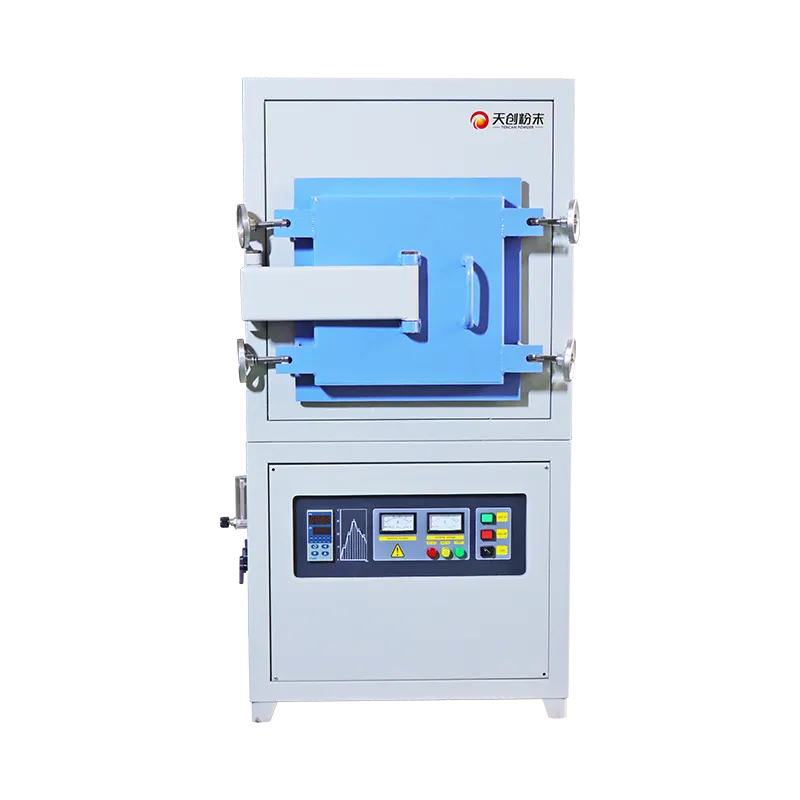
At its core, a box-type atmosphere furnace is a professional thermal processing device that materials science labs, powder metallurgy facilities, and advanced ceramics manufacturers use to heat-treat samples under precisely controlled gaseous environments. Unlike conventional muffle furnaces that operate in ambient air, this equipment can create a vacuum or introduce inert, reducing, or reactive gases (such as argon, nitrogen, or hydrogen) to prevent oxidation, promote specific chemical reactions, or achieve desired material properties. The box-type design offers a large, accessible chamber that accommodates bulky samples or multiple small specimens simultaneously, making it an indispensable tool for both R&D and small-scale production.
Core Function and Working Principle
The fundamental function of a box-type atmosphere furnace is to transform raw materials from their initial state — often green compacts, loose powders, or metallic parts — into a final sintered, annealed, or heat-treated product with controlled microstructure and composition. The working principle revolves around three integrated systems: the heating system, the gas management system, and the control system.
Heating Mechanism
The furnace chamber is lined with high-temperature refractory materials, such as polycrystalline alumina fibers, which provide excellent thermal insulation and energy efficiency. Heating elements — typically resistance wire, silicon carbide rods, or molybdenum disilicide (MoSi2) elements — are embedded in the walls or around the chamber. The temperature is controlled by a PID (Proportional-Integral-Derivative) controller, which can achieve precision of ±1°C or better, ensuring uniform and repeatable thermal profiles.
Atmosphere Control
The distinguishing feature of this furnace is its ability to modulate the internal atmosphere. A vacuum pump first evacuates the chamber to remove ambient air, and then a controlled gas flow is introduced through a mass flow controller or needle valve. The gas can be inert (e.g., argon, nitrogen), reducing (e.g., hydrogen, forming gas), or even reactive (e.g., oxygen for oxidation studies). A pressure gauge and safety relief valve maintain the desired pressure, typically from vacuum to slightly above atmospheric pressure. The sealed door, often equipped with water-cooled O-rings, ensures leak-tightness during operation.
Process Parameters
Key parameters include heating rate (typically 1–20°C/min), soaking temperature (up to 1700°C or higher for MoSi2 models), holding time, cooling rate, and gas flow rate. These parameters directly influence the final product's density, grain size, phase purity, and mechanical properties. For example, slower heating rates help avoid thermal shock in ceramic green bodies, while precise gas composition prevents decarburization in steel parts.
Core Components and Key Technologies
While the box-type atmosphere furnace may appear as a single unit, its performance relies on several critical subsystems:
- Chamber and Insulation: High-alumina fiber or vacuum-formed ceramic fiber modules reduce heat loss and enable rapid heating/cooling cycles.
- Heating Elements: Depending on the maximum temperature, elements can be resistance wire (≤1200°C), SiC rods (≤1400°C), or MoSi2 (≤1700°C).
- Vacuum System: A rotary vane or dry vacuum pump, combined with a vacuum gauge, achieves base pressures down to 10⁻² mbar or lower.
- Gas Delivery System: Includes mass flow controllers, gas mixing manifolds, and purge valves for precise atmosphere composition.
- Control System: A programmable logic controller (PLC) with a touch-screen interface allows users to create multi-step recipes, log data, and set alarms.
- Safety Features: Over-temperature protection, automatic gas shut-off, and water-cooled door seals ensure safe operation.
Key Performance Indicators and Selection Criteria
When selecting a box-type atmosphere furnace, researchers and procurement specialists should evaluate the following metrics:
Temperature Range and Uniformity
Maximum temperature determines the range of materials that can be processed. For most ceramic and metal sintering, 1200°C to 1700°C is common. Temperature uniformity (typically ±5°C over the working zone) is critical for batch consistency.
Atmosphere Capability
Check whether the furnace supports both vacuum and positive pressure operation. Some models are designed only for inert gas flow at atmospheric pressure, while others offer full vacuum-to-overpressure capability. The leak rate (e.g., < 0.1 mbar·L/s) indicates sealing quality.
Chamber Size and Heating Rate
Chamber dimensions (e.g., 10" x 10" x 11" or customizable) dictate sample throughput. Faster heating and cooling rates improve productivity but may require more robust heating elements and insulation.
Automation and Programmability
A modern furnace with programmable PID control, recipe storage, and remote monitoring capabilities reduces operator error and increases reproducibility. Touch-screen interfaces are preferred for ease of use.
Energy Efficiency
Low thermal mass insulation (e.g., ceramic fiber) reduces energy consumption and shortens cycle times, which is important for both cost and environmental considerations.
Application Fields and Selection Advice
Box-type atmosphere furnaces are widely used in:
- Materials Research: Sintering of advanced ceramics (e.g., zirconia, alumina), cermets, and composite materials.
- Powder Metallurgy: Consolidation of metal powders under controlled atmospheres to prevent oxidation.
- Heat Treatment: Annealing, brazing, and quenching of specialty alloys in inert or reducing environments.
- Catalyst and Battery Materials: Calcination and activation of catalyst supports and electrode materials.
- Electronics: Soldering and sealing of electronic components in nitrogen or forming gas.
For laboratory R&D, a compact, multi-purpose box-type atmosphere furnace with a temperature range of 1200–1600°C and both vacuum and inert gas capabilities is often the best choice. For production-scale applications, larger chambers with higher heating rates and automated gas handling systems are recommended. Always verify compatibility with the specific gases you plan to use (e.g., hydrogen requires special safety provisions).
For more detailed specifications, visit the Box-Type Atmosphere Furnace product page or explore related equipment such as the Muffle Furnace and Vacuum Tube Furnace for comparison.
Related Products
Get In Touch
Our professional team will reply to you within one business day. Please feel free to contact us!