
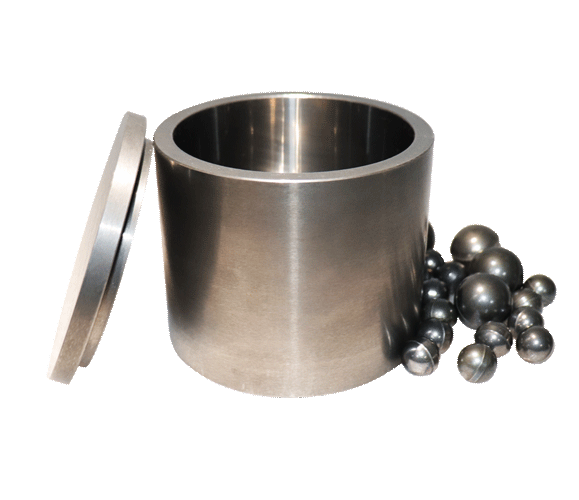
What is a Tungsten Carbide Planetary Mill Jar? A High-Wear-Resistant Milling Container for Ultrafine Grinding of Hard Materials

From its core, a tungsten carbide planetary mill jar is a high-performance grinding container used in planetary ball mills to pulverize, mix, and homogenize extremely hard and abrasive materials down to micron or even nanometer particle sizes. It is the preferred choice when milling ultra-hard substances such as cemented carbides, tungsten carbide powders, hard metals, ceramics, and other brittle materials that would quickly destroy conventional jars made of stainless steel or agate. The jar's exceptional hardness (HRA 89–92) and density (approximately 14.5 g/cm³) provide high impact energy transfer and superior wear resistance, ensuring minimal contamination of the sample during prolonged milling sessions.
Core Function and Working Principle
The tungsten carbide planetary mill jar serves as the vessel where grinding media (usually tungsten carbide balls) and the material to be milled are placed. During operation, the jar is mounted on a planetary ball mill's rotating disc. As the main disc rotates (revolves), each jar also spins on its own axis in the opposite direction. This planetary motion generates strong centrifugal forces (up to 20–30 g) and Coriolis forces, which cause the grinding balls to collide repeatedly with the inner wall of the jar and with each other, crushing the material trapped between them.
The extremely high specific weight of tungsten carbide (about twice that of stainless steel) enhances the kinetic energy of the grinding balls. This results in faster particle size reduction, even for materials with Mohs hardness close to 9. Studies have shown that using a tungsten carbide jar and balls can reduce the crystallite size of WC powder from 377 nm down to 177 nm within 6 hours at 600 rpm. The jar's design also facilitates both dry and wet grinding, as well as inert atmosphere milling when sealed with a specialized lid.
Key operational parameters that influence the final particle size and distribution include the milling speed (rpm), milling time, ball-to-powder weight ratio (typically 5:1 to 15:1 for WC materials), and the size of the grinding balls. Increasing speed and time generally reduces particle size, but an optimal balance must be struck to avoid excessive wear or overheating. The solid/ball ratio is particularly important: a ratio of 1:10 to 1:30 is often used for mechanical activation of kaolin and similar materials, while for tungsten carbide powders, a ratio of 4:1 to 10:1 is common.
Core Components and Key Technologies
A tungsten carbide planetary mill jar is not a simple container; it integrates several design features to ensure high performance and longevity:
- Material composition: The jar is made from sintered tungsten carbide (WC) with a cobalt binder (typically 6–10% Co). The addition of cobalt enhances toughness while maintaining extreme hardness. Some jars use a WC-6Co grade for a good balance of wear resistance and fracture toughness.
- Surface finish: The inner surface is precision-ground to provide a smooth, uniform milling environment, reducing the risk of sample contamination and facilitating easy cleaning.
- Lid sealing: Most tungsten carbide jars come with a tight-sealing lid, often with an O-ring, to prevent leakage during high-speed operation. Optional vacuum or inert gas sealing is available for air-sensitive materials.
- Compatible grinding media: To avoid cross-contamination, the recommended grinding balls are also made of tungsten carbide, usually with diameters of 6 mm, 10 mm, or 12 mm. Using different ball sizes can optimize the grinding effect by combining impact and friction.
Available capacities typically range from 50 ml to 500 ml, with 100 ml and 250 ml being the most common for laboratory use. The jar dimensions are standardized to fit most planetary ball mill models from major manufacturers (e.g., TENCAN, RETSCH, FRITSCH).
Key Performance Indicators and Selection Guide
When selecting a tungsten carbide planetary mill jar, the following parameters are critical:
- Hardness and wear resistance: Tungsten carbide jars offer the highest abrasion resistance among all jar materials (except diamond). This ensures a long service life even when milling hard ceramics or cemented carbides.
- Density: The high density (≈14.5 g/cm³) increases the impact force of the grinding media, leading to faster grinding compared to lighter jars (e.g., zirconia ~6 g/cm³, stainless steel ~8 g/cm³).
- Chemical inertness: Tungsten carbide is resistant to most acids and alkalis, making it suitable for aggressive chemical environments.
- Temperature tolerance: The jar can withstand the high local temperatures generated during high-energy milling without deformation or loss of strength.
- Cost vs. performance: Tungsten carbide jars are more expensive than stainless steel or agate jars, but for applications demanding minimal contamination and extreme wear life, the investment is justified.
- Cleaning and maintenance: The non-porous surface allows easy cleaning with ultrasonic baths or solvents. However, care must be taken to avoid dropping or chipping the jar due to its brittleness.
Typical output particle sizes achievable: below 10 microns for most hard materials, and down to the nanometer range (sub-100 nm) for materials like tungsten carbide, alumina, or silicon nitride when milling for several hours.
Application Areas and Selection Advice
Tungsten carbide planetary mill jars are indispensable in industries and research fields that require ultrafine grinding of ultra-hard materials:
- Powder metallurgy: Production of nanometric WC-Co composite powders for cutting tools and wear-resistant parts.
- Ceramics and refractories: Grinding of alumina, silicon carbide, boron carbide, and other hard ceramic precursors.
- Hard metal recycling: Breaking down cemented carbide scrap into reusable powder (as demonstrated in studies on Al-alloying treated WC-Co tools).
- Materials science research: Mechanical alloying, mechanical activation, and synthesis of nano-scale materials under controlled atmospheres.
- Geology and mining: Preparation of rock and mineral samples for analysis (but often agate jars are preferred for geological samples to avoid iron contamination).
Selection advice: For routine milling of soft to medium-hard materials, stainless steel or agate jars are more economical. For milling of tungsten carbide, cemented carbides, or materials with hardness >7 on Mohs scale, a tungsten carbide jar is essential. If the sample must be free of any metallic contamination (e.g., for battery materials or biological samples), consider using a zirconia or agate jar instead. Always choose the jar material that matches the density and hardness of the grinding media to avoid excessive wear on the jar from the balls.
References
Related Products
Get In Touch
Our professional team will reply to you within one business day. Please feel free to contact us!