

What is a Trough Mixer? A Horizontal Mixing Machine for Blending Powders and Pastes in Pharmaceutical, Chemical, and Food Industries
What is a Trough Mixer?
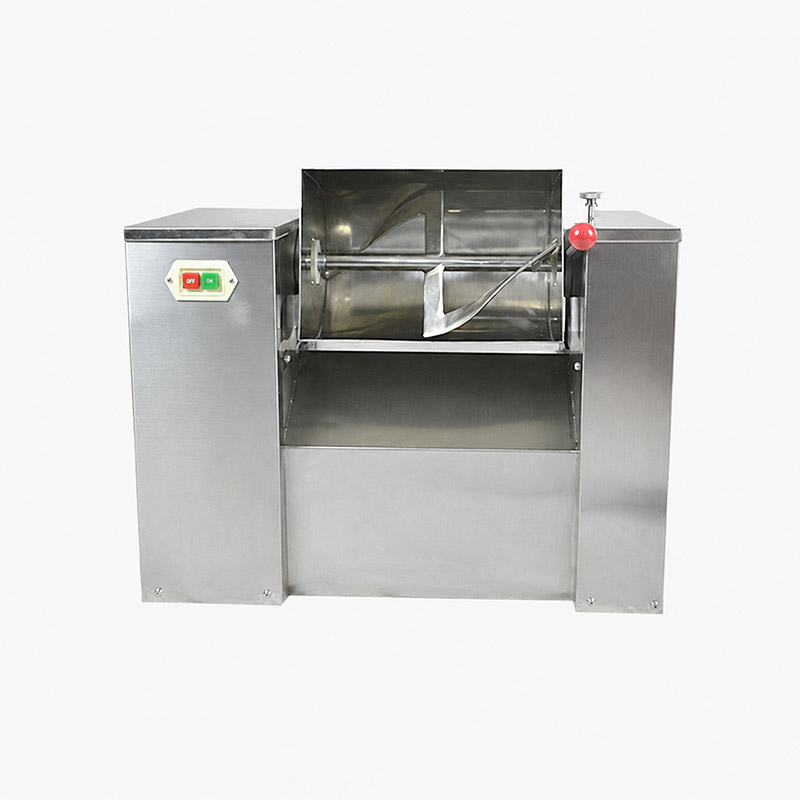
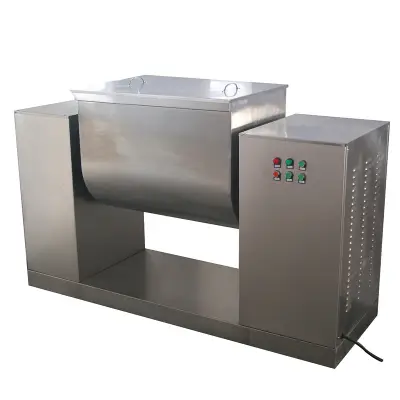
At its core, a trough mixer is a specialized horizontal mixing machine used in the pharmaceutical, chemical, and food industries to uniformly blend dry powders, granules, and pastes. It consists of a U-shaped trough and an S-shaped stirring blade that rotates to push materials in a reciprocating motion, achieving high homogeneity. The equipment is known for its simple design, easy cleaning, and ability to handle both powder and paste formulations.
Core Function and Working Principle
The trough mixer transforms bulk raw materials from a loose or agglomerated state into a consistent, uniform mixture. The main working mechanism is mechanical agitation: the S-shaped single blade (or sometimes double blades) rotates slowly inside the trough, pushing the material from one end to the other and causing it to fold, shear, and redistribute. This continuous circulation ensures that components of different densities and particle sizes become evenly distributed.
Key process parameters include the mixing time (typically set via a timer), the rotation speed of the agitator (usually fixed but can be variable), and the fill level of the trough. The mixing effect is influenced by the gap between the blade and the trough wall, which is designed to minimize dead zones. The trough can be tilted to discharge the finished mixture, and the contact parts are often made of stainless steel to resist corrosion and meet hygiene standards.
Core Components and Key Technologies
Although the trough mixer is a relatively simple machine, several critical components determine its performance:
- U-shaped Trough: The body of the mixer, made of stainless steel or other corrosion-resistant materials. It has a smooth interior surface to facilitate cleaning and prevent material sticking.
- S-shaped Stirring Blade: The main agitator, usually a single shaft with blades arranged in an S shape. The blade advances the material while generating a lateral pushing force, ensuring that all parts of the trough are actively mixed.
- Transmission System: A motor and gearbox (or belt drive) that rotate the stirring shaft at a controlled speed. Some models use a speed reducer to achieve a low speed (e.g., 24 rpm for a 400L model) suitable for gentle mixing.
- Discharge Mechanism: The trough can be tilted (usually by a separate motor or manual lever) to dump the product. The tilt angle is typically limited to less than 105° to prevent spillage.
- Sealing System: Shaft seals at both ends prevent leakage of powder or liquid during operation.
Key Performance Indicators and Selection Tips
When selecting a trough mixer, users should evaluate the following parameters:
- Working Volume: Ranges from small laboratory units (e.g., 10 L) to large production models (e.g., 400 L or more). Choose a size that matches your batch size.
- Mixing Precision: Trough mixers can achieve a mixing uniformity of up to 99% for dry powders, but the actual performance depends on the material properties and mixing time.
- Agitator Speed: Typically between 20–50 rpm. Higher speeds may cause excessive heat or damage to friable materials; lower speeds are gentler but require longer mixing time.
- Material of Construction: For food and pharmaceutical applications, 304 or 316L stainless steel is required. For chemical or abrasive materials, special coatings or wear-resistant linings may be needed.
- Cleaning and Maintenance: Removable blades, easy-access trough openings, and smooth surfaces simplify cleaning between batches. Some models offer CIP (clean-in-place) options.
- Automation: Basic models use manual timers and switches, while advanced units can be integrated with PLC and HMI for recipe management and data logging.
Application Areas and Selection Advice
Trough mixers are widely used in:
- Pharmaceuticals: Blending active pharmaceutical ingredients with excipients, wet granulation, and paste mixing.
- Chemicals: Mixing dry powders, pigments, and additives for coatings, adhesives, and detergents.
- Food: Combining flour, spices, seasonings, and other dry ingredients; also suitable for dough and pastes.
- Cosmetics: Homogenizing creams, ointments, and powder bases.
For small-scale labs or R&D, a compact trough mixer (e.g., 10–50 L) is ideal. For production lines, choose a larger model (100–400 L) with automatic discharge and optional vacuum or heating/cooling jackets. If you need to mix very sticky or wet materials, consider a horizontal screw belt mixer or a vacuum kneading machine as alternatives.
References
Related Products
Get In Touch
Our professional team will reply to you within one business day. Please feel free to contact us!