

What Is the T-Bright Dental Furnace? A Dental Lab Zirconia Sintering Furnace
What Is the T-Bright Dental Furnace?
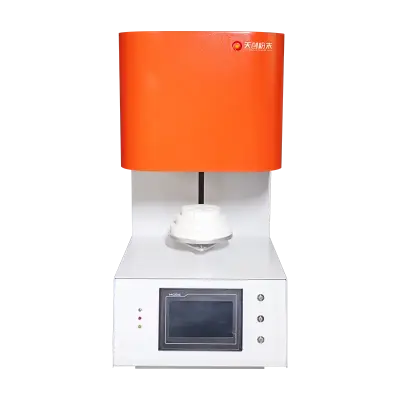
From the core, the T-Bright dental furnace is a laboratory sintering furnace that dental laboratories, prosthetic centres and clinical milling rooms use to turn milled zirconia restorations — crowns, bridges, inlays, onlays, abutments and multi-unit frameworks — from a soft, chalky green state into a dense, hard and biocompatible ceramic. In everyday laboratory language it is simply called a zirconia sintering furnace or a dental firing furnace. It does not shape the restoration; the CAD/CAM milling machine does that. Its role is to finish the job, using a precisely controlled high-temperature cycle to burn out the organic binder and close the pores between ceramic particles, so that the milled part finally becomes the strong, tooth-coloured object that is cemented into the patient's mouth.
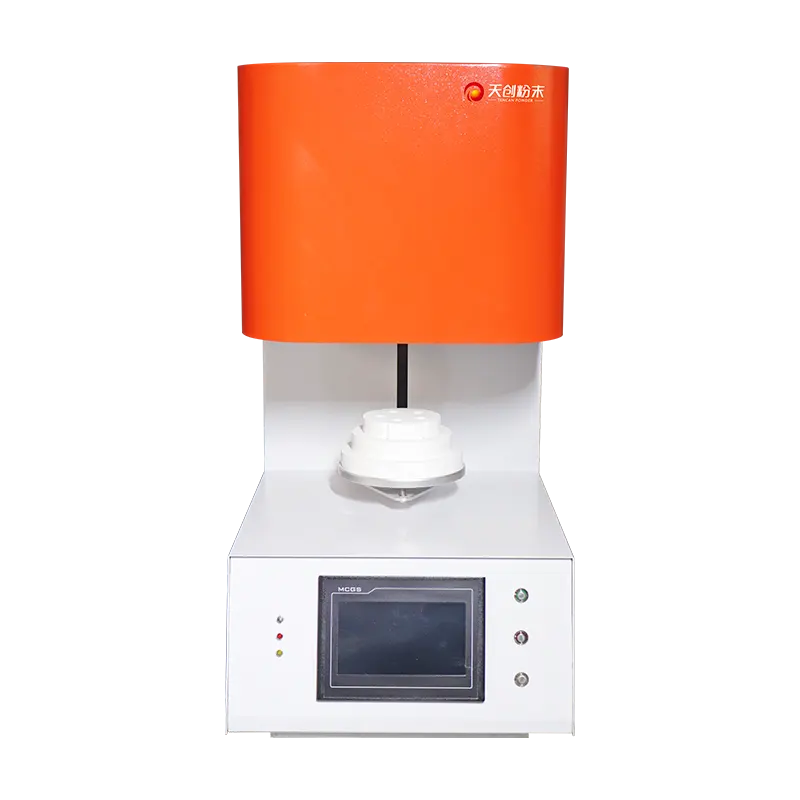
Because sintering decides the final density, translucency, shade, fit and mechanical strength of the restoration, the furnace is one of the most quality-critical items in a digital dental workflow. A milling machine can produce a perfect shape, but only a correctly programmed and correctly maintained furnace converts that shape into a reliable restoration.
Core Functions and Working Principle
From Soft Green-State Zirconia to a Dense Restoration
Dental zirconia reaches the laboratory as a pre-sintered blank. The blank is only partially dense — typically around half the theoretical density of the finished ceramic — with ceramic particles held together by a small amount of organic binder, which is what makes the material soft enough to be machined with carbide or diamond burs. After milling, the restoration is deliberately produced slightly oversized, usually by roughly 20–25%, to compensate for the shrinkage that will occur during densification.
The T-Bright furnace completes this chain. As the chamber heats up, the binder decomposes and escapes as gas, and at higher temperature the particles begin to bond to one another through solid-state diffusion. Pores shrink, grain boundaries form and the body contracts. When the cycle is right, the restoration reaches near-full density, gains the strength and translucency the material is specified for, and shrinks predictably onto the dimensions planned by the design software.
Inside the Heating Cycle: Burnout, Ramps, Holds and Cooling
A sintering cycle is not a single "heat it up" step; it is a sequence of stages, and each one has a job.
Binder burnout. In the low-temperature range, roughly from room temperature to a few hundred degrees Celsius, the organic binder is decomposed and driven off. This stage must be slow. If the furnace races through it, gas is generated faster than it can escape through the pore network, and the result is blistering, internal voids or surface defects that no later stage can repair.
Heating ramp. Above the burnout range the furnace climbs toward the sintering temperature. The ramp rate controls how evenly the load and the chamber reach that temperature; too fast a ramp produces a thermal gradient between the surface and the core of a thick framework.
Holding at peak temperature. For typical dental 3Y-TZP zirconia the peak lies in the region of 1450–1550 °C, held for roughly one to three hours depending on the material and the mass of the load. This is where densification actually happens. Holding too long coarsens the grains and can reduce strength and translucency; holding too short leaves residual porosity.
Controlled cooling. Cooling is not simply "switch off and wait". A controlled decline avoids thermal shock, and in some materials the cooling profile influences the final phase composition and therefore the strength and shade.
Process Parameters That Shape the Final Restoration
- Peak temperature — the strongest single lever on density, shrinkage and translucency. Every zirconia blank is supplied with a recommended sintering profile, and deviating from it changes the fit as well as the optics.
- Heating rate — determines the risk of cracking and the uniformity of the result, especially in multi-unit bridges with thick sections.
- Holding time — trades density against grain growth.
- Cooling rate — affects residual stress and, in some materials, the final shade.
- Load arrangement — how restorations sit on the sintering tray or beads, how close they are to the elements and to each other, and whether a bulky framework shields a thin unit.
- Chamber atmosphere and air exchange — zirconia is normally sintered in air, but clean air and adequate ventilation matter for reproducible colour.
These parameters are only useful if the furnace can actually reproduce them. That is why programmable, repeatable temperature profiles matter far more in a dental laboratory than raw heating power.
Core Components and Key Technologies
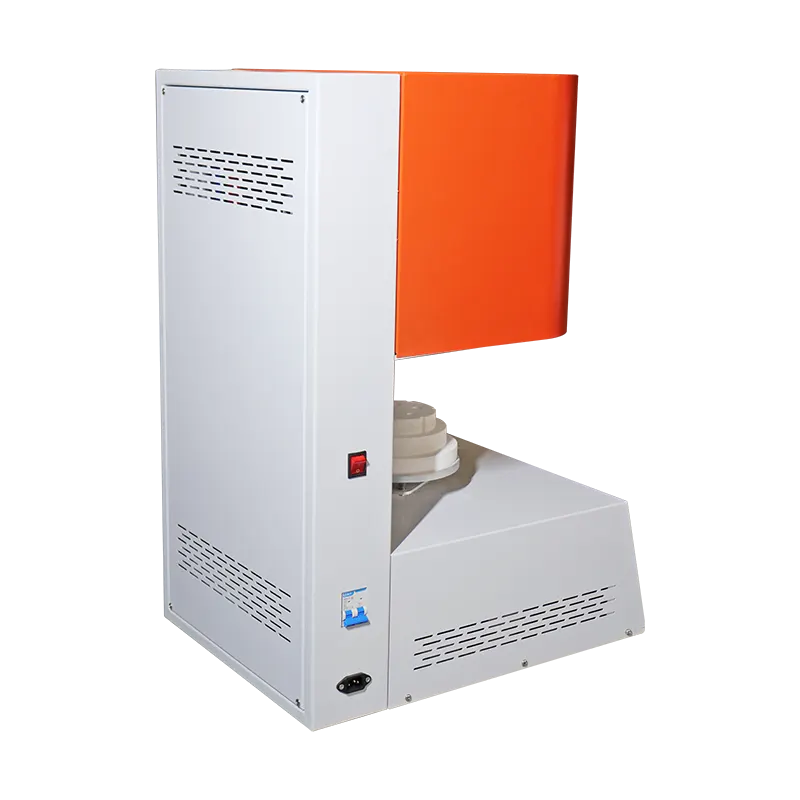
Although the technician interacts mainly with the control panel, the outcome depends on several physical subsystems of the T-Bright dental furnace working together.
Heating Chamber and Heating Elements
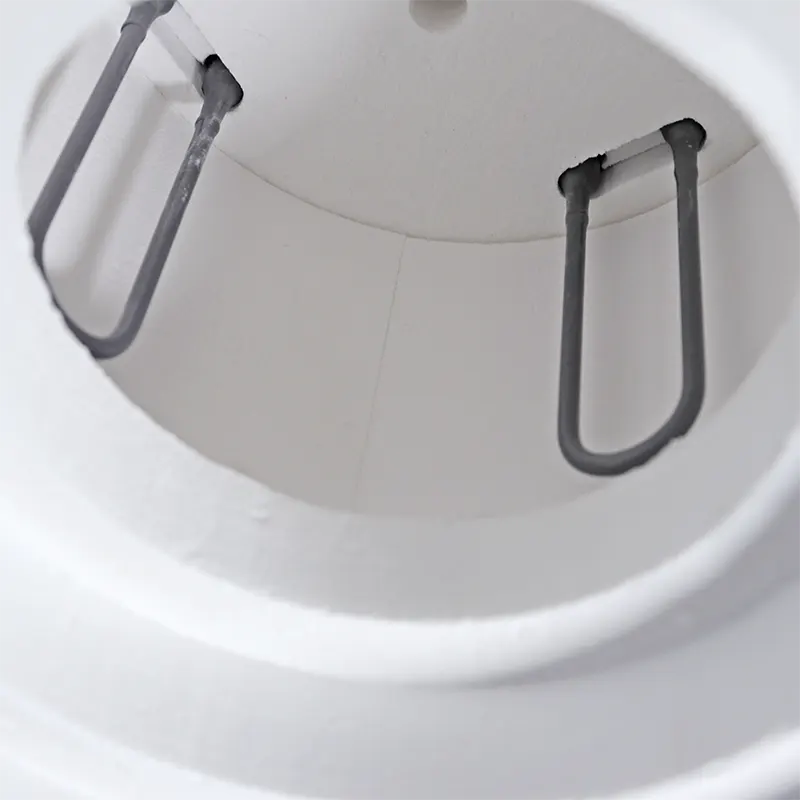
The chamber is the heart of the machine. Its usable volume, shape and element layout determine how many units can be sintered at once and how evenly they are heated. Elements are chosen for stability at high temperature and for resistance to the vapours released during burnout — a furnace whose elements degrade quickly will drift away from its calibrated profile long before it fails outright.
Thermal Insulation and the Cold-Face Housing
Efficient insulation keeps the heat where it belongs. It reduces the power needed to hold peak temperature, protects the electronics and keeps the outer surfaces of the machine at a safe touch temperature — a practical requirement in a small laboratory where the furnace often sits close to the milling machine and the working bench.
Temperature Sensing and Closed-Loop Control
A thermocouple measures the chamber temperature and feeds it back to a controller, which adjusts power output continuously to follow the programmed curve. The quality of this loop — sensor accuracy, controller resolution and compensation for cold-junction and cable effects — determines whether the profile written in the program is the profile the restorations actually experience.
Program Storage and User Interface
Dental laboratories rarely run one material only. A practical furnace stores several sintering programs so that the correct profile for each zirconia brand can be recalled by number instead of typed in each time. A clear display, a simple editing procedure and protection against accidental changes are unglamorous features that prevent expensive mistakes.
Types of Dental Furnaces and Where the T-Bright Fits
Dental laboratories use several families of heat-treatment equipment, and they are often confused because they look similar.
Zirconia Sintering Furnaces
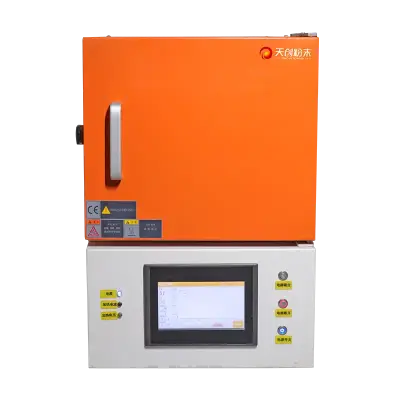
These are built for long, hot cycles: high peak temperature, slow ramps, extended holds and the ability to run overnight. The T-Bright dental furnace belongs to this family and is listed by TENCAN within its sintering series.
Porcelain Firing Furnaces
These operate at lower temperatures, typically below 1000 °C, with vacuum capability and fast, short cycles for veneering ceramics. They prioritise vacuum control and fine temperature steps rather than long high-temperature holds.
Combination and Multifunction Units
Some units offer both sintering and firing programs, trading some specialisation for bench space. They suit small clinics with mixed, low-volume work.
How the Categories Differ
The differences come down to peak temperature capability, element and insulation design, vacuum hardware, cycle length and control software. Choosing the wrong family is not a matter of convenience — a firing furnace cannot densify zirconia, and a pure sintering furnace is not the right tool for vacuum porcelain work.
Key Performance Indicators and Selection Points
When comparing furnaces, the specification sheet is only a starting point. The points below are what actually determine day-to-day performance.
Sintering Capacity and Chamber Volume
Match usable volume, not just the number of units quoted. A full-arch bridge with a bulky framework takes far more space than three single crowns, and stacking restorations to fit more in reduces uniformity. Think in terms of your busiest day, not your average day.
Temperature Uniformity and Control Accuracy
Uniformity across the chamber is what makes the tenth crown in a batch behave like the first. Ask for the achievable uniformity at sintering temperature, the control resolution and the recommended calibration interval.
Heating and Cooling Capability
Element power and insulation together set the achievable ramp rate, while cooling design sets how quickly a completed batch can be unloaded. In a busy laboratory, cycle time — not just peak temperature — limits throughput.
Energy Consumption and Throughput
A sintering furnace runs for hours at a time, often overnight, so standing losses matter. Good insulation and an efficient chamber design reduce the electricity bill and, just as importantly, reduce the heat dumped into the room.
Automation and Programmability
Stored programs, delayed start, multi-step profiles, alarms and run logging separate a professional instrument from a basic oven. Delayed start alone allows cheaper night-time operation and morning unloading.
Maintenance, Consumables and Serviceability
Thermocouples drift, elements age, insulation bricks crack, and sintering trays and beads need replacing. Ask how accessible these parts are, how calibration is performed, and what the expected element life is under your own cycle count.
Applications and Selection Advice
Typical Application Scenarios
The T-Bright dental furnace is aimed at the same workflows as other dental sintering furnaces: chairside and laboratory milling of zirconia crowns, bridges and implant frameworks; small prosthetic laboratories that outsource design but want to control their own sintering; dental schools and training centres that need reproducible teaching cycles; and research groups working on zirconia-based ceramics and prosthetic materials. In all of these the furnace serves the same core function — converting a milled, porous, machinable part into a dense, clinically usable restoration.
Matching the Furnace to Your Workflow
For a single-chair clinic milling a few units a week, cycle time and simplicity matter more than chamber volume; a compact unit with reliable stored programs and a delayed start is usually the right fit. For a mid-size laboratory running several CAD/CAM mills, capacity, uniformity and the ability to run overnight batches without supervision dominate. For teaching and research, adjustable multi-step profiles, documentation and the freedom to experiment with non-standard curves are the deciding features. In every case, confirm the actual specifications — chamber dimensions, maximum temperature, program capacity and power supply — on the T-Bright dental furnace product page before ordering.
Key Takeaways
- The T-Bright dental furnace is a sintering furnace for dental zirconia, not a milling or shaping device.
- Densification happens through binder burnout, a controlled ramp, a high-temperature hold and a controlled cool.
- Peak temperature, ramp rate, hold time and load arrangement decide fit, strength and translucency.
- Uniformity and repeatability matter more than headline heating power.
- Match capacity, programmability and maintenance access to your real daily workload.
Get In Touch
Our professional team will reply to you within one business day. Please feel free to contact us!