
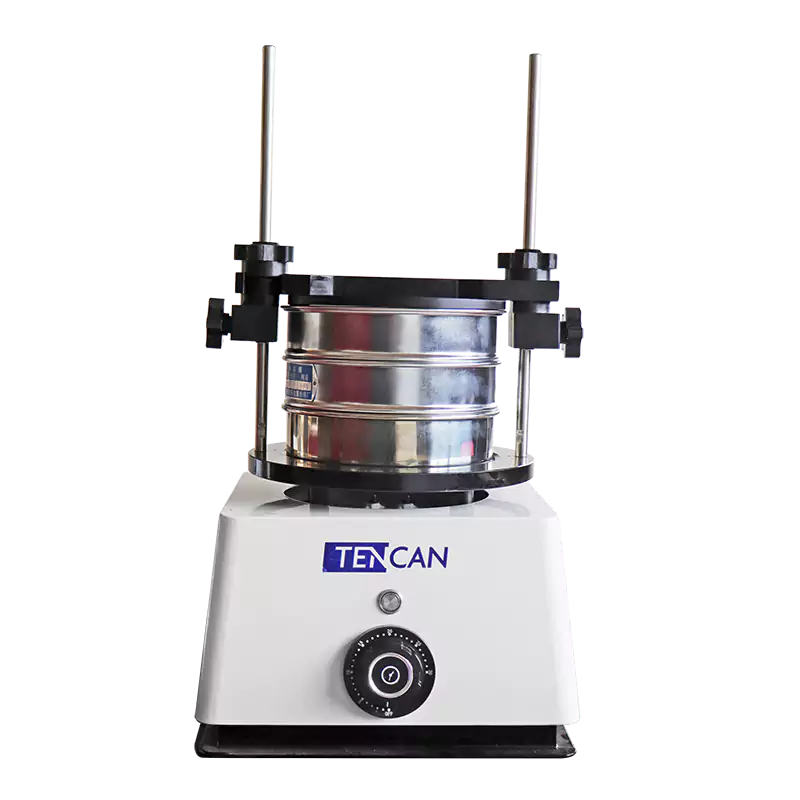
What is a Small Laboratory Screening Machine? A Compact Sieving Device for Particle Size Analysis and Powder Classification

What is a Small Laboratory Screening Machine?
At its core, a small laboratory screening machine is a compact sieving device designed for precise particle size analysis and powder classification in research and quality control laboratories. It is used to separate granular materials into different size fractions by passing them through a series of woven wire mesh sieves under controlled vibration. This equipment is essential for determining the particle size distribution of powders, granules, and bulk solids, enabling scientists and engineers to characterize materials accurately and ensure product consistency.
Core Function and Working Principle
The primary function of a small laboratory screening machine is to transform a bulk sample of mixed particle sizes into distinct fractions of known size ranges. The machine achieves this by utilizing a vibrating motion that agitates the stacked sieve column, causing particles to move across the sieve surface. Particles smaller than the mesh openings pass through to the next sieve, while larger particles remain on the sieve, forming a graded series of fractions.
The working principle relies on a combination of mechanical vibration and gravitational force. An electric motor drives an eccentric weight or electromagnetic coil, generating a three-dimensional vibration pattern (vertical, horizontal, and tilting) that efficiently moves the sample across the sieve surface. The amplitude and frequency of vibration can be adjusted to optimize the sieving process for different materials, ensuring that even fine particles are effectively separated without clogging the mesh. The entire assembly is typically enclosed in a compact, noise-dampened housing, making it ideal for benchtop use in confined laboratory spaces.
Key Components and Technologies
A small laboratory screening machine consists of several critical components that work together to deliver reliable performance:
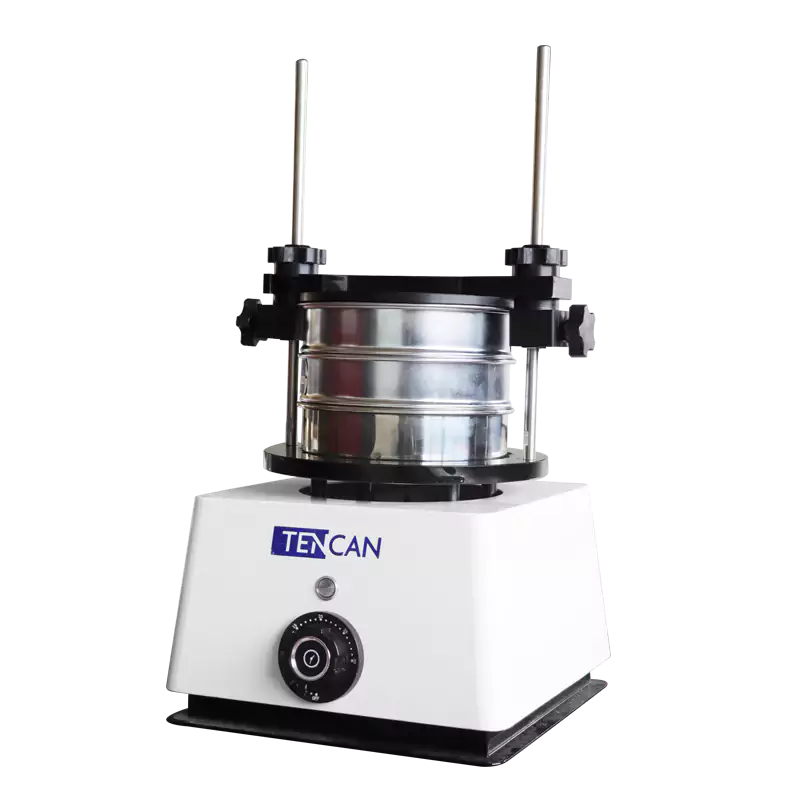
- Sieve Stack: A set of standard test sieves (usually 200 mm or 100 mm diameter) with precisely woven wire mesh, ranging from coarse to fine openings. The stack is clamped securely to the machine base.
- Vibration Mechanism: An electromagnetic or mechanical drive system that generates the oscillatory motion. Electromagnetic drives offer precise control over frequency and amplitude, while mechanical drives provide robust, continuous operation.
- Control Unit: A digital timer and amplitude regulator allow the user to set sieving duration and intensity, ensuring repeatable results across different tests.
- Clamping System: Quick-release clamps or threaded rods hold the sieve stack firmly in place, preventing movement during operation and ensuring consistent particle contact with the mesh.
Advanced models may include features such as programmable sieving cycles, automatic sieving amplitude adjustment, and integrated data logging for connecting to particle size analysis software.
Key Performance Indicators and Selection Criteria
When selecting a small laboratory screening machine, users should evaluate the following performance metrics:
- Processing Capacity: Typically ranges from 20 g to 3 kg per batch, depending on the sample type and sieve diameter. For routine quality control, a capacity of 100–500 g is common.
- Particle Size Range: The machine can handle particles from as coarse as 20 mm down to 20 microns (or finer with specialized sieves). The number of sieves in the stack (usually up to 8) determines the number of fractions.
- Sieving Accuracy: High-precision vibration ensures consistent particle separation, with repeatability within ±1% of the mean value for most materials.
- Ease of Maintenance: Quick-release clamping and easy access to the vibration mechanism simplify cleaning and sieve replacement. Stainless steel construction resists corrosion and is easy to sanitize.
- Automation and Programmability: Digital timers and amplitude controls allow the user to store standard test methods, reducing operator variability and improving throughput.
For users who require wet sieving of slurries or suspensions, some models offer a wet sieving accessory that includes a water spray nozzle and collection pan. Dry sieving is the standard mode for most powder applications.
Applications and Selection Advice
The small laboratory screening machine is widely used in industries such as pharmaceuticals (for API and excipient particle size), food processing (flour, spices, additives), chemicals (catalysts, pigments), mining and minerals (ore, sand, soil), and environmental testing (sediment, dust). It is also a staple in academic research laboratories for material characterization and in quality control departments for incoming raw material inspection.
For routine quality control with moderate sample volumes, a standard model with 200 mm sieves and a digital timer is sufficient. For research applications requiring high precision and fine particle analysis (down to 20 microns), consider a model with electromagnetic drive and programmable amplitude. If the laboratory handles abrasive or corrosive materials, choose a machine with a stainless steel body and sealed vibration mechanism. Always verify that the sieve mesh conforms to international standards (e.g., ASTM E11 or ISO 3310) to ensure result comparability.
References
Related Products
Get In Touch
Our professional team will reply to you within one business day. Please feel free to contact us!