

What Is a Production Type Sand Mill? A Continuous Wet Grinding Mill for Slurries
From its core, a production type sand mill is a wet grinding and dispersing machine used to reduce solid particles suspended in a liquid to a finer, more uniform state. Teams in coatings, inks, pigments, battery materials, ceramics, agrochemicals, pharmaceuticals, and specialty chemicals use it to turn a coarse premix or agglomerated slurry into a stable, repeatable fine dispersion. Unlike a dry mill, it keeps the material in a liquid vehicle, which controls dust, supports formulation, and allows continuous handling.
What a Production Type Sand Mill Does
A sand mill is a type of wet media mill. The name comes from the small grinding media, often called beads or sand, that are agitated inside a chamber. The slurry passes through this agitated media bed, and the motion of the media creates the shear, impact, and attrition needed to break down particles and agglomerates. In modern production equipment, the sand is usually an engineered ceramic, glass, steel, or polymer bead chosen for wear resistance and compatibility with the product.
The word production describes the mill's role in the process rather than a single mechanical feature. A production type sand mill is intended to operate as part of a larger manufacturing line, where feed preparation, flow control, cooling, discharge, and downstream filtration or storage must work together. It is selected when the required output, consistency, and continuity exceed what a small laboratory or pilot mill can provide. The objective is not simply to make particles smaller; it is to make the same dispersion, within specification, batch after batch and shift after shift.
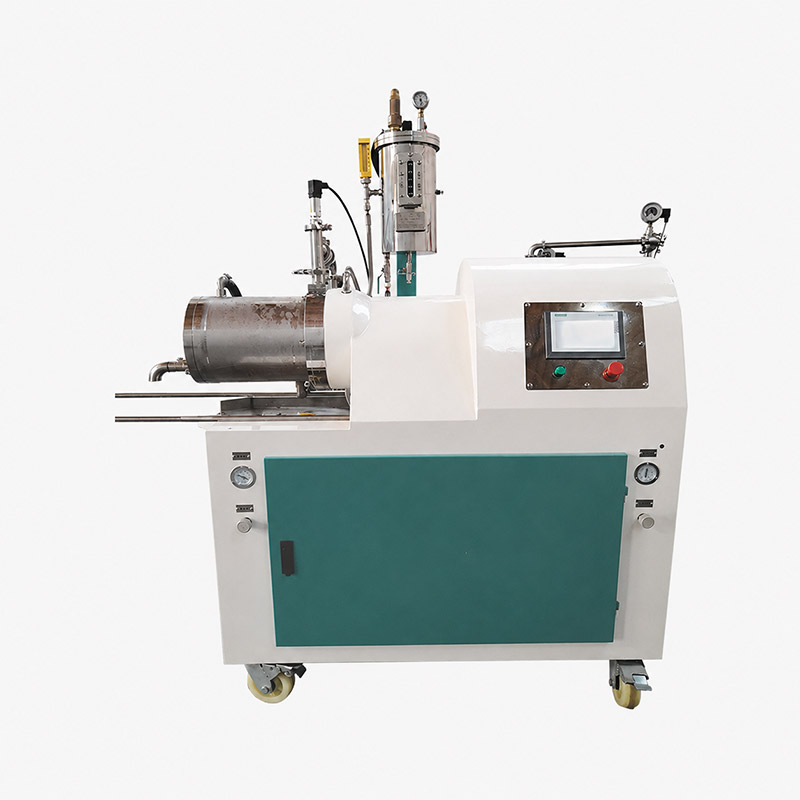
Sand milling can accomplish several jobs at once. It can reduce true particle size, break loose clusters, wet out powders that resist ordinary mixing, distribute additives, and smooth out inconsistencies in viscosity or texture. The relative importance of these jobs depends on the formulation. In a pigment concentrate, deagglomeration and color development may matter more than reducing primary crystal size. In a ceramic slip or battery slurry, the target may be a narrow particle-size distribution and a stable suspension. The mill must therefore be matched to the product, not chosen from output alone.
The Working Principle: From Coarse Slurry to Fine Dispersion
All production sand mills follow the same basic sequence: prepare and feed the slurry, energize the media, separate the product from the media, and remove the heat generated by grinding.
Feeding and premix
Before the slurry reaches the grinding chamber, it should be pumpable, free of oversize contamination, and reasonably wetted. A feed pump moves the premix into the mill at a controlled rate; the rate, together with chamber volume and the number of passes, determines how long the material remains in the high-energy zone. Premixing is not a formality. If powder is still dry or agglomerated when it enters the mill, the grinding media must spend energy wetting and breaking large clusters instead of refining the product. Air entrapment is another concern: foam or entrained gas can cause uneven flow, pressure fluctuation, and inconsistent dispersion. A well-designed feed section therefore includes filtration, deaeration where needed, and instrumentation that lets the operator confirm stable flow.
Energy transfer in the grinding chamber
Inside the grinding chamber, the agitator rotates and transfers energy to the grinding media. The media do not simply spin with the shaft; they are fluidized, pushed outward, rolled over one another, and accelerated through the slurry. The product is subjected to high shear in the narrow gaps between media, to impact when media collide, and to attrition as particles are caught between moving surfaces. This combination breaks down particles and, perhaps more commonly, tears apart agglomerates that behave like larger particles until they are dispersed.
Several variables shape that energy transfer. Media size and density affect the number of contact points and the force of each contact. Smaller media create more contacts and are often useful for fine dispersion, but they are harder to separate and may not handle coarse or viscous feeds efficiently. Media fill level changes the available grinding volume and free space. Agitator speed changes tip speed and shear, but it also raises energy use, wear, and heat. Slurry viscosity and solids loading influence how freely the media move. None of these variables can be optimized in isolation.
The mill therefore works as a system. A change that improves fineness may reduce throughput, increase temperature, or shorten the life of a screen. A change that increases flow may reduce residence time and leave the product coarser. Production operation is about finding a stable window in which product quality, output, and reliability are acceptable together.
Media separation, flow, and temperature control
At the outlet, a separation device keeps the grinding media inside the chamber while allowing the slurry to leave. Depending on the mill design, this may be a screen, a slotted gap, or a dynamic separator. The separator is a critical but often overlooked part of the process. If it blinds or wears, flow becomes unstable, pressure rises, and media may escape downstream. Good operation therefore includes monitoring pressure, checking flow, and inspecting the separator on a planned basis.
Most production sand mills run continuously: feed enters at one end, passes through the agitated media, and discharges at the other. The residence time is controlled by the feed rate, the chamber volume, and the way the slurry moves through the mill. For difficult products, the slurry may be passed through more than once or circulated through a holding tank until the target fineness is reached. Continuous operation is efficient for stable recipes, while circulation or multiple passes give more flexibility when the formulation changes.
Grinding generates heat. The energy used to accelerate media and shear the slurry is largely converted into thermal energy, so cooling is not an accessory; it is part of the process. A cooling jacket, heat exchanger, or both may be used to remove heat and keep the product within a safe temperature range. This matters for solvent-based products, temperature-sensitive polymers, biological materials, and formulations that can gel, degrade, or change color when overheated.
Core Components and Their Role
Although configurations vary, a production sand mill can be understood through a small set of functional parts. The grinding chamber contains the media and provides the working volume. Its liner must resist abrasion and chemical attack while avoiding contamination of the product. The agitator, whether described as a rotor, disk, pin, or bar, transfers shaft power to the media. Its geometry affects shear distribution, pumping action, and wear patterns. The drive system must deliver stable torque under changing load, because slurry viscosity can rise or fall during processing. The separation device retains media, and the feed and discharge connections integrate the mill with tanks, pumps, filters, and controls.
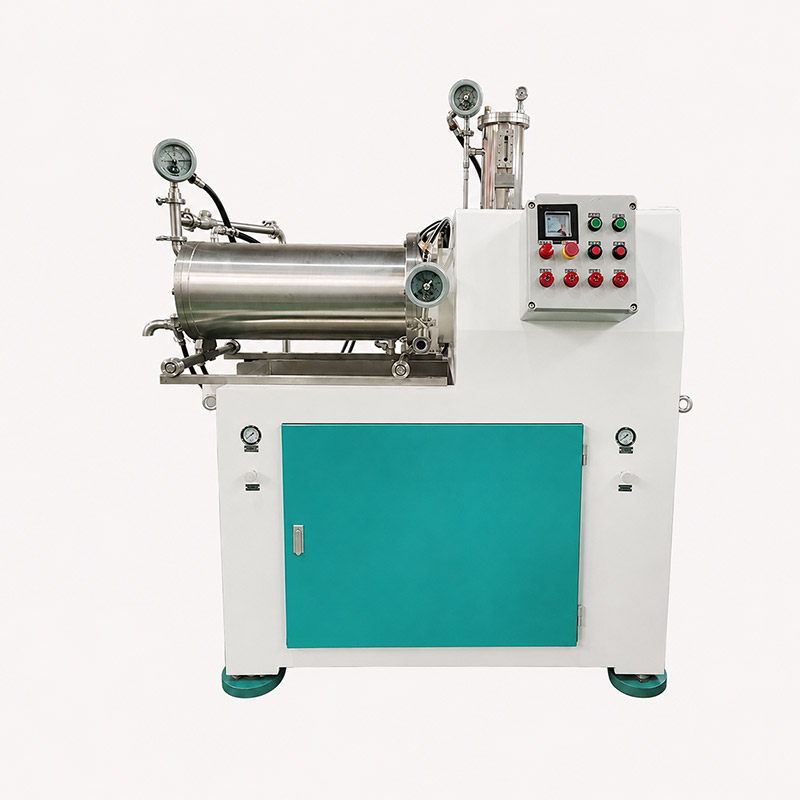
The grinding media are just as important as the hardware. Media material, size, shape, and fill determine grinding efficiency and product contamination risk. Ceramic media are chosen where metal contamination is unacceptable; steel media may be selected where density and toughness are needed, provided the formulation can tolerate the material. The media must also be compatible with the slurry chemistry. A bead that softens, swells, or leaches in a solvent can ruin the product and create a maintenance problem. For this reason, media selection should be based on the formulation, target fineness, and wear life rather than on a single generic recommendation.
Cooling, sealing, and instrumentation complete the system. Shaft seals must contain the slurry and, where relevant, prevent air ingress or solvent loss. Temperature sensors, pressure gauges, flow meters, and level controls give the operator the information needed to keep the process stable. Automated controls can store recipes, interlock the feed and cooling, and log operating data, but their value depends on whether the sensors and actuators are appropriate for the actual process. A production mill is not a standalone box; it is a controlled wet-grinding loop.
Types and Configurations to Understand Before Choosing
Production type sand mills are not all identical. The category covers several mechanical arrangements and operating modes, and the right choice depends on the product, the plant, and the way production is organized.
Batch, continuous, and circulation operation
Batch mills process a fixed quantity in a tank or chamber and discharge when the target is reached. They suit small lots, frequent formulation changes, and products that require a precise endpoint. Continuous mills feed and discharge without interruption and are preferred for stable recipes and higher output. Circulation systems combine a mill with a holding tank and repeatedly pass the slurry through the grinding zone; they offer good temperature control and flexibility but require careful tank design and monitoring. The production type is generally associated with continuous or circulation operation, but the best choice depends on batch size, changeover frequency, and quality control strategy.
Horizontal and vertical arrangements
Sand mills may be arranged horizontally or vertically. Horizontal designs are common in production because they offer a compact footprint and straightforward access for maintenance, though the specific layout of any model should be confirmed on the product page. Vertical designs use a different flow path and can be useful where floor space is limited. The orientation affects how media are distributed, how easily the chamber drains, and how maintenance is performed, but it does not by itself determine product quality. The complete system, including feed, cooling, separation, and controls, matters more than the axis alone.
Rotor and chamber geometry
Inner geometry also varies. Disk agitators, pin agitators, and slotted or bar designs create different flow patterns and shear profiles. A geometry that works well for a low-viscosity ink may not be suitable for a highly filled ceramic slip or a shear-sensitive emulsion. Chamber volume, liner material, and the number of grinding zones are selected together with the rotor. When comparing offers, ask for the intended viscosity range, recommended media, wear parts, and cleanability rather than relying only on a generic category name.
Grinding media options
Grinding media choice is a separate decision. Glass beads are economical for some applications but may not be suitable for hard minerals or aggressive solvents. Zirconia-based ceramics offer high density and wear resistance for demanding fine grinding. Steel and tungsten carbide media provide high energy but must be evaluated for contamination. Polymer media can be useful where metal and ceramic contamination are unacceptable, although their lower density changes the grinding performance. The final choice should be tested with the actual formulation.
Key Performance Indicators and Selection Criteria
When selecting a production sand mill, compare the complete process rather than a single headline number. The most useful specifications are the ones that connect to your product, your plant, and your operating team.
Throughput and system balance
Throughput is often stated as output per hour, but that figure is meaningful only when target fineness, formulation, and number of passes are defined. A mill that produces a large flow at a coarse grind may be much slower when asked for a fine dispersion. Match the mill to upstream premix and downstream storage, and allow margin for viscosity changes and future products. Ask how output is measured: once-through, circulation, or multi-pass operation can give different results.
Fineness and particle-size distribution
Fineness should be described as a particle-size distribution, not only an average. A narrow distribution usually gives more predictable gloss, color, stability, and rheology. The measurement method matters: a grind gauge is useful for production control, while laser diffraction or microscopy gives more detail. During trials, track the full curve, not just the endpoint. The mill should reach the target repeatably without excessive passes, overheating, or media loss.
Energy, temperature, and wear
Energy efficiency is best judged as specific energy, or energy consumed per unit of product at the required fineness, rather than motor size alone. Higher agitator speed or denser media may reduce the time needed to reach the target, but they also increase heat, wear, and operating cost. Temperature control is part of the same balance. If the product must stay cool, the cooling system and the mill's heat-removal capacity can become limiting factors, especially in circulation mode.
Materials, contamination, and cleanability
Wetted materials must be compatible with the slurry and with cleaning chemicals. Wear is not only a maintenance cost; it can change the product. Metal contamination may affect color, electrical properties, or regulatory compliance, while liner wear can alter clearances and grinding performance. Cleanability affects changeover time and cross-contamination risk. Look for accessible chambers, replaceable liners, easy separator access, and drain points that let the system empty completely.
Automation, maintenance, and support
Automation can improve repeatability by linking feed rate, agitator speed, temperature, pressure, and discharge. Recipe management is useful when the plant makes several products. However, automation cannot compensate for a poorly matched mill. Confirm that the sensors are suitable for the actual slurry, that alarms are meaningful, and that operators can clean and maintain the system without bypassing safety interlocks. Ask about seal life, spare-parts availability, and the tools needed for routine service.
| Selection area | Why it matters | What to confirm |
|---|---|---|
| Output | Must match feed and downstream capacity | Target fineness, pass strategy, viscosity |
| Fineness | Defines product quality and stability | Particle-size method, repeatability, trial data |
| Thermal control | Protects temperature-sensitive formulations | Cooling capacity, temperature limits, sensors |
| Materials | Prevents contamination and premature wear | Wetted parts, media compatibility, liner life |
| Cleanability | Reduces changeover time and cross-contamination | Access, drainability, cleaning procedure |
| Controls | Supports repeatability and traceability | Recipes, alarms, data logging, interlocks |
Applications and Selection Advice
Production sand mills appear wherever a fine, stable dispersion is needed. In coatings, inks, and pigments, they develop color, gloss, and hiding power by breaking down pigment agglomerates. In battery and electronic materials, they disperse conductive additives, binders, and active particles into uniform slurries. In ceramics and minerals, they reduce and homogenize slips, fillers, and glazes. Agrochemical formulations use them to stabilize suspensions and emulsions. Pharmaceutical, cosmetic, and food applications require careful attention to cleaning, materials, and process validation. Adhesives and sealants use the mill to distribute fillers and control texture.
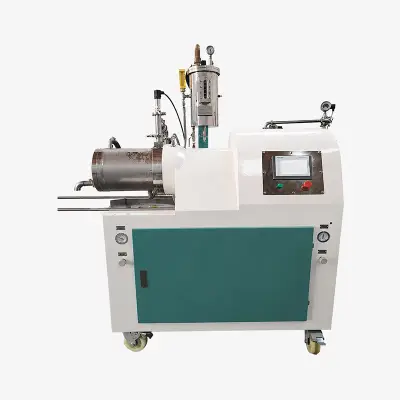
Selection advice should begin with the product, not the machine. Define the target particle-size distribution, viscosity, temperature limit, solids loading, batch size, and cleaning requirement. Then decide whether continuous, circulation, or batch operation fits the production pattern. Test the formulation in a pilot mill or with a qualified laboratory when possible, and scale up using measured data rather than a simple volume ratio. Check media compatibility, cooling demand, and the cost of wear parts. For a production-scale wet grinding application, the Production Type Sand Mill is the relevant product reference; its page should be used to confirm the available configuration and technical details.
The best choice is usually the mill that reaches the specification with the fewest compromises across output, temperature, contamination, cleaning, and maintenance. A lower purchase price can be misleading if the mill requires frequent media changes, produces inconsistent fineness, or slows changeovers. Total cost of ownership and process capability are better selection criteria than motor power or chamber volume alone.
Installation, Operation, and Maintenance Notes
A production sand mill needs a stable installation and a suitable utilities envelope. The foundation or frame must support the mill and absorb vibration. Feed and discharge piping should be short, well supported, and arranged to avoid air pockets. Cooling water quality and flow must be confirmed, and solvent or dust hazards must be addressed through ventilation and electrical protection. Before commissioning, verify rotation, seal integrity, sensor calibration, and emergency stops.
Operation should follow a written procedure covering pre-checks, start-up, feed ramp, temperature control, sampling, shutdown, and cleaning. Operators should know what normal pressure and flow look like and what to do when they deviate. During the run, log agitator speed, feed rate, temperature, pressure, and product checks. These records make it easier to detect wear, separator blinding, or a change in raw material before a batch is lost.
Maintenance is mainly about wear and cleanliness. Inspect the grinding chamber, agitator, liner, separator, seals, and media at planned intervals. Replace worn parts before they affect the product or damage other components. Check media for size change, contamination, and breakage. Clean the system thoroughly during product changeovers, and confirm that cleaning agents are compatible with the wetted materials. Keep spare screens, seals, and media on hand for critical products.
Conclusion
A production type sand mill is a wet grinding and dispersing system that turns a coarse or agglomerated slurry into a fine, uniform product at manufacturing scale. Its performance depends on the interaction of media, agitator, flow, cooling, separation, and control. By defining the product specification first and then evaluating throughput, fineness, thermal control, materials, cleanability, and maintenance together, buyers can choose a mill that is capable on paper and reliable in daily production. For configuration details, consult the Production Type Sand Mill product page.
Related Products
Get In Touch
Our professional team will reply to you within one business day. Please feel free to contact us!