

What Is a Production-Type Sand Mill? A Wet Grinding Machine for Fine Slurries
A Practical Definition
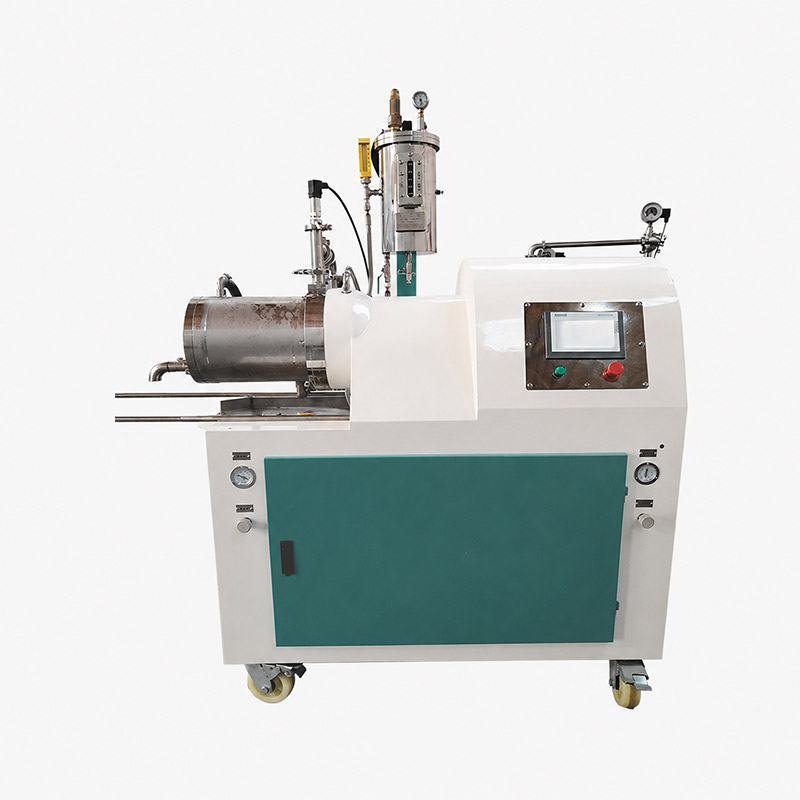
From a practical standpoint, a Production type sand mill is a wet grinding and dispersing machine built for continuous or semi-continuous production of fine slurries. It receives a pre-mixed liquid-solid feed and reduces both particle size and agglomerate size while distributing the solid phase evenly through the liquid vehicle. The output is a smoother, more uniform dispersion with controlled fineness. Unlike a small laboratory batch mill, a production-type unit is arranged around stable throughput, repeatable results, heat removal, and service access, so it can operate as part of a larger coating, ink, chemical, ceramic, battery-material, or pharmaceutical process rather than only as a development tool. It is therefore both a size-reduction device and a dispersion device, and its value comes from doing both jobs consistently at production scale.
Core Function and Working Principle
From Pre-Mix to Fine Slurry
A sand mill does not usually begin with dry powder and turn it into powder. It works on a slurry that has already been combined in a pre-mixer or holding tank. That feed contains solid particles, agglomerates, and a liquid carrier, and it may also contain dispersants, binders, solvents, or other formulation aids. The machine pumps this slurry into a milling chamber that is partly filled with small grinding media. A rotating rotor or agitator transfers energy to the media, and the media transfer that energy to the product. Particles trapped between moving media are subjected to impact, compression, and shear, while the liquid wets the newly exposed surfaces and helps separate clusters into smaller units. The transformation is therefore physical: coarse particles and agglomerates become finer, better wetted, and more evenly distributed.
The word dispersion is as important as grinding. A formulation can contain particles that are already small but still clustered, or a powder can be poorly wetted even after intense mixing. A production sand mill combines mechanical breakage with wetting and spatial distribution. The chamber is not a simple stirred tank; it is a flow-through vessel with a defined energy density, media charge, and residence-time pattern. Slurry enters the chamber, passes through the agitated media field, and leaves through a separation device that keeps the media inside. That separator is a critical part of the working principle. If it lets media escape, the product becomes contaminated and downstream equipment may be damaged. If it blinds or restricts flow, pressure and temperature can rise, and the grinding result becomes unstable. Good design keeps the media in the chamber while allowing the slurry to move at a controlled rate.
Impact, Shear, and Media Motion
The basic mechanism is mechanical energy transfer. A high-speed rotor creates radial and axial flow patterns in the chamber. Media accelerate, collide, roll, and create high shear in the narrow gaps between particles and beads. Coarse particles fracture where flaws or weak boundaries exist, and agglomerates separate as the liquid penetrates and stabilizes the new surfaces. Grinding and dispersion are related but not identical: grinding changes particle size, while dispersion distributes particles and wets them so they remain separated. A production mill must do both, because a narrow particle-size result that immediately re-agglomerates is not a useful result. The machine also has to avoid overgrinding, which can change color, rheology, surface chemistry, or stability.
Several process parameters interact. Rotor tip speed is a major lever: higher tip speed increases energy input and usually accelerates size reduction, but it also raises heat generation, wear, and the risk of damaging shear-sensitive material. Grinding-media size, density, shape, and fill level determine how much contact energy is available and how many contact points exist. Smaller media can create more contacts for fine grinding, while larger or denser media can break tougher particles. Slurry viscosity, solids loading, and flow rate affect media motion and residence time. A formulation that is too viscous may not flow evenly through the chamber; one that is too thin may allow media to settle or pass too quickly. The practical task is to find a stable operating window in which energy input, flow, temperature, and product quality remain consistent.
Residence Time and Recirculation
Production sand mills can be arranged for single-pass continuous operation, multiple passes, or recirculation through a holding tank. Each arrangement changes the residence-time distribution and the amount of cumulative energy the product receives. A single pass is easy to understand: the slurry moves through once, and the outlet condition must meet the target immediately. Recirculation is common when the target fineness requires repeated passes, but it demands good tank mixing, reliable flow measurement, and temperature control, because the whole batch is repeatedly exposed to the mill. In general, a narrow and well-controlled residence-time distribution gives more predictable results. Flow rate and chamber volume set the average residence time, while rotor speed and media condition set the energy intensity. A production line should therefore monitor flow, pressure, motor load, and temperature together rather than treating any one reading as a complete description of the process.
What the Mill Does Not Do by Itself
A sand mill is not a substitute for formulation design or pre-mixing. If the feed is poorly wet, excessively foamy, or unstable before milling, the mill may amplify the problem rather than solve it. It also cannot guarantee a narrow particle-size distribution if the feed contains very hard agglomerates or if the separation and flow control are inadequate. The machine supplies energy, but the formulation supplies the chemistry that keeps particles apart after grinding. Dispersants, pH, rheology modifiers, and solvent balance all influence the final result. For this reason, production trials should include the complete formulation and the intended pre-mix procedure, not only a simplified laboratory sample. The mill is a powerful tool inside a process, not a standalone guarantee of quality.
Core Components and Technical Design
Milling Chamber and Rotor
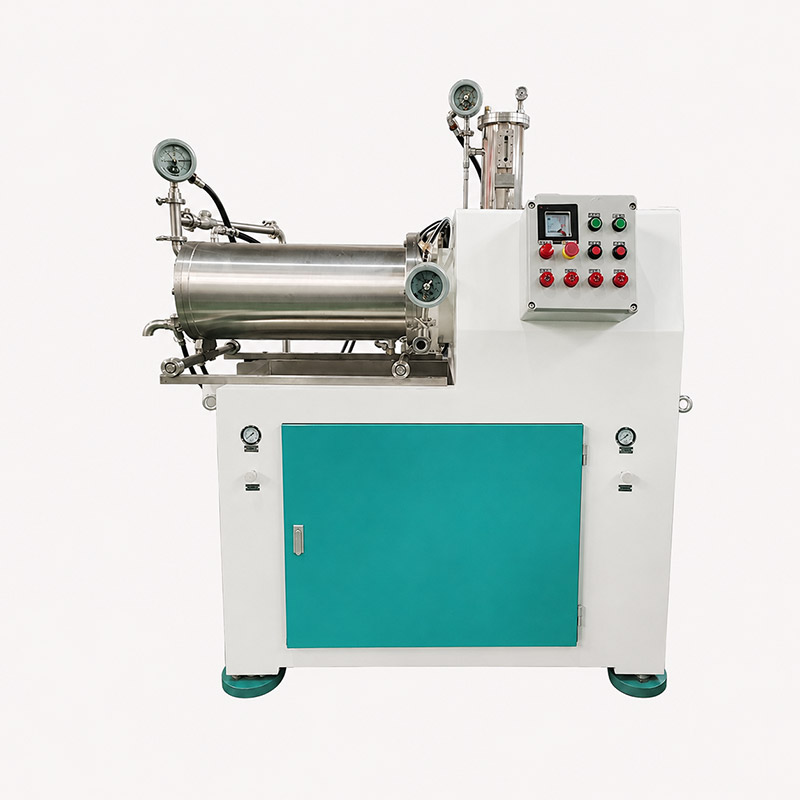
The milling chamber is the working heart of the machine. Its inner surfaces, rotor, and media-contact parts must resist abrasion and corrosion while remaining suitable for the product chemistry. The chamber geometry influences flow, shear, and cleaning. Disk rotors, pin rotors, and other agitator shapes are used in different sand-mill designs, and each creates a different balance of pumping and shear. A production chamber must be accessible for inspection, media removal, and cleaning, because residual product or trapped media can contaminate the next batch. The chamber should also be sized for the intended duty: large enough to provide the needed residence time at a practical flow rate, but not so large that startup, cleaning, and product losses become excessive. For a production-type sand mill, repeatable mechanical alignment and a robust shaft and bearing system are especially important because the machine may run for long periods under load.
Grinding Media and Separation
Grinding media are a consumable and a process variable at the same time. Media material, density, diameter, roundness, and wear resistance all affect the result. Ceramic, zirconia, and steel media are common choices in different applications, but the final choice depends on contamination limits, product chemistry, target fineness, and energy requirements. Media wear can introduce foreign matter, so the user must consider not only grinding performance but also the cost of media replacement and the risk to product quality. The separation system that retains media is equally important. A screen, slot, or dynamic gap must be matched to the smallest media size and to the slurry viscosity and particle load. A separator that is too open releases media; one that is too tight causes pressure buildup and flow instability. Production reliability often depends on this detail more than on nominal motor power.
Cooling, Sealing, and Mechanical Reliability
Most of the electrical energy delivered to the mill eventually becomes heat in the slurry. That heat can change viscosity, accelerate evaporation, degrade temperature-sensitive ingredients, or shift the dispersion equilibrium. Cooling jackets, cooled chamber surfaces, seal cooling, and sometimes cooled feed are therefore part of the process design, not mere accessories. The mechanical seal is another critical area. It must keep the product inside the chamber while excluding air and preventing leakage of solvent or carrier liquid. Dry-running protection, pressure monitoring, and a suitable seal-flush strategy can extend seal life and reduce downtime. Because production sand mills often run continuously, small mechanical weaknesses become costly. Shaft runout, bearing condition, seal alignment, and vibration should be checked during commissioning and maintained as part of a routine reliability program.
Control, Cleaning, and Process Integration
A production-type sand mill is rarely used as a stand-alone box. It is integrated with a feed pump, pre-mix tank, recirculation loop, heat exchanger, filters, and downstream storage. The control system should therefore coordinate the mill with the rest of the line. Useful functions include variable-speed rotor control, flow and pressure monitoring, temperature interlocks, motor-load display, and recipe storage. These functions help operators repeat a proven setting rather than adjust the machine by feel. Cleaning is also part of the design. Product changeover, color changes, and validation requirements all depend on how quickly and completely the chamber, separator, piping, and seals can be cleaned. A machine that is mechanically capable but difficult to clean may still be a poor production choice. The best configuration is the one that matches the product, the cleaning regime, and the available operator skill.
Key Performance Indicators and Selection Criteria
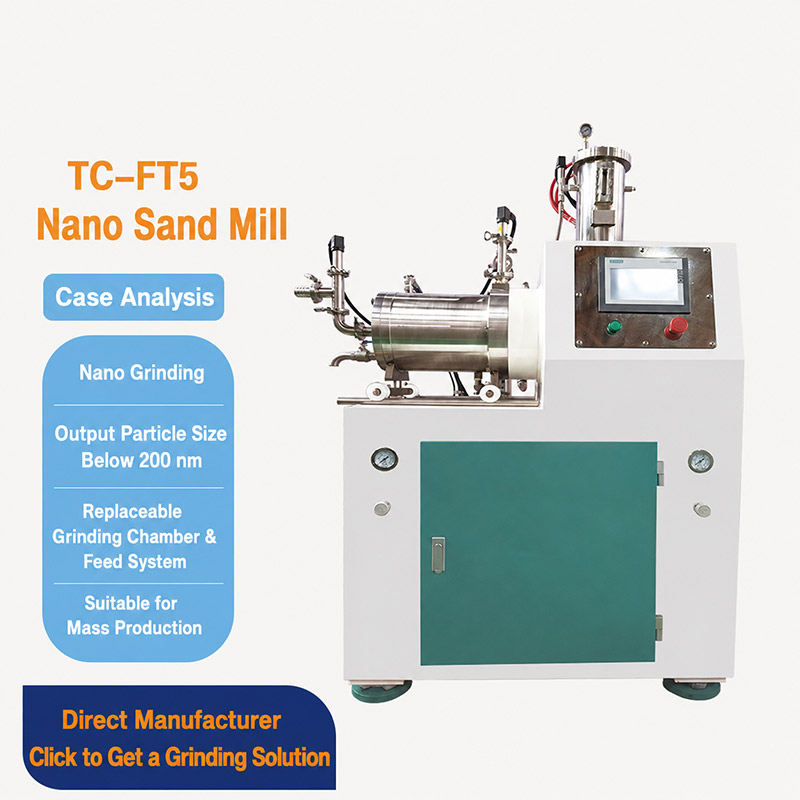
The first selection question is throughput, but throughput should not be read from a single headline number. Production capacity depends on the formulation, starting particle size, target fineness, viscosity, solids loading, media, and acceptable number of passes. A mill that reaches a fine result in one pass at a low flow rate may have a very different practical output from one that requires recirculation. Buyers should ask for capacity data that matches their own product family, or plan a trial with representative material. It is also useful to define normal, maximum, and minimum production rates, because a line that is oversized for normal operation may waste energy and product, while a line that is too small has no room for growth. The right production-type sand mill should fit the real operating schedule, including cleaning and changeover time.
Fineness and dispersion quality are the second major indicators. The target may be expressed as a grind-gauge reading, a median particle size, a top-cut limit, or a rheology requirement. These measures are not interchangeable. A good grind gauge result can still hide fine agglomerates, and a small median size can coexist with a broad distribution or an unstable dispersion. Selection should therefore include a defined test method and a realistic acceptance criterion. The machine should be able to reach the target repeatedly, not only in a demonstration. It is also important to check how the result changes when flow rate, temperature, or media condition moves slightly. A robust process has some tolerance for normal variation; a fragile process depends on a narrow set of conditions that are difficult to hold in production.
Energy use and temperature control are closely linked. Grinding efficiency is not simply a matter of installing a larger motor. The useful question is how much energy is delivered to the particle surfaces and how much becomes waste heat, wear, or unstable flow. Specific energy consumption, temperature rise per pass, and cooling demand are practical indicators. A mill that grinds quickly but overheats the product may force the operator to slow down or add cooling, reducing the real advantage. For heat-sensitive products, the ability to remove heat from the chamber and the recirculation loop can be more important than maximum power. Energy cost should be evaluated together with media consumption, seal life, and product loss, because the lowest purchase price is rarely the lowest total cost.
Automation and maintainability deserve equal attention. A production sand mill should offer repeatable control of rotor speed, feed flow, and temperature, with clear alarms and interlocks. Recipe management reduces operator error during changeovers. Maintenance access should be practical: media changes, separator inspection, seal replacement, and chamber cleaning should not require excessive disassembly. Spare-part availability and technical support matter as well, especially for wear parts and seals. Finally, the buyer should confirm safety and compliance details for the intended environment, including electrical classification, solvent handling, grounding, and guarding. These points are not marketing extras; they determine whether the machine can be operated safely and predictably over its service life.
Applications and Selection Advice
Production sand mills are used where a fine, stable liquid-solid dispersion must be made at industrial scale. Typical sectors include coatings and paints, printing inks, dyes and pigments, agrochemical suspensions, ceramic slips and glazes, battery and electronic materials, cosmetics, and pharmaceutical or food-related suspensions where the equipment and materials are suitable. The common thread is not a single industry but a process need: the product must be reduced in particle size, wetted thoroughly, and kept dispersed without excessive heat or contamination. Different products place different demands on the machine. A solvent-based ink may require careful seal and solvent handling, a ceramic slip may be abrasive, and a temperature-sensitive ingredient may require generous cooling. Selection should begin with the formulation and the quality target, not with a generic capacity table.
A sensible selection process has four stages. First, define the feed: solids, carrier, viscosity, starting particle size, temperature sensitivity, and any hazard related to solvent or dust. Second, define the output: target fineness, acceptable distribution, rheology, stability, and the test method that will be used. Third, define the production case: batch size, required output per shift, cleaning frequency, available utilities, and operator skill. Fourth, run a representative trial and check not only the first result but also repeatability, cleaning time, media wear, and temperature behavior. Buyers should be cautious about selecting a mill solely by motor power or chamber volume. Those numbers matter, but they do not describe the complete process. The most useful specification is a demonstrated result on a material close to the intended product.
Scale-up should be handled with care. A laboratory result can guide media choice and energy level, but a production mill has different flow paths, cooling capacity, and residence-time behavior. It is better to scale up in stages or to use a supplier trial with representative material than to assume that a simple multiplier will preserve the result. During the trial, operators should record rotor speed, flow, temperature, pressure, media charge, and product quality together. That record becomes the basis for the production recipe and for troubleshooting later. If the product is sensitive to heat, contamination, or overgrinding, the trial should include a realistic hold time and a cleaning check. A well-chosen production-type sand mill should be able to repeat the approved result after a normal cleaning cycle, not only during a carefully prepared demonstration.
Operation and Maintenance Planning
Before installation, plan the utility and maintenance envelope. The machine needs suitable power, cooling water or a chiller loop, ventilation or solvent handling where required, and enough space for media changes and seal access. Operators should be trained to recognize abnormal pressure, temperature, vibration, and motor load, because these signals often appear before a quality problem or mechanical failure. A preventive schedule should cover media inspection, separator condition, seal checks, lubricant or bearing requirements, and calibration of flow and temperature instruments. Recording baseline data after commissioning makes later troubleshooting much easier. In many plants, the most expensive downtime is not the repair itself but the production lost while the cause is identified. Good documentation and spare-part planning turn a production sand mill into a predictable asset rather than a bottleneck.
Frequently Asked Questions
Does a production sand mill grind dry powder?
No. A sand mill is normally a wet-processing machine. It works on a slurry or liquid suspension, and the liquid carrier helps control dust, heat, and particle re-agglomeration. Dry size reduction is handled by different equipment.
Is a larger mill always more productive?
Not necessarily. Practical output depends on formulation, target fineness, flow, cooling, and cleaning time. A smaller mill that matches the product and runs reliably can be more useful than an oversized unit that is difficult to control.
What determines the final fineness?
Fineness depends on the combined effect of media size and density, rotor speed, residence time, solids loading, viscosity, and formulation chemistry. The best settings are usually established by a representative trial rather than by a single rule.
Further Reading
For product information, images, and the manufacturer description, see the Production type sand mill page. Equipment details and final specifications should be confirmed with the supplier for the intended formulation and production duty.
Related Products
Get In Touch
Our professional team will reply to you within one business day. Please feel free to contact us!