

What is a Production Type Sand Mill? A High-Efficiency Wet Grinding Equipment for Industrial-Scale Nano Dispersion
Introduction
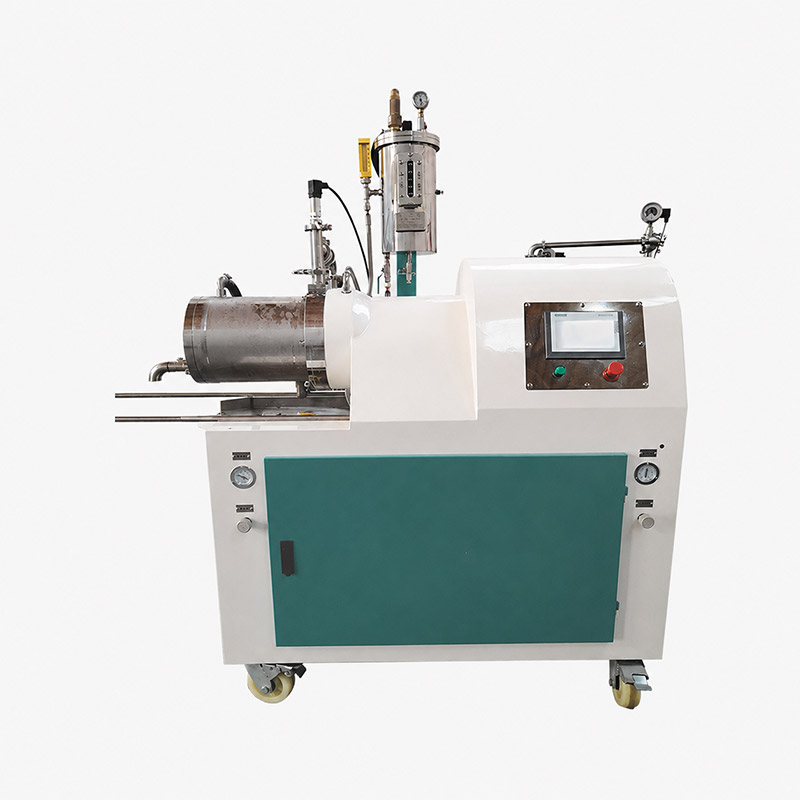
At its core, a production type sand mill is a specialized wet grinding and dispersing equipment that industries such as paint, ink, chemical, pharmaceutical, and advanced materials use to continuously reduce solid particles in liquid suspensions down to micron or even nanometer sizes. Unlike traditional ball mills, the production sand mill delivers higher energy density, better particle size distribution, and superior throughput for commercial manufacturing.
Core Function and Working Principle
How It Transforms Materials
The production type sand mill converts coarse slurry containing solid particles (from 100–200 µm initially) into a fine, stable dispersion with particle sizes often below 1 µm (1000 nm) or even reaching 100 nm. The core mechanism involves a high-speed agitator shaft equipped with discs or pins that rotate inside a stationary grinding chamber filled with small grinding beads (typically 0.1–2.0 mm zirconia, glass, or ceramic beads). The intense shear, impact, and friction forces generated by the beads effectively break down agglomerates and reduce primary particle size.
Key Process Parameters
The final product quality depends on several adjustable parameters: agitator tip speed (usually 10–15 m/s), bead filling ratio (70–85% of chamber volume), residence time, slurry viscosity, and material temperature. Modern production sand mills often incorporate advanced cooling jackets to prevent overheating, and PLC-controlled feed pumps to maintain consistent process conditions.
Main Types and Classifications
Mechanical Configuration
Production sand mills come in horizontal and vertical orientations. The most common for large-scale production is the horizontal closed type, which offers excellent self-cleaning and prevents media sedimentation. Within the horizontal family, there are disc-type and pin-type agitators. Pin-type mills generally achieve finer grind due to higher energy density and more uniform bead distribution.
Discharge Systems
According to the reference materials, the JRX-G series sand mill is available in two designs: A-type (front-end discharge) and B-type (back-end discharge). The A-type is more suitable when space is limited, while B-type facilitates easier maintenance and cleaning. Additionally, dynamic gap separators allow the use of very fine beads (down to 0.1 mm) for nano-grinding applications.
Key Performance Indicators and Selection Criteria
Throughput and Capacity
Production sand mills range from small pilot units (5–20 L chamber) to large industrial machines (250–1000 L). The required output (liters per hour) and desired particle size dictate the mill size. Higher specific energy input (kWh/kg) is needed for finer grinding.
Grinding Fineness and Efficiency
The finest achievable particle size depends on bead material and size, as well as energy density. For nano grinding (< 100 nm), high energy density mills with 0.1–0.5 mm beads are necessary. The production type sand mill typically achieves uniform particle size distribution (PSD) with D90 below 1 µm, crucial for high-performance coatings and electronic materials.
Automation and Maintenance
Modern production mills feature touchscreen controls, recipe storage, and automated feeding. Maintenance ease is enhanced by quick-opening chambers, easy media removal, and robust mechanical seals. Stainless steel construction and explosion-proof options are available for safety.
Application Fields and Selection Advice
Industries Served
Production type sand mills are essential in manufacturing coatings and paints, printing inks, agrochemicals (pesticide suspensions), pharmaceuticals (nano suspensions), magnetic materials, ceramics, and lithium-ion battery electrode dispersions. The ability to process high-viscosity slurries (up to 50,000 cP) makes them versatile.
Choosing the Right Model
For R&D and small-scale batches, a lab horizontal bar pin nano sand mill is recommended. For production scale, select a mill based on required hourly output and target fineness. Consult manufacturers for grinding tests to optimize bead loading and process parameters.
Reference
- Production type sand mill: https://www.planetaryballmills.com/products/grinding-series/sand-mill/production-type-sand-mill.html
Related Products
Get In Touch
Our professional team will reply to you within one business day. Please feel free to contact us!