

What is a Portable Mini Magnetic Blender? A Compact Mixing Device Used for Laboratory-Scale Liquid Blending and Homogenization
Core Definition
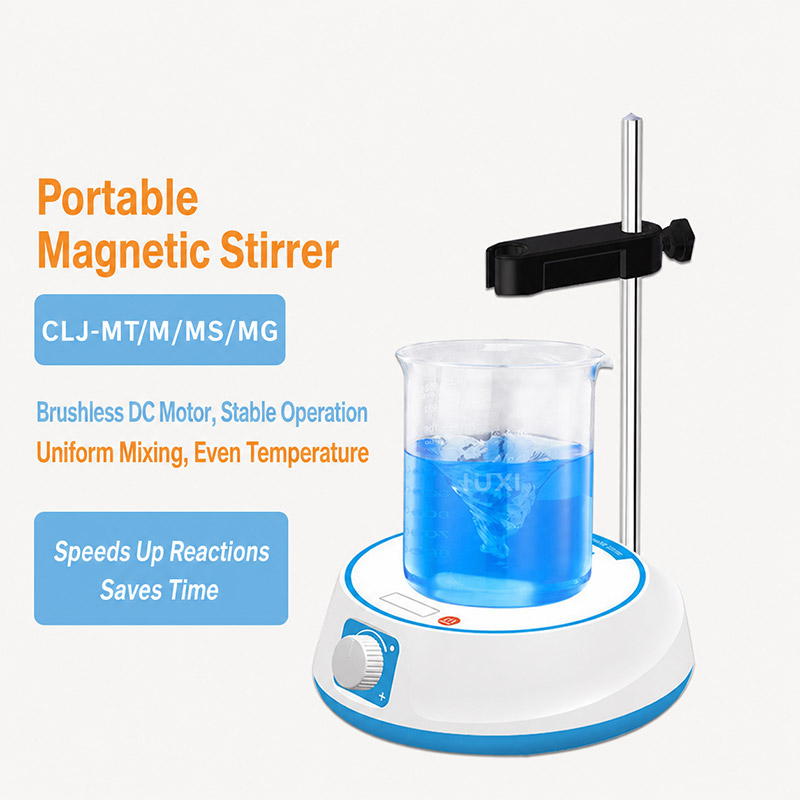
From a core perspective, the Portable Mini Magnetic Blender is a specialized laboratory mixing device widely used in chemical, pharmaceutical, materials science, and educational research to efficiently blend liquids, disperse solid particles into suspensions, and achieve homogeneous mixtures at small scales. Its compact footprint, contactless agitation mechanism, and straightforward operation make it an indispensable tool for benchtop experiments where precision, cleanliness, and space efficiency are paramount.
Working Principle & Core Functions
The fundamental function of this equipment is to transform non-uniform liquid systems into consistent, well-dispersed solutions through controlled mechanical agitation. Unlike traditional overhead stirrers that rely on motor shafts penetrating the reaction vessel, the magnetic blender operates on a completely contactless principle. This design eliminates the risk of mechanical seal failure, fluid leakage, and cross-contamination between samples.
Magnetic Coupling & Contactless Agitation
The core working mechanism revolves around electromagnetic induction. A high-torque brushless DC motor located beneath the work surface drives a permanent magnet assembly. As the motor rotates, it generates a synchronized rotating magnetic field. When a corresponding magnetic stir bar (typically encased in PTFE or glass) is placed inside the target vessel, it couples with the external magnetic field and begins to spin freely within the liquid. The speed of the stir bar directly mirrors the rotational speed of the internal drive magnet, allowing for precise control over agitation intensity without any physical connection to the motor.
Vortex Dynamics & Homogenization Efficiency
As the stir bar rotates, it imparts kinetic energy to the surrounding fluid, generating a stable vortex pattern. This continuous circulation creates shear forces that effectively break down particle agglomerates, dissolve powders, and ensure uniform temperature and concentration distribution throughout the mixture. The absence of moving parts inside the vessel also makes the system exceptionally quiet and vibration-free, which is critical for sensitive analytical procedures and long-duration incubation experiments.
Key Components & Technical Architecture
Modern portable models integrate several engineered modules to enhance reliability, safety, and user experience. The drive system typically employs advanced electronic speed controllers that provide smooth acceleration and deceleration curves, preventing splashing during startup. The work surface is constructed from corrosion-resistant stainless steel or coated aluminum alloy, designed to withstand frequent exposure to acids, bases, and organic solvents while facilitating rapid cleaning.
Advanced units feature digital LED displays for real-time RPM monitoring, programmable timer functions, and thermal overload protection circuits. Some variants are equipped with optional integrated heating plates, enabling simultaneous mixing and temperature-controlled reactions. This dual functionality is particularly valuable in polymer synthesis, catalytic studies, and crystallization processes where precise thermal management directly influences reaction kinetics.
Performance Metrics & Selection Guidelines
When selecting a portable mini magnetic blender, researchers should evaluate several critical performance indicators to match their specific experimental requirements. First, consider the maximum stirring capacity, which typically ranges from 50 mL to 5 L depending on liquid viscosity. Higher viscosity fluids require lower operating speeds and stronger torque output to maintain effective circulation.
Second, examine the adjustable speed range, usually spanning 100 to 2,000 RPM. A wider range offers greater versatility, allowing users to switch gently between delicate emulsions and robust slurries. Third, assess the construction material and thermal resistance if heating functionality is required. Additionally, noise levels below 50 dB are standard for modern lab environments, ensuring operator comfort during extended use. Finally, verify compatibility with standard laboratory glassware and ensure the unit meets relevant electrical and chemical safety certifications.
Application Scenarios & Operational Recommendations
These devices are extensively utilized across academic laboratories, quality control facilities, and R&D departments in industries such as pharmaceuticals, cosmetics, food science, nanomaterial development, and environmental testing. For users conducting routine titrations, solvent mixing, or buffer preparation, a basic model with analog speed control provides sufficient performance. However, for sensitive biological assays, nanoparticle dispersion, or volatile solvent handling, opting for a unit with brushless motors, digital feedback loops, and low-vibration design is strongly recommended.
Proper maintenance significantly extends service life and ensures experimental reproducibility. Users should regularly inspect the stir bar coating for wear, avoid dropping heavy glass vessels onto the work surface, and clean spills immediately using appropriate solvents. For complementary laboratory processing equipment, explore our detailed guides on experimental flotation machines and portable tissue grinders.
References
- Portable Mini Magnetic Blender Official Page: https://www.planetaryballmills.com/ko/products/research-equipment/portable-mini-magnetic-blender.html
- Multi Station Magnetic Stirrer: https://www.planetaryballmills.com/products/research-equipment/multi-station-magnetic-stirrer.html
- Mini Centrifuge: https://www.planetaryballmills.com/products/research-equipment/mini-centrifuge.html
Related Products
Get In Touch
Our professional team will reply to you within one business day. Please feel free to contact us!