

What Is a Portable Mini Magnetic Blender? A Compact Device for Mixing Samples
From the core, a portable mini magnetic blender is a professional laboratory mixing device that chemistry, biology, pharmaceutical, environmental and materials laboratories use to blend, dissolve, suspend or homogenize small volumes of liquid samples quickly, gently and reproducibly. Unlike a kitchen blender, it does not cut through the liquid with high-speed blades. Instead, it uses a rotating magnetic field to spin a small magnetic stir bar inside the vessel, creating controlled agitation at the bottom of the container. The words portable and mini matter as much as the mixing function itself: the unit is built to be small, light and often battery powered, so it can be moved between benches, carried into a fume hood or a glove box, or taken to a sampling site where a small sample still has to be mixed properly.
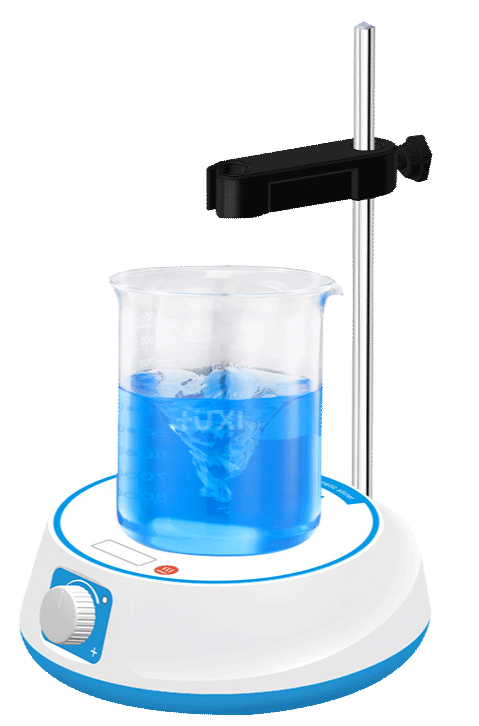
Because the mixing action takes place inside the vessel and is driven from below rather than through a shaft, the device fits neatly into workflows where cross-contamination and sample loss are unacceptable. The current model and its accessories are described on the Portable Mini Magnetic Blender product page.
Core Functions and Working Principle
From a Non-Uniform Sample to a Uniform One
Every mixing device exists to solve the same basic problem: a material system is not uniform, and the analyst needs it to be uniform. In a small laboratory vessel that non-uniformity takes several forms — two liquids that separate into layers, a powder that settles at the bottom of a solvent, a precipitate packed into a cake, a viscous reagent that must be diluted before measurement, or particles that have to stay in suspension while a subsample is taken.
Mixing works through three mechanisms acting together. Convection moves large volumes of fluid from one place to another, and at low speeds the spinning stir bar pushes liquid outward and pulls it down the vessel walls, setting up a circulation loop. Shear and turbulence break up agglomerates and stretch droplets and bubbles so that they disperse. Molecular diffusion finishes the job at the smallest scale, evening out concentration differences that convection cannot reach. A magnetic blender does not produce the violent turbulence of a blade homogenizer, but it produces enough circulation and shear to dissolve salts, blend reagents, resuspend settled solids and keep a sample homogeneous during handling.
The Magnetic Drive Mechanism
Inside the base of a portable mini magnetic blender sits a small electric motor with one or more permanent magnets mounted on its shaft. When the motor rotates, those magnets create a rotating magnetic field in the space directly above the base. A stir bar — a small encapsulated cylinder or oval containing its own magnet, usually coated with PTFE or another chemically inert polymer — is placed in the vessel. The bar aligns itself with the rotating field and spins on the bottom of the vessel, dragging the surrounding liquid with it. The stronger the magnetic coupling and the faster the field rotates, the faster the bar turns and the more energy reaches the liquid.
Because the drive is magnetic, nothing penetrates the vessel, and that single design feature explains most of the practical advantages. Samples can be mixed in closed, screw-capped containers, so volatile solvents do not evaporate and hazardous aerosols do not escape. Sterile or sealed vessels stay sealed. There is no shaft seal to wear out, no bearing to lubricate and no blade to clean, and switching from one sample to the next usually means rinsing a stir bar and swapping a container rather than dismantling a mixing head. In a portable instrument these benefits are amplified, because there is simply no room for a complicated mechanical drive.
Key Process Parameters That Shape the Result
The most obvious parameter is the rotational speed of the stir bar, usually expressed in revolutions per minute. Low speeds create gentle circulation that suits fragile cells, shear-sensitive polymers or dissolution that should not foam. Higher speeds produce a visible vortex, stronger shear and faster dissolving or suspending, but they also generate heat, draw more power and may entrain air. A useful working rule is to use the lowest speed that keeps the sample visibly moving and homogeneous.
Several other parameters interact with speed. The size and shape of the stir bar determine how much liquid it can move: a longer bar gives more torque in a wide beaker, while a short oval bar suits narrow tubes and vials. Vessel geometry matters, because a flat-bottomed container lets the bar spin freely while a rounded one can make it wander or stall. Viscosity is a limiting factor — as it rises, the magnetic coupling may slip, a phenomenon known as decoupling. Fill volume, mixing time and temperature all shift the outcome as well: an overfilled vessel splashes and mixes poorly, and a very short mixing time leaves concentration gradients behind even when the liquid looks uniform.
Temperature is the parameter that is easiest to forget. Mixing itself adds energy to the liquid, and in a small insulated vessel that energy can raise the temperature noticeably over a long run, which matters for heat-sensitive biological samples and for reactions whose rate depends on warmth. Some units offer controlled heating to speed up dissolution; others deliberately avoid it so the sample stays near ambient. Either way, a mixing protocol should specify speed, time and temperature together, because changing one of them changes the result.
Typical Configurations and Core Components
What Is Inside the Unit
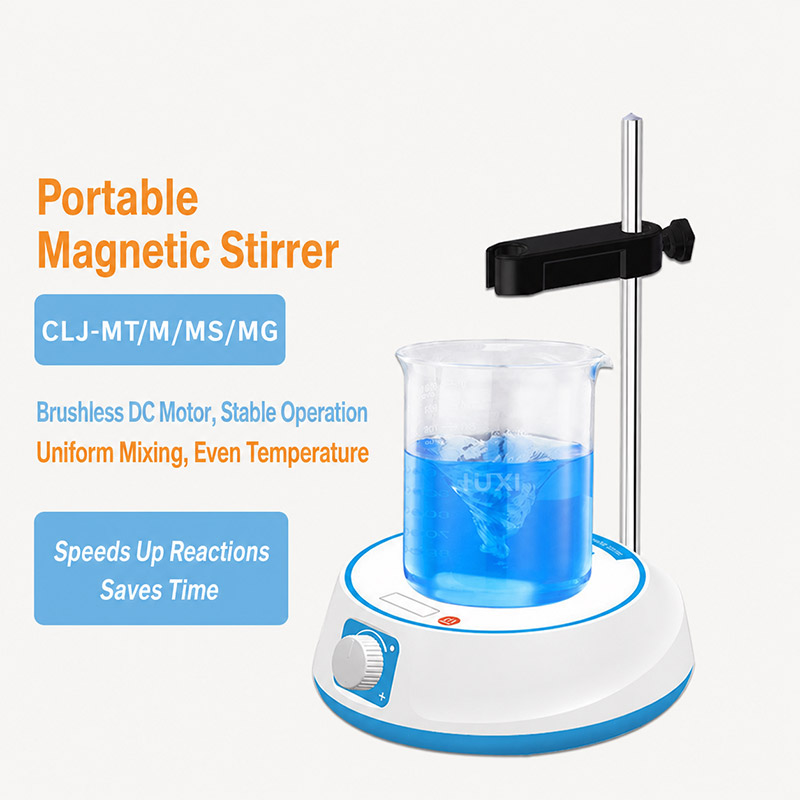
A portable mini magnetic blender is a deceptively simple instrument, but each part contributes to the quality of the mix:
- Drive base: houses the motor, the rotating magnet assembly and the control electronics; its flat top surface is the mixing platform.
- Stir bar: the inert-coated magnetic element that actually agitates the liquid inside the vessel.
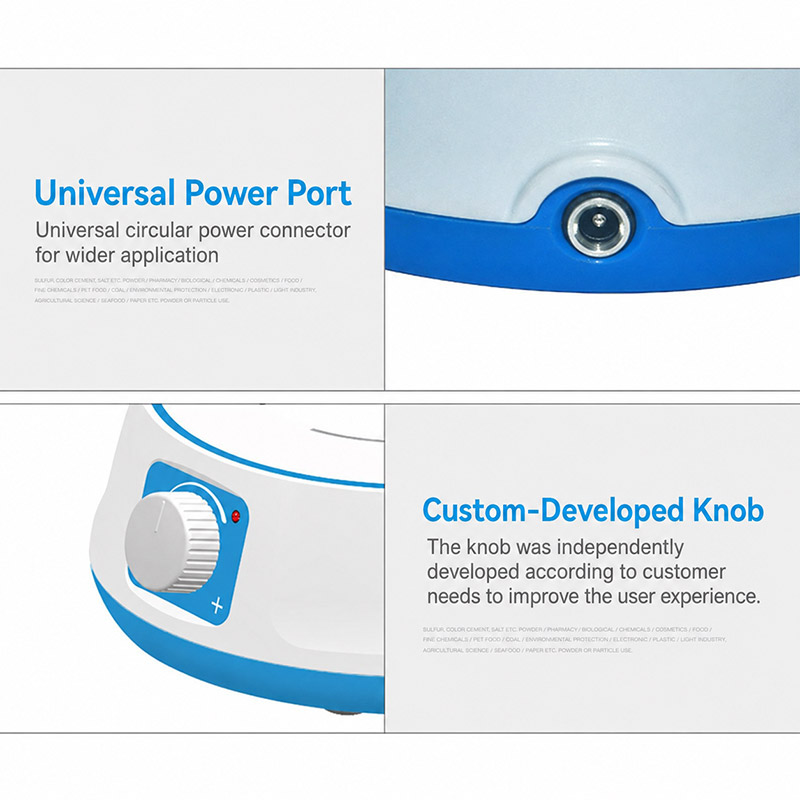
- Speed control: a knob, slider or digital keypad that sets the motor speed, sometimes with a display for repeatable settings.
- Power source: rechargeable battery, disposable cells or a mains adapter, depending on how portable the model is meant to be.
- Vessel holder or anti-slip pad: keeps beakers, tubes and bottles centred over the drive magnets so the bar does not decouple.
Single-Position and Multi-Position Designs
The simplest configuration mixes one vessel at a time. That is usually the right choice when samples are handled individually, when the vessel is large relative to the base, or when mixing conditions must be adjusted for each sample. Multi-position versions place several drive magnets under a wider platform so that tubes or small vials can be mixed in parallel. Parallel mixing is valuable when a batch of samples has to receive identical treatment — a series of dilutions, a set of extraction tubes or a rack of small reaction vials — because it removes the variability that comes from mixing samples one after another. The trade-off is that each position usually has less torque available and is best suited to low-viscosity liquids in small vessels.
Battery-Powered and Mains-Powered Variants
Portability in a mini blender is mostly a question of power. Battery-powered units can be used on a bench with no cable, inside a fume hood where routing a cord is awkward, in a laminar flow cabinet, in a glove box, or outdoors during field sampling. Runtime depends on battery capacity, the selected speed and the load, so a unit running at high speed against a viscous sample will drain faster than one stirring water slowly. Mains-powered units avoid that limitation and can sustain long mixing runs, but they tie the instrument to a socket. Many designs sit between the two extremes, running from an internal battery and recharging from a USB or mains adapter.
Analog, Digital and Heated Options
Control style affects reproducibility more than it affects mixing power. An analog knob is quick and intuitive but does not record what speed was used, so the next operator cannot repeat the run exactly. A digital interface with a set speed and a timer lets a protocol be written down, shared and repeated, which is valuable in regulated laboratories where method transfer matters. Some mini blenders also add gentle heating to accelerate dissolution or hold a sample at a steady temperature while it is mixed; heating adds capability but also adds bulk, power consumption and one more variable to control. Whether it is needed depends entirely on the chemistry being handled.
Choosing a Stir Bar That Matches the Job
The stir bar is the only component that touches the sample, so it deserves more attention than it usually receives. Length and shape set the circulation pattern: a long cylindrical bar moves more liquid and stays stable at higher speeds, a small oval bar fits narrow tubes, and a pivot-ring design reduces friction and noise in flat-bottomed vessels. The coating determines chemical compatibility — PTFE is the common all-purpose choice because it resists most acids, bases and solvents, while other coatings serve specific aggressive media. A bar that is too small for the volume will decouple; a bar that is too large may damage a thin-walled container.
Key Performance Indicators and Selection Points
Working Volume and Vessel Compatibility
Before comparing speeds and prices, check the working volume range. A mini blender is designed for small samples, and performance falls off at both ends of that range. Too little liquid and the stir bar may not stay properly submerged or may splash the vessel walls; too much liquid and the spinning bar cannot set the whole volume in motion, so mixing becomes slow and uneven. The vessel must also suit the platform: flat-bottomed beakers, bottles, centrifuge tubes and vials with a diameter smaller than the base plate work best, and the vessel material should be compatible with both the sample and the stir bar coating.
Speed Range and Mixing Quality
Speed range indicates how flexible the instrument is. A narrow low-speed range suits delicate biological work; a wider range that reaches higher speeds handles dissolution and suspension tasks more quickly and copes with slightly thicker liquids. What matters most is not the maximum number quoted but whether the instrument holds its set speed under load. A drive that slows down as viscosity rises delivers inconsistent mixing, whereas a well-regulated drive keeps the stir bar turning and the sample homogeneous. Reproducibility, not raw power, is the truest measure of mixing quality in a laboratory.
Power, Runtime and Portability
For a portable unit, weight and runtime are the practical performance indicators. Weight determines whether the device really travels with the analyst or quietly stays on one bench. Runtime determines whether the battery covers a working session or only a single short mix. Consider how the unit will be charged, whether the battery is user-replaceable, and whether it can also run while connected to a power source. If the blender will be used mainly at one workstation, portability may matter far less than stability and a wide, non-slip base.
Controls, Maintenance and Safety
Automation features such as timers, programmable speeds and preset stirring profiles reduce operator variation, which is especially useful when several people share one instrument. Maintenance, in contrast, is refreshingly simple for this class of device: because the drive is sealed and there is no mixing shaft, routine care amounts to keeping the platform clean, checking the stir bar coating for cracks and making sure liquids never enter the base. Safety follows the same logic — sealed vessels limit vapour and aerosol release, and the absence of exposed blades removes a common hazard — but normal laboratory rules still apply, including choosing a bar coating that resists the solvent in use.
Applications and Selection Advice
Where a Portable Mini Magnetic Blender Fits
Typical applications cluster around small-volume liquid handling. In analytical chemistry the device dissolves standards, blends reagents and keeps working solutions uniform. In biology and biochemistry it resuspends cell pellets, mixes buffer components and stops cell suspensions from settling before aliquoting. In pharmaceutical and quality-control laboratories it prepares small formulations, checks homogeneity before analysis and supports dissolution testing. Environmental laboratories use it to mix extracted samples and to prepare samples on site, where carrying a full-size stirrer is impractical. Materials and powder-processing groups use it to wet powders, disperse small amounts of additive in a carrier liquid and prepare slurries before coating or casting steps.
The common thread is scale. Whenever the sample is a few millilitres up to a few hundred millilitres and the goal is homogeneity rather than size reduction or high-shear emulsification, a magnetic mixer is usually the simplest and most economical answer. When the sample is large, the liquid extremely viscous, or the target a fine emulsion or sub-micron dispersion, a different class of equipment — an overhead stirrer, homogenizer, colloid mill or bead mill — is the appropriate tool, and the mini blender serves instead as a preparation or sample-handling device. Further laboratory mixing and grinding options are listed alongside the Portable Mini Magnetic Blender in the same catalogue.
How to Choose the Right Configuration
Match the instrument to the job rather than to the specification sheet. If samples are handled one at a time in beakers, a single-position portable unit is enough. If the workflow is a rack of tubes processed identically, choose a multi-position platform. If the work happens in a fume hood, a laminar flow cabinet or the field, prioritise battery operation, low weight and a stable base. If reproducibility and documentation matter, prioritise digital speed setting and a timer. If the chemistry needs warmth as well as motion, consider a heated version. Finally, check consumables: stir bars are inexpensive, but their size, shape and coating must suit the vessel and the solvent, so keeping a small assortment on hand is worthwhile.
Frequently Asked Questions
Why does the stir bar sometimes stop spinning?
This is called decoupling, and it usually has a simple cause: the speed is set too high for the viscosity of the liquid, the vessel is not centred over the drive magnet, the base is not level, or the stir bar is too small for the volume being mixed. Lowering the speed often restores smooth rotation at once; if the sample is genuinely thick, a larger bar or a different mixing method is the better solution.
Can it be used with a closed container?
Yes — this is one of the strengths of magnetic mixing. Because the drive is external and no shaft enters the vessel, a screw-capped bottle or a sealed tube can be mixed without opening it, which limits evaporation and aerosol release. Make sure the container is not overfilled, since the liquid still has to circulate freely.
Can it mix viscous liquids?
Only within limits. Magnetic mixing depends on the torque the rotating field can transmit to the stir bar, and as viscosity rises that coupling eventually slips. Diluted gels, syrups and polymer solutions can often be mixed with a larger bar at moderate speed, but pastes, thick creams and concentrated suspensions are better handled by an overhead stirrer, a kneader or a mill.
Does mixing speed affect sample quality?
It can. Excessive speed introduces air, generates heat and may damage shear-sensitive material such as cells or long-chain polymers, while insufficient speed leaves concentration gradients and settled solids. Mixing gently but long enough is usually better than mixing briefly at high speed.
Reference
The product information in this article is based on the manufacturer's page for the Portable Mini Magnetic Blender, where current configurations and technical details can be confirmed. Reference column: product listing for the Portable Mini Magnetic Blender.
Related Products
Get In Touch
Our professional team will reply to you within one business day. Please feel free to contact us!