

What Is a Polyurethane Coated Iron Core Grinding Ball? Media for Fine Grinding
What Is a Polyurethane Coated Iron Core Grinding Ball?
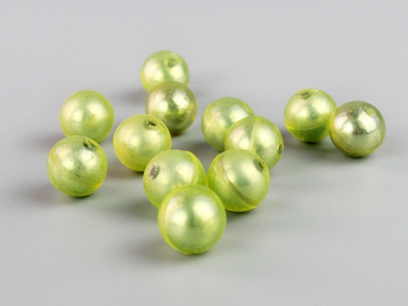
At its core, a polyurethane coated iron core grinding ball is a professional ball mill grinding medium that ceramic, mineral-processing, pigment, coating, chemical and battery-material producers use to reduce solid particles to fine and ultrafine sizes. Structurally, it is a composite sphere: a dense metallic core, normally iron or steel, is fully encapsulated inside a jacket of polyurethane (PU). The heavy core supplies the mass and impact energy that fractures particles, while the polymer jacket absorbs abrasion, deadens noise and keeps the metal from touching either the mill lining or the material being processed.
The purpose of that layered design becomes obvious when you compare it with the two media it sits between. An uncoated steel ball is heavy and inexpensive, but it wears, it can stain white or light-coloured powders with iron, and it makes a mill extremely loud. A solid polyurethane ball is quiet and chemically inert, but it is too light to deliver serious comminution energy. A polyurethane coated iron core grinding ball borrows density from metal and surface behaviour from polymer, and that combination is what makes it useful across a wide range of grinding duties.
Core Function and Working Principle
A grinding ball never cuts particles; it transfers energy into them. Everything a medium does — how fast the powder fines down, how wide the particle-size distribution becomes, how much wear debris is generated — follows from how much energy the ball delivers, where it delivers it, and what happens to the ball's own surface along the way. The coated iron core ball is engineered to make those three factors predictable and controllable.
From Coarse Feed to Fine Powder
Inside any rotating or vibrating mill — a planetary ball mill, a roller jar mill, a vibration mill or a horizontal drum mill — the media charge is continually lifted by the jar wall and then released. The feed, usually a few hundred micrometres to a few millimetres in size, occupies the gaps between the balls. Every rotation subjects it to two distinct mechanisms of size reduction.
The first is impact: a falling ball strikes the powder bed and fractures brittle particles along their existing flaws. The second is attrition, or shear: as neighbouring balls slide and roll against each other, they nip particles between two surfaces and grind them down progressively. Impact dominates when the media are large, dense and fall from a good height; attrition dominates when the media are smaller, when the mill runs at a moderate speed and when the jar is well filled. Ultrafine grinding depends almost entirely on the second mechanism, which is why media density and media surface condition matter so much at the end of a long milling campaign.
Because a coated iron core ball is heavy, it still generates useful impact energy early in the process, when agglomerates and coarse crystals must be broken down. Because its working surface is a compliant polymer rather than hard steel, the later, attrition-dominated stage is gentler and more evenly distributed throughout the bed. In practice, this usually produces a narrower particle-size distribution, less over-grinding of the finest fraction, and less heat build-up than an equivalent charge of uncoated metal.
How the Iron Core and the Polyurethane Jacket Work Together
The iron core is the engine of the ball. Density is what converts rotational speed and mill geometry into kinetic energy, so a heavy core is what allows a mill of a given size to accomplish meaningful size reduction in a reasonable time. Density also keeps the media sitting inside the grinding bed instead of floating on top of a low-viscosity slurry, which matters greatly in wet grinding.
The polyurethane jacket performs three jobs at once. First, it is a wear barrier: PU resists abrasion and repeated elastic deformation, so the metal — the part that would contaminate the product — never contacts the workpiece. Second, it is a damping layer: it softens the metallic ring of ball-on-ball and ball-on-jar collisions, reducing noise substantially and cutting the fatigue loading that eventually cracks jars and linings. Third, it is a chemical interface: suitable PU grades tolerate water, mild acids and alkalis and many organic solvents, and their low surface energy discourages sticky or oily powders from building up on the media.
The coating also changes contact mechanics. A hard steel ball concentrates force into a tiny contact patch; that fractures particles effectively but generates localised heat and can pit soft or brittle jar linings. A polymer-clad ball spreads the same load over a larger, more compliant area, so the temperature rise inside the jar stays milder. That is valuable for polymers, pharmaceutical intermediates and any material prone to oxidation, melting or phase change during milling.
Process Parameters That Decide the Final Particle Size
Whatever mill you operate, a small set of parameters governs how a coated media charge behaves:
- Media diameter: small balls create more contact points and favour fine grinding; large balls deliver higher impact energy and handle coarser feed. A graded charge that mixes two or three diameters often gives the best balance between breakage rate and fineness.
- Media-to-powder ratio: the mass of the ball charge divided by the mass of the sample. Increasing the ratio accelerates grinding but reduces how much powder a given jar can hold.
- Jar fill level: the media usually occupy roughly a third to a half of the jar volume. Too little media wastes impact energy; too much suppresses the tumbling motion that generates attrition.
- Rotational speed: higher speed raises energy input, up to the point where the charge centrifuges against the wall and grinding effectively stops. Planetary mills add a second lever, the ratio between jar rotation and disc rotation.
- Time, liquid and atmosphere: longer runs give finer powder but also more wear, more heat and more risk of re-agglomeration. Wet grinding with a suitable carrier liquid, or dry grinding under inert gas, changes the outcome for reactive or oxidisable materials.
Core density and coating hardness are the fixed parameters underneath all of these. Selecting them correctly is what makes the adjustable settings easy to tune.
Types and Construction Options of Coated Grinding Media
Coated media are a family rather than a single item. What separates one ball from another is the core, the coating formulation, and the geometry of the ball itself.
Variants defined by the core
The most common construction uses an iron or carbon-steel core, which offers a favourable density-to-cost ratio and is the reason these balls feel noticeably heavier than their size suggests. The ratio of core diameter to overall ball diameter is the key design decision. A larger core means more mass and more impact energy; a proportionally thicker jacket means longer wear life and a softer, quieter, less contaminating contact. Manufacturers therefore build several core-to-jacket ratios, letting a user bias the charge toward aggression on the one hand or longevity on the other.
Variants defined by the coating
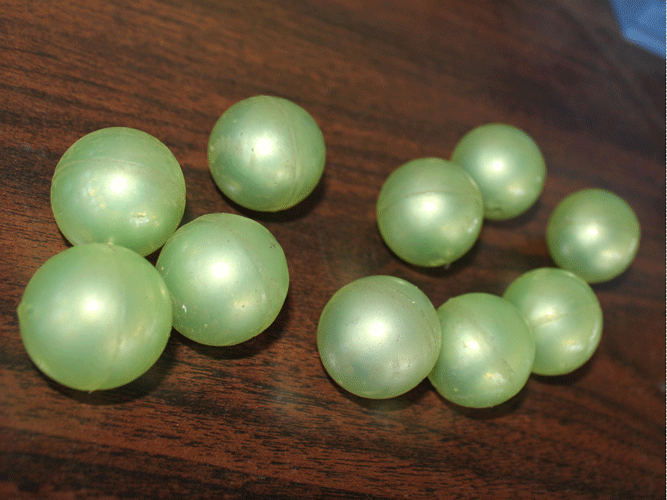
Polyurethane is itself a broad material family. Grades differ in hardness (usually quoted on the Shore A or Shore D scale), in resilience, in hydrolysis resistance and in solvent compatibility. A softer coating deforms more, protecting fragile jar linings and fragile particles; a harder grade stands up better to abrasive slurries such as mineral sands, alumina or quartz. Colour is largely cosmetic, but moulding quality is not: a bubble, seam or thin patch in the jacket is exactly where wear will start, and where metal exposure can follow.
How coated balls compare with other grinding media
| Media type | Mass character | Wear and contamination | Noise | Typical fit |
|---|---|---|---|---|
| Carbon steel balls | High | High wear; iron pickup likely | High | Ore, cement and other dark, iron-tolerant feeds |
| Stainless steel balls | High | Lower than carbon steel but still metallic | High | General laboratory milling where trace iron is acceptable |
| Zirconia balls | High | Very low wear; low contamination | Medium | High-purity ceramics, electronics, batteries |
| Corundum or alumina balls | Medium-high | Low, but alumina-based | Medium | Ceramic bodies, glazes, minerals |
| Agate balls | Low-medium | Very low; acid resistant | Low-medium | Geological and analytical samples |
| Solid PU balls | Low | Low, but limited grinding power | Very low | Dispersion, gentle mixing, soft materials |
| Polyurethane coated iron core balls | High | Low while the jacket is intact; metal is shielded | Low | Fine and ultrafine grinding where energy and cleanliness both matter |
The table is qualitative on purpose: the right comparison depends on your feed, your target particle size and the value of the product being milled. What the coated ball offers is a way to keep the mass of a metallic medium while moving the wear surface into a polymer that the product can tolerate.
Matching media to jars and mills
Media should always be considered together with the jar. PU-coated balls pair naturally with PU, nylon, PTFE and tempered nylon jars, where the compliant jacket reduces both jar wear and acoustic noise. In planetary mills with small jars, they are a way to raise energy input without the sharp, damaging impact of plain steel. In roller and vibration mills running continuously, they extend jar life and reduce the frequency of media top-ups, because the jacket protects the core from the abrasive slurry that would otherwise erode it.
Key Performance Indicators and Selection Points
When specifying coated grinding media, buyers should focus on the indicators that translate directly into process cost and product quality.
Grinding capacity and throughput
Capacity in a batch mill is a function of jar volume, media fill level and media mass. The coated iron core ball contributes density, so a moderate volume of media delivers the kinetic energy that a lighter charge could not. In continuous mills, throughput depends on the residence time needed to reach the target fineness; because coated media grind more evenly, the residence time and the risk of over-milling are both easier to control. Anyone sizing a mill should estimate the required batch mass first and then choose media diameter and fill level to match.
Particle size control and distribution
The ability to reach a target size, and to reach it consistently, is the central quality metric. Coated media excel at the fine end: they generate a high density of gentle shear events, which narrows the distribution and limits the tail of coarse unground particles. Users should test with a graded charge, monitor the median size and the span over successive short runs, and stop the campaign when the size curve flattens rather than simply running for a fixed time.
Wear life, contamination and cost per unit of product
Wear is best viewed as cost per tonne of finished powder, not as price per ball. A coated ball costs more than a plain steel ball, but it wears more slowly in abrasive service and, crucially, it keeps iron out of the product, which avoids rejected batches and expensive purification steps. Inspect the jacket periodically: as long as the PU layer is intact, the medium behaves as a clean polymer surface; once a jacket is perforated, that individual ball should be removed from the charge.
Energy, noise and the working environment
Grinding is an energy-hungry unit operation, and the media influence how efficiently that energy is used. A dense core means less milling time for a given fineness; a polyurethane jacket means markedly lower noise levels and less vibration transmitted into the frame, floor and neighbouring equipment. In laboratories and workshops where mills run for hours, noise and dust reduction are genuine selection criteria rather than afterthoughts.
Compatibility, automation and maintenance
Check that the coating grade suits your carrier liquid, your pH and your solvent system, and that media diameter suits your jar geometry and screen or discharge arrangement. For automated installations, consistent ball mass and diameter help the control system predict grinding energy; because coated media wear slowly and evenly, the behaviour of the charge stays stable over many cycles, which reduces the need for frequent re-weighing and rebalancing.
Applications and Selection Advice
Coated iron core media are used wherever a process needs both grinding energy and a clean, quiet surface. Typical settings include ceramic and glaze preparation, where iron pickup would discolour the body; pigment and coating manufacture, where colour fidelity matters; mineral and filler processing, where abrasive slurries would rapidly destroy soft polymer-only media; chemical and pharmaceutical intermediates that must remain free of metallic contamination; and battery and electronic materials, where trace metals are a quality risk. They are also common in university and analytical laboratories, where planetary mills sit close to desks and noise control is part of the working environment.
Selection advice follows the duty. For laboratory work with small jars, choose smaller diameters and a graded charge so that a modest media mass still produces enough contact points; use a softer coating if you are milling fragile crystals or using a plastic jar. For pilot and production mills handling abrasive slurries, choose larger diameters with a thicker, harder jacket, and keep the fill level in the middle of the recommended range so that the charge tumbles rather than cascades. If your priority is the finest possible powder, accept a slightly longer cycle and use a high media-to-powder ratio with small media; if your priority is throughput, use larger media and let a secondary fine-grinding stage finish the job. In every case, run a short trial, measure the size distribution and the wear rate, and scale up from data rather than from intuition.
Maintenance, Handling and Storage Notes
Coated media are low-maintenance but not maintenance-free. After each campaign, rinse the balls with a compatible liquid, dry them, and check a random sample for jacket damage, swelling or softening. Store them away from direct sunlight, ozone sources and extreme heat, since prolonged UV exposure and high temperatures can age polyurethane. Keep the charge as a complete set: mixing worn and new media of the same nominal size is acceptable, but mixing sizes randomly can change the energy balance of the mill. When topping up, add media gradually and re-check the mill's operating current or power draw, because a heavier charge draws more power even when the mill is empty of powder.
Frequently Asked Questions
Can a coated ball simply replace steel media in an existing mill?
Usually yes, with two checks. First, confirm that the mill can carry the mass: coated balls are dense, and a charge of equal volume can weigh noticeably more than a charge of the same size in a lighter ceramic. Second, confirm that the discharge or screening arrangement can handle the ball diameter you intend to use. If both are satisfied, the change is normally a straight substitution that reduces noise and contamination without changing the mechanics of the mill.
How do I know when a coated ball needs replacing?
Watch the jacket, not the core. A serviceable ball has a continuous, uniform polymer layer; once you can see the metal core, or once the coating is cut, blistered or worn through at a contact point, that ball should be taken out of service. Because wear is progressive, routine inspection at fixed intervals is more reliable than waiting for a visible failure, and it prevents a single damaged ball from introducing iron into an otherwise clean batch.
Are coated balls suitable for wet grinding?
Yes, provided the coating grade is matched to the liquid. Polyurethane generally performs well in water and in many mild chemical systems, and its low surface energy limits the caking and ball-to-ball sticking that wet grinding can cause. Highly aggressive solvents or strongly alkaline slurries require a specific PU grade, so compatibility should always be confirmed before a long campaign.
Do they work in planetary ball mills?
They do, and this is one of their most common uses. Planetary mills are often limited by the energy that small jars can deliver; dense coated media raise that energy while their compliant surface protects the jar wall and reduces the noise that small high-speed mills produce. A graded charge with a moderate fill level and intermittent operation to limit heat build-up is a good starting point.
What about very soft or heat-sensitive materials?
Here the jacket is a genuine advantage. Soft polymers, waxes and organic crystals tend to smear on hard steel, and localised hot spots can melt or degrade them. The larger, gentler contact area of a coated ball spreads the load and keeps the temperature rise lower. For the most sensitive materials, combine coated media with short milling intervals, a lower speed and, where appropriate, wet or cryogenic conditions.
Choosing the Right Media for Your Process
Understanding what a polyurethane coated iron core grinding ball is comes down to one idea: it separates the job of carrying energy from the job of touching the product. The iron core carries energy; the polyurethane jacket touches the product, the jar and the air, keeping wear debris, iron contamination and noise out of the process. Once that division of labour is clear, the selection questions become straightforward — how much energy your feed needs, how fine the target powder must be, how sensitive the material is to metal and heat, and how long you want the charge to last between top-ups.
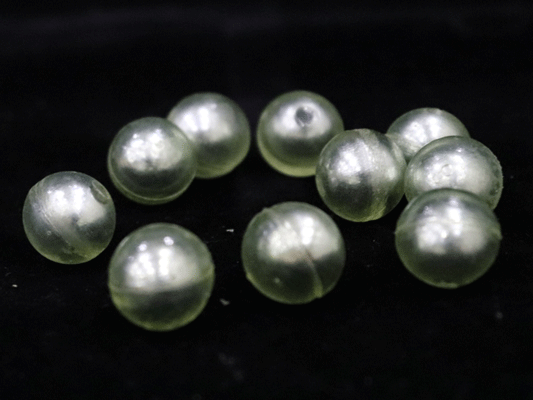
Start with a small trial charge, measure particle size, wear and noise, and adjust diameter, fill level and coating hardness from there. You can review the specification and available options for the polyurethane coated iron core grinding ball on the product page, then match the media to your jar, your mill and your material. A second visual reference for coating thickness and finish is shown below, and comparing it with your own worn media is a quick way to judge remaining service life.
Related Products
Get In Touch
Our professional team will reply to you within one business day. Please feel free to contact us!