
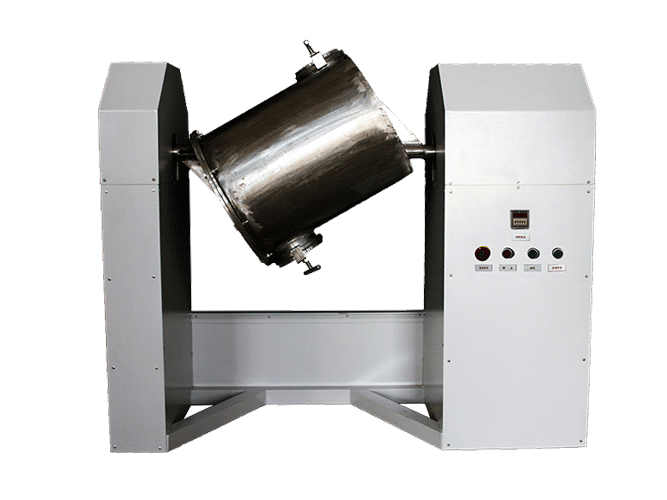
What is an Oblique Mixer? A Versatile Batch Mixer for Homogeneous Blending of Powders and Granules

Introduction
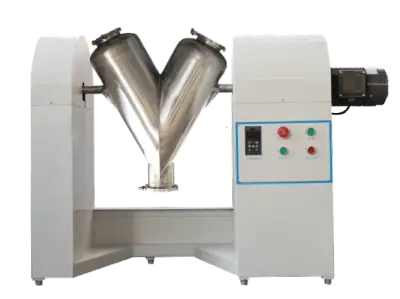
At its core, an oblique mixer is a specialized batch mixing device that powder metallurgy, chemical, ceramic, pharmaceutical, and other industries use to uniformly blend dry powders, granules, and other particulate materials. The equipment achieves homogeneous mixing through a three-dimensional tumbling motion generated by its inclined container, effectively combining different components by gravity-induced convection, shear, and diffusion.
Core Function and Working Principle
The oblique mixer transforms a batch of mixed powders from an initial segregated state into a uniformly blended final product. Its core working principle relies on the inclined rotation of a mixing container (typically a cylindrical or polyhedral drum) mounted at an angle to the horizontal axis. When the drum rotates, the material inside is continuously lifted and cascaded by gravity, creating a tumbling bed that promotes particle intermingling. The oblique angle prevents material from simply sliding, instead inducing a complex three-dimensional flow pattern that includes axial convection and radial diffusion.
Key process parameters affecting mixing quality include rotation speed (typically 10–50 rpm), mixing time (from a few minutes to several tens of minutes), and fill level (usually 30–60% of the total volume). Proper selection of these parameters ensures that the final mixture achieves a coefficient of variation (CV) of less than 5% for most industrial applications. The oblique mixer can also be equipped with optional internal baffles or spray nozzles for adding liquid binders or coatings.
Core Components and Key Technologies
An oblique mixer consists of several essential subsystems:
- Mixing Container: Typically made of stainless steel (304 or 316L) for corrosion resistance and easy cleaning. The interior surface can be polished to a mirror finish to minimize material adhesion. For abrasive materials, optional wear-resistant linings (e.g., polyurethane or ceramic) are available.
- Drive System: A geared motor with variable frequency drive (VFD) provides precise speed control. The drive is coupled to the container through a chain or belt, ensuring smooth and reliable operation.
- Sealing and Containment: High-quality seals prevent dust leakage, making the oblique mixer suitable for handling fine powders. Optional vacuum or inert gas purging capability allows blending of air-sensitive materials.
- Discharge Mechanism: A manual or pneumatic discharge valve at the bottom of the container enables quick and complete emptying. Some models feature a tilting frame for facilitated unloading.
Key Performance Indicators and Selection Criteria
When selecting an oblique mixer, users should consider the following critical parameters:
- Working Capacity: Laboratory models typically range from 0.5 L to 20 L, while industrial units can handle up to 100 L or more per batch. The rated capacity is usually based on the total volume of the container, but the actual fill volume is about 60% of that.
- Mixing Uniformity: The standard deviation of component concentration across the batch (CV) is a direct measure of mixing quality. A well-designed oblique mixer can achieve CV < 3% for many free-flowing powders.
- Speed and Scalability: Variable speed control (e.g., 5–50 rpm) allows optimization for different materials. The same geometric design can be scaled up linearly from lab to production, ensuring consistent mixing results.
- Automation and Programmability: Advanced models offer programmable timers, automatic start/stop cycles, and data logging for process validation. Integration with a central control system is possible via RS485 or Ethernet.
- Maintenance and Cleaning: Quick-release clamps, smooth interior surfaces, and accessible seals reduce downtime for changeover between batches. CIP (clean-in-place) options are available for hygiene-sensitive applications.
Application Areas and Selection Advice
Oblique mixers are widely used in laboratories and small-scale production for blending ceramic powders, battery materials (e.g., cathode and anode powders), pharmaceutical granules, food additives, pigments, and metal powders. They are particularly suitable for materials that are prone to segregation or require gentle handling to avoid particle breakage.
For users with minimal batch sizes (e.g., 0.5–5 L), a compact benchtop oblique mixer is ideal for R&D and formulation development. For production volumes up to 50 L per batch, a floor-standing model with a tilting discharge mechanism offers convenience. When processing hazardous or oxygen-sensitive materials, a vacuum-capable oblique mixer with an inert gas purge system is recommended. For very large batches beyond 100 L, consider a double cone mixer or V-type mixer, which share similar tumbling principles but offer higher throughput.
References
- Oblique mixer product page: https://www.planetaryballmills.com/products/mixed-series/oblique-mixer.html
- V-type mixer: https://www.planetaryballmills.com/products/mixed-series/v-type-mixer.html
- Double cone mixer: https://www.planetaryballmills.com/products/mixed-series/double-cone-mixer.html
- 3D mixer: https://www.planetaryballmills.com/products/mixed-series/3d-mixer.html
Related Products
Get In Touch
Our professional team will reply to you within one business day. Please feel free to contact us!