

What is a Low Temperature Planetary Grinding Machine? A Specialized Ball Mill for Cryogenic Grinding of Heat-Sensitive Materials
What is a Low Temperature Planetary Grinding Machine?
At its core, a low temperature planetary grinding machine is a specialized type of planetary ball mill that incorporates a cooling system to maintain a low-temperature environment during the grinding process. Researchers and engineers in materials science, pharmaceuticals, and biotechnology use it to pulverize, mix, and homogenize samples that are sensitive to heat, such as polymers, biological tissues, energetic materials, or volatile compounds. By preventing thermal degradation, this equipment ensures that the final powder retains its original chemical and physical properties.
Core Function and Working Principle
The primary function of a low temperature planetary grinding machine is to reduce particle size and achieve fine or nano-scale powders under controlled cold conditions. Its working principle combines the classic planetary ball mill motion with an integrated cooling system.
Planetary Motion and Grinding Action
The machine consists of a rotating sun disk (base plate) on which two or four grinding jars are mounted. When the sun disk rotates, each jar also rotates around its own axis in the opposite direction, creating a planetary motion. This compound movement generates strong centrifugal forces (up to 20 g or more) that drive grinding balls to collide, shear, and friction against the material. As a result, samples are rapidly crushed and ground into fine powders. The speed ratio between revolution and rotation is typically fixed (e.g., 1:2) to maximize energy transfer.
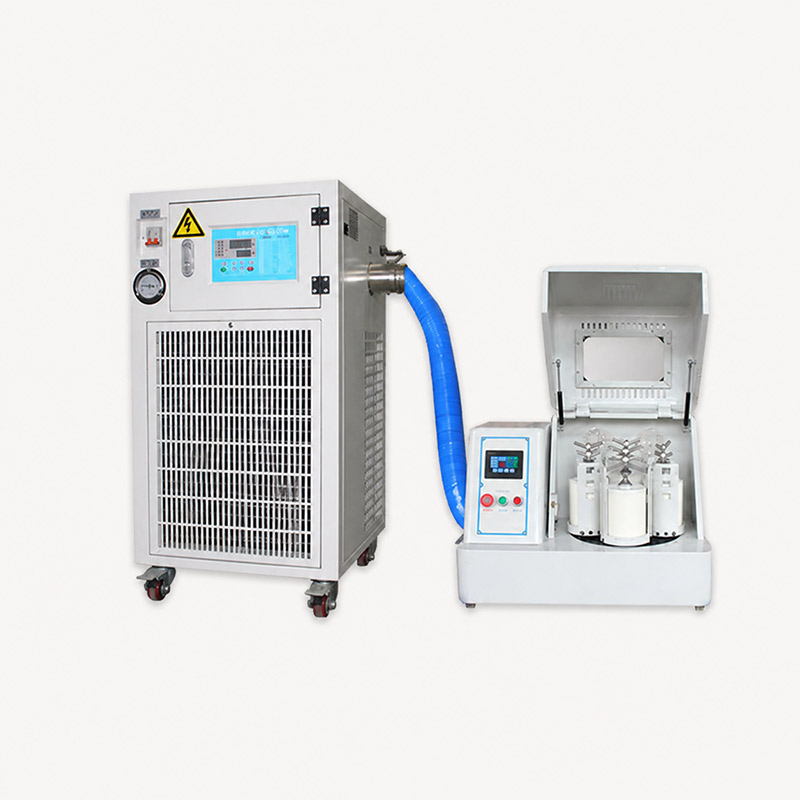
Cooling System
What distinguishes the low temperature version from standard planetary ball mills is its ability to keep the grinding chamber at sub-zero or low positive temperatures. The cooling system can be based on:
- Refrigerated Circulator: A coolant (e.g., ethylene glycol/water mixture) is circulated through a jacket surrounding the grinding jars or the main chamber, removing the heat generated by impacts.
- Cryogenic Gas Injection: Liquid nitrogen or dry ice is introduced directly into the sealed jar to achieve temperatures as low as –196 °C before and during grinding.
- Integrated Freezing: Some models pre-cool the entire jar assembly in a freezer before installation.
Key Components and Technologies
While the product is a single type rather than a family with multiple distinct models, understanding its critical components helps users appreciate its capabilities:
Grinding Jars and Media
The jars and balls must be made of materials that perform well at low temperatures, such as stainless steel, agate, zirconia, or tungsten carbide. Vacuum-tight or gas-tight sealing is often required to prevent condensation or contamination.
Control System
Modern low temperature planetary grinding machines feature programmable controllers that allow setting revolution speed, rotation speed, grinding time, and cooling parameters. Touch-screen interfaces are common, simplifying operation and data logging.
Insulation and Sealing
To minimize heat ingress and maintain stable low temperatures, the machine housing is often insulated, and the drive system is designed to reduce thermal conduction from the motor.
Key Performance Indicators and Selection Criteria
When selecting a low temperature planetary grinding machine, the following metrics are critical:
- Temperature Range: The achievable minimum temperature (e.g., –50 °C, –196 °C with liquid nitrogen) and stability.
- Capacity: Single jar volume (typically 0.2 L to 2 L) and total processing volume.
- Speed Range: Revolution speed (100–600 rpm) and rotation speed (200–1200 rpm) determine impact energy and final fineness.
- Fineness Achievable: Sub-micron to nanometer level, depending on material and duration.
- Cooling Method: Circulator vs. cryogenic – choose based on required minimum temperature and availability of liquid nitrogen.
- Automation: Programmable cycles, data recording, and safety interlocks (e.g., over-temperature shutdown).
- Maintenance: Ease of cleaning jar seals and replacing coolant hoses.
Application Fields and Selection Advice
Typical Applications
- Pharmaceuticals: Grinding heat-sensitive drugs, vitamins, or herbal extracts without degradation.
- Polymers and Plastics: Cryogenic milling of elastomers, rubber, and PVC into fine powders.
- Biological Samples: Homogenizing tissues, bone, seeds, or food products for analysis.
- Energetic Materials: Safe grinding of explosives and propellants that may decompose at elevated temperatures.
- Electronics and Ceramics: Preparing nano-powders for advanced capacitors or sensors without phase transformation.
Selection Recommendations
For laboratories with occasional low-temperature needs, a benchtop model with a refrigerated circulator (e.g., –20 °C to –40 °C) is cost-effective. For ultra-low temperatures (below –100 °C), a liquid nitrogen compatible design is essential. Consider the required sample throughput and jar size; larger jars may require more powerful cooling. Always verify compatibility of jar and ball materials with your specific sample and coolant.
References
Related Products
Get In Touch
Our professional team will reply to you within one business day. Please feel free to contact us!