
What is a Low Temperature Planetary Grinding Machine? A Cryogenic Grinding Device for Heat-Sensitive Materials in Laboratories

What is a Low Temperature Planetary Grinding Machine?
At its core, a low temperature planetary grinding machine is a specialized type of planetary ball mill that integrates a cooling system—typically using liquid nitrogen or a recirculating chiller—to maintain the grinding chamber at sub-zero temperatures during operation. Researchers and engineers in fields such as materials science, pharmaceuticals, biotechnology, and chemistry use it to mill, mix, and homogenize heat-sensitive, volatile, or reactive materials that would otherwise degrade or change properties under the heat generated by conventional high-energy ball milling.
Core Function and Working Principle
The primary function of this equipment is to transform coarse solid particles into fine powders (down to submicron or even nanometer scale) while keeping the temperature of the material and grinding jars low. The device operates on the same planetary motion principle as a standard planetary ball mill: a rotating disk (the sun wheel) carries four grinding jars that also spin on their own axes. This combination of revolution and rotation generates high centrifugal forces, causing the grinding balls to impact and shear the sample with extreme energy.
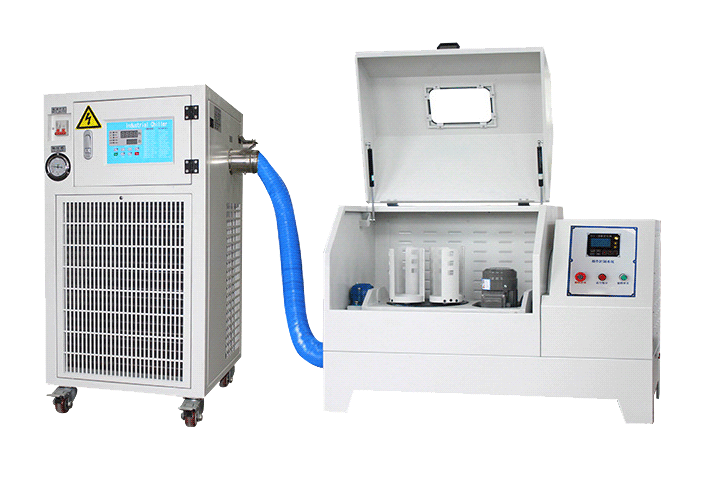
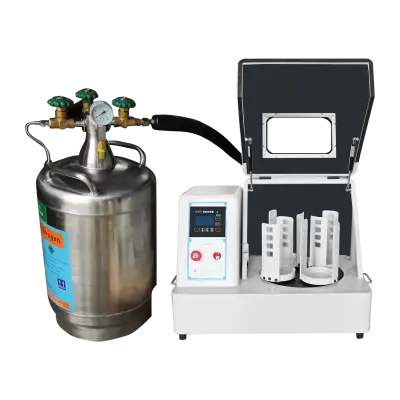
What sets the low temperature version apart is its active cooling mechanism. In the liquid nitrogen (LN₂) type, the grinding jars are housed inside an insulated chamber through which a continuous stream of liquid nitrogen vapor is circulated. The cold gas absorbs the frictional heat generated by the high-speed collisions, keeping the jar surface temperature as low as -40°C to -20°C. In the air-cooled (refrigeration) type, an external compressor and heat exchanger provide chilled air at around 5–15°C, which is blown into the chamber to remove heat. The choice of cooling method depends on the required temperature range and the sensitivity of the material.
Key process parameters that affect the final particle size include the rotation speed (both sun wheel and jar), the ball-to-powder weight ratio, the grinding time, and the coolant flow rate. By precisely controlling these variables, users can achieve a consistent, ultra-fine product while preserving the chemical and physical integrity of the sample.
Types of Low Temperature Planetary Grinding Machines
Liquid Nitrogen (LN₂) Cooled Type
This type uses a liquid nitrogen tank and a gas delivery system to inject cold nitrogen vapor into the grinding chamber. It can achieve the lowest temperatures, typically -40°C to -20°C at the jar surface, making it ideal for cryogenic milling of polymers, elastomers, waxes, and biological tissues. The LN₂ consumption is moderate (about 4–5 L/hour for a 4L machine), and the system requires a separate Dewar or tank for liquid nitrogen storage.
Refrigeration (Air-Cooled) Type
Also known as the "low temperature circulating cold air" type, this variant uses a built-in refrigeration compressor (similar to an air conditioner) to cool the air that is circulated through the insulated grinding chamber. It maintains the jar temperature between 5°C and 15°C, depending on ambient conditions. This type is simpler to operate, less expensive, and does not require consumable cryogens, making it suitable for routine milling of materials that only need moderate cooling, such as certain pharmaceuticals, pigments, and electronic ceramics.
Full-Directional Low Temperature Type
Some advanced models combine the low-temperature feature with a full-directional (360° rotation) mechanism. This design allows the grinding jars to roll in multiple axes, preventing material sedimentation and sticking to jar walls, and ensuring uniform grinding even at low temperatures. These are often used for high-value nanomaterials and battery electrode materials.
Key Specifications and Selection Criteria
When selecting a low temperature planetary grinding machine, users should pay attention to the following performance indicators:
- Grinding capacity: Typically available in 2L, 4L, or larger volumes, with each jar holding 50–1000 mL of material. The total sample volume per batch can be up to two-thirds of the jar capacity.
- Final particle size: Most models can achieve submicron (0.1 µm) or even nanometer (<100 nm) particles, depending on the material and grinding conditions.
- Temperature range: Liquid nitrogen systems can reach jar temperatures as low as -40°C, while air-cooled systems typically reach 5–15°C. Check the lowest achievable temperature for your specific material.
- Speed control: Variable frequency drive (VFD) allows stepless speed adjustment, typically from 100 to 900 rpm for the sun wheel. Programmable control with automatic forward/reverse rotation and timed shut-off is standard.
- Noise and vibration: Look for models with rolling friction drive (instead of gear drive) for quieter operation and longer service life.
- Automation: Many modern units feature touch-screen interfaces, memory for multiple process recipes, and real-time monitoring of temperature and speed.
Application Areas and Selection Advice
Low temperature planetary grinding machines are widely used in:
- Pharmaceuticals: milling of heat-sensitive active ingredients, herbal extracts, and co-crystals.
- Biotechnology: cryogenic grinding of DNA/RNA samples, tissues, and cells for extraction.
- Materials science: preparation of nano-powders of metals, oxides, and composites that are prone to oxidation or thermal decomposition.
- Chemical industry: fine grinding of pigments, catalysts, and polymers like PTFE and nylon.
- Food and cosmetics: milling of spices, herbs, and pearl powder without loss of volatile oils or nutrients.
For laboratories working with materials that require extreme cold (e.g., elastomers, biological tissues), the liquid nitrogen–cooled type is the best choice. For routine milling of moderately heat-sensitive samples (e.g., some pharmaceuticals, ceramic precursors), the air-cooled type offers a balance of cost and convenience. If you need to process multiple samples of different compositions simultaneously, a model with four independent jars is recommended.
References
For more details, please visit the product page: Low Temperature Planetary Grinding Machine
Related Products
Get In Touch
Our professional team will reply to you within one business day. Please feel free to contact us!