

What Is a Low Temperature Planetary Grinding Machine? A Cooled Mill for Powders
What Is a Low Temperature Planetary Grinding Machine?
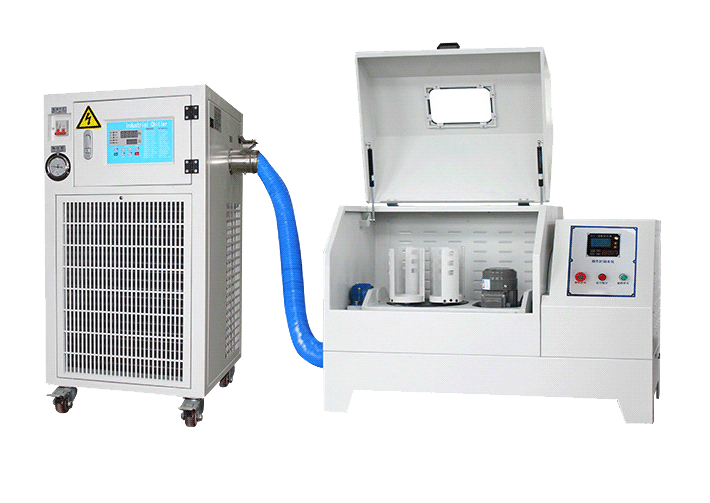
From its core, a low temperature planetary grinding machine is a specialized grinding system that combines planetary ball milling with active temperature control. It is used to reduce granular, crystalline, fibrous, or composite materials into finer powders while limiting the heat produced by impact and friction. The planetary action supplies the mechanical energy; the low-temperature environment protects materials that might soften, oxidize, degrade, agglomerate, or change phase when they become warm.
The equipment is closely related to a planetary ball mill. In a conventional planetary mill, jars rotate around a central axis while also spinning in the opposite direction. This compound motion drives grinding balls against the sample and against the jar wall. A low temperature planetary grinding machine adds a cooling strategy so that the same mechanical process can be applied to heat-sensitive powders. The product page identifies this model as a Low temperature planetary grinding machine, placing it in the planetary milling family rather than in the crusher, mixer, or sieve categories.
Why Temperature Control Matters in Fine Grinding
Grinding is not a gentle process at the particle level. Every impact between a ball and a particle, and every sliding event along the jar wall, converts mechanical energy into heat. In a small laboratory jar the total energy may seem modest, but it is concentrated in a small volume of powder, balls, and gas. Poor heat removal can therefore raise the local temperature quickly, even when the outside of the jar feels cool.
Heat can change a sample in ways that are difficult to reverse. Polymers may soften or smear. Pharmaceutical crystals may lose crystallinity. Battery materials may react with oxygen or moisture. Food and agricultural samples may lose volatile compounds. Metallic or sulfide powders may oxidize. In each case, a finer particle size is not useful if the material has also changed chemically or physically. Temperature control is therefore not an accessory; it is part of the grinding method.
A low temperature planetary grinding machine addresses this problem by removing heat during milling and, depending on the configuration, by starting the process at a reduced temperature. The objective is not simply to make the jar cold. The objective is to keep the sample within a safe thermal window for the full grinding cycle, including the periods of highest impact energy and the pauses between them.
How the Machine Works
Planetary Motion and Energy Transfer
In a planetary mill, one or more jars are mounted on a rotating carrier. The carrier turns around the central axis, while each jar also rotates around its own axis. Because the two rotations occur at different speeds and often in opposite directions, the grinding balls follow complex paths inside the jar. They are lifted, thrown, and rolled, producing a mixture of impact and shear. This is more energetic than simple tumbling in a horizontal drum, which is why planetary mills are associated with fine grinding and mechanical activation.
The grinding result depends on the balance between impact and friction. Larger or denser balls deliver stronger impacts, while smaller balls create more contact points and more surface wear. High rotation speeds increase energy but also increase heat generation. The fill level of the jar matters as well: too little powder wastes contact opportunities, while too much powder cushions the balls and reduces efficiency. A low temperature system must manage these same variables while also controlling the thermal load.
Cooling and Thermal Management
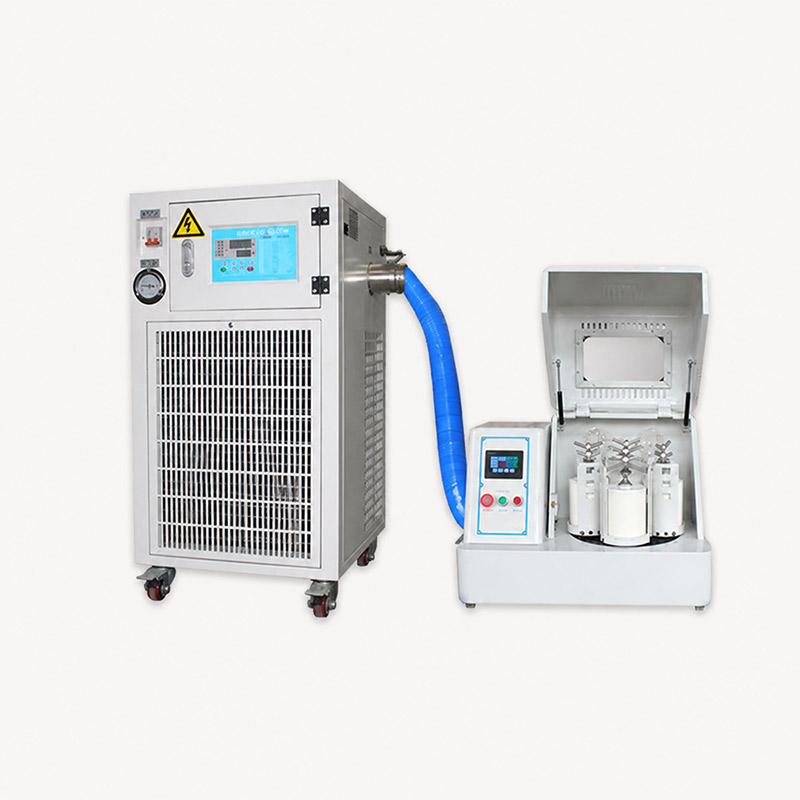
The cooling path can take several forms depending on the machine design. Heat may be removed from the jar exterior by a cooled chamber, a refrigerated air flow, a cooled contact surface, or another controlled low-temperature interface. Insulation and sensor placement determine whether the measured temperature reflects the cooling medium, the jar wall, or the sample environment. For this reason, users should ask how temperature is measured and where the sensor is located, not only what temperature range is printed on a data sheet.
Effective thermal management also involves the grinding schedule. Short grinding intervals separated by cooling pauses can prevent heat accumulation in the sample. A programmable cycle allows the operator to repeat the same pattern, which improves comparability between batches. Pre-cooling the jar, the balls, or the feed material may further reduce the starting temperature, but it must be done in a way that avoids condensation, ice formation, or thermal shock to the jar material.
From Feed Material to Ground Powder
The process begins with a representative feed sample. The sample should be dry enough, free of oversized pieces, and compatible with the jar and ball material. The operator loads the sample and grinding media into the jar, seals it, and places it on the carrier. After the cooling system reaches the chosen set point, the mill starts the programmed cycle of rotation, counter-rotation, pauses, and cooling. At the end of the run, the jar is allowed to equilibrate before opening so that condensation does not contaminate the powder.
The final powder is the result of many interacting variables: initial particle size, material hardness and toughness, jar volume, ball diameter and density, ball-to-powder ratio, rotation speed, grinding time, cooling temperature, and the number of pause intervals. No single setting guarantees a target particle size for every material. A sensible development path is to begin with a conservative cycle, inspect the powder for fineness and thermal damage, and then adjust one variable at a time. This approach is slower than copying a single recipe, but it produces a process that can be repeated and defended.
Main Configurations and Design Choices
Jar Materials and Liner Options
Planetary mill jars are available in materials such as stainless steel, agate, zirconia, corundum, tungsten carbide, nylon, PTFE, and polyurethane. Each choice balances wear resistance, impact toughness, chemical inertness, and contamination risk. A hard ceramic jar may resist abrasion but can be brittle under strong impact. A polymer jar may reduce metallic contamination but can deform or retain heat differently. For low temperature work, the jar material must also tolerate the intended cooling without cracking, shrinking excessively, or becoming difficult to seal.
Ball Media and Contamination Control
The grinding balls should be matched to the jar and to the sample. Using the same or a compatible material reduces galvanic effects and simplifies interpretation of contamination. Hard, dense media transfer more energy, while lighter or smaller media may be preferable when the sample is soft, thermally sensitive, or easily over-ground. The total mass of media, the number of balls, and the ball-to-powder ratio all influence the energy dose. Operators should record these details because a change in media can shift the particle size distribution even when the programmed speed and time remain unchanged.
Cooling Interface and Insulation
A low temperature planetary grinding machine must connect mechanical motion with a cold environment. The design challenge is to keep the jars cool without allowing condensation to reach electrical components, seals, or the sample. Good designs separate the cold zone from sensitive parts, provide drainage or drying paths, and make the jar access practical for routine loading. The user should check how the chamber is cleaned, how ice or frost is managed, and whether the cooling system can recover quickly after the jars are changed.
Controls, Safety, and Repeatability
Programmable controls are valuable because they turn a manual technique into a repeatable method. Speed profiles, pause intervals, total run time, and cooling set points should be stored and recalled. Safety features should cover over-temperature protection, motor overload, lid or door interlocks, and clear warning states. For a shared laboratory, a simple login or recipe naming system can prevent accidental changes between users. Maintenance access should also be considered: filters, seals, fans, and sensors need inspection, and the machine should be designed so that these tasks do not require dismantling the entire drive system.
Key Performance Indicators for Selection
Achievable Fineness and Particle Size Distribution
The most visible performance indicator is the fineness that can be reached in a practical time. However, a single average particle size can hide a broad distribution, agglomeration, or a fraction of unground material. Buyers should ask for evidence of repeatable particle size distributions for materials similar to their own, not only for a best-case demonstration. They should also consider whether the mill can deliver gentle grinding when needed, because a machine that only operates at maximum energy may be unsuitable for heat-sensitive or fibrous samples.
Thermal Stability and Cooling Capacity
Cooling capacity should be judged under realistic grinding loads. A system that holds a low temperature in an empty chamber may warm quickly once jars, media, and powder are added. Useful questions include how the temperature is controlled, where the sensor sits, how quickly the chamber recovers after loading, and whether the cooling system runs continuously or cycles on and off. For heat-sensitive materials, the ability to program cooling pauses and to monitor the trend over time may matter more than a single minimum temperature value.
Batch Size and Throughput
Planetary mills are often chosen for small batches, method development, and valuable materials. Throughput should therefore be assessed in terms of useful powder per cycle, not only jar volume. A large jar filled with a small sample may be inefficient, while a small jar may require many cycles to produce enough material for validation. The number of jars per run, the loading and unloading time, and the cooling recovery time all contribute to practical throughput. For scale-up work, users should confirm that the selected machine can reproduce the energy dose and thermal history of the laboratory recipe.
Material Compatibility
Compatibility covers more than chemical resistance. It includes abrasion, impact, sealing, and thermal expansion. A jar that is inert at room temperature may become brittle when cold. A seal that works in a dry room may stiffen or leak after cooling. A metal that is acceptable for one sample may introduce unacceptable iron or chromium contamination in another. Selection should therefore be based on the sample, the acceptable contamination limit, the cleaning procedure, and the intended temperature range.
Automation and Maintenance
Automation is useful when it improves control rather than adding complexity. Recipe storage, stepwise speed changes, pause programming, and temperature logging help operators compare runs and investigate problems. Maintenance should be straightforward: the chamber should be easy to dry, the jar clamps should be accessible, and the cooling system should have service points that a laboratory technician can reach. A machine that is difficult to clean will eventually produce inconsistent results, regardless of its nominal specifications.
Applications and Selection Advice
Low temperature planetary grinding is relevant wherever fine comminution must be combined with protection from heat. This includes battery and energy materials, ceramics and glass, polymers and composites, pharmaceuticals, food and agricultural samples, geological and environmental samples, and catalyst or chemical research. In many of these fields the purpose is not only size reduction. Mechanical activation, blending, alloying, or sample homogenization may also be intended, and temperature control helps preserve the desired state of the material.
For a laboratory that mainly grinds hard, stable ceramics, a standard planetary mill with appropriate jars may be sufficient. For a laboratory that handles polymers, pharmaceuticals, volatile compounds, or reactive powders, the thermal margin becomes a central selection criterion. The right choice is the system that can hold the sample within its safe temperature window while still delivering enough energy to reach the target fineness. Buyers should request trials or references for similar materials, and they should define acceptance tests in advance: particle size, crystallinity, color, moisture, contamination, and batch-to-batch variation.
Before purchasing a low temperature planetary grinding machine, prepare a short material dossier. List the feed size, target size, sample hardness, thermal sensitivity, moisture sensitivity, chemical reactivity, acceptable contamination, typical batch mass, and cleaning requirements. Then ask how the candidate machine will address each point. This turns a general equipment comparison into a focused engineering decision and reduces the risk of buying a mill that is either underpowered for the powder or unnecessarily complex for the application.
Frequently Asked Questions
Is a low temperature planetary grinding machine the same as a cryogenic mill?
They overlap but are not always identical. A cryogenic mill usually implies a very cold medium, such as liquid nitrogen or a deep-cooled gas, while a low temperature planetary grinding machine may use a controlled refrigerated environment or another cooling method. The key question is whether the system can keep the sample within its required thermal window during the actual grinding load. The label matters less than the measured thermal performance and the material compatibility of the jars and seals.
Can any planetary mill be converted into a low temperature machine?
Not safely without engineering review. Cooling changes seal behavior, condensation risk, lubricant performance, and the mechanical properties of jars and clamps. A retrofit may be possible for some systems, but it should be evaluated by the manufacturer or a qualified engineer. Users should not place a standard mill in a cold room or improvised enclosure unless the motor, electronics, and safety systems are rated for that environment.
Does low temperature grinding always produce a finer powder?
No. Cooling can reduce thermal damage and prevent agglomeration, which may improve the measured fineness or preserve the material, but it can also make some materials more brittle or change the grinding behavior. The outcome depends on the material and the energy dose. Cooling is a control variable, not a guarantee of smaller particles. It should be evaluated together with media selection, speed, time, and jar material.
What should be recorded for repeatable results?
Record the jar material and volume, ball material and size, ball mass, sample mass, ball-to-powder ratio, rotation speed, grinding and pause times, cooling set point, initial and final temperature, and the cleaning procedure. Keep a sample of the feed and the product. If a result changes, this record allows the operator to identify whether the cause was a material change, a media change, a temperature change, or a scheduling change.
Can the same recipe be used after changing jars?
Usually it should be rechecked. A different jar material changes impact behavior, heat transfer, and wear. Even jars of the same nominal volume may have different wall thickness or internal geometry. Run a small comparison and measure the particle size and temperature trend before accepting the new jar for routine work.
How should the machine be cleaned and maintained?
Follow the manufacturer instructions for the jar, chamber, and cooling system. Dry the chamber after cold operation to prevent frost or condensation from remaining on seals and sensors. Inspect jar seals for wear, check clamps for secure fit, and keep the cooling air path free of dust. For shared equipment, train users to record recipes and report abnormal noises, temperature drift, or seal damage immediately.
Product Information and Next Step
The reference product for this article is the Low temperature planetary grinding machine listed on the product page. That page is the appropriate place to confirm current configurations, jar options, cooling details, and technical support. Because low temperature grinding is material-specific, the most useful next step is to describe the sample and the target result before choosing a configuration.
In summary, a low temperature planetary grinding machine is best understood as a planetary mill with a thermal control strategy. It uses the motion of jars and balls to reduce particle size, and it uses cooling to protect the sample from the heat that this motion creates. The right system is the one that matches the material, the required fineness, the batch size, and the laboratory workflow, not simply the one with the lowest advertised temperature.
Related Products
Get In Touch
Our professional team will reply to you within one business day. Please feel free to contact us!