
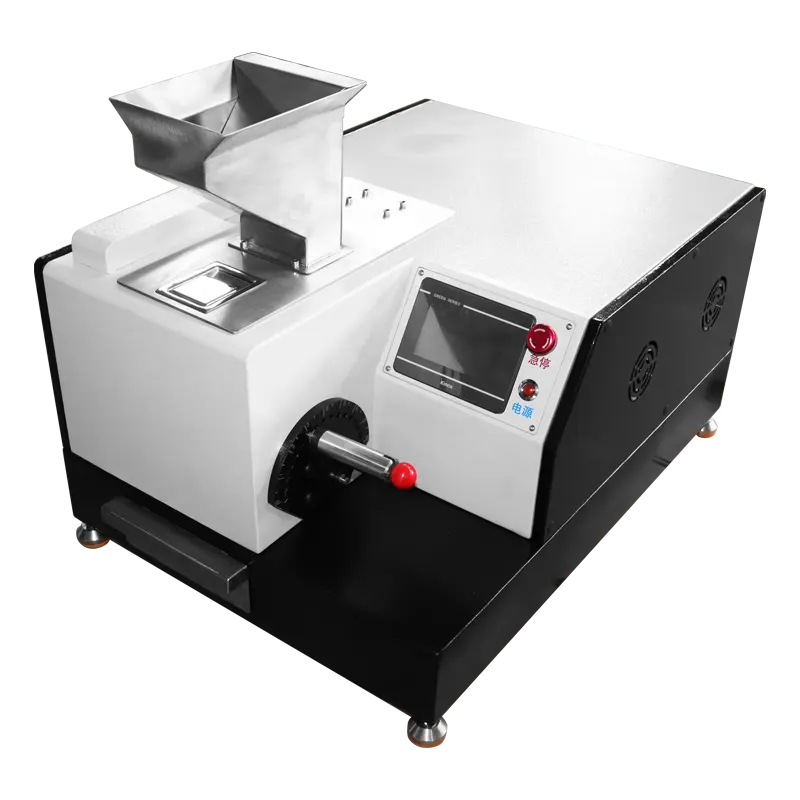
What is a Lab Jaw Crusher? A Crushing Equipment for Efficient Laboratory Sample Preparation

What is a Lab Jaw Crusher?
At its core, a lab jaw crusher is a specialized crushing equipment designed for laboratory environments to reduce solid materials such as rocks, ores, ceramics, coal, and slag into smaller, uniform particles. It is commonly used as the first step in sample preparation, providing pre-crushed material for subsequent fine grinding equipment like ball mills or planetary mills. By converting large chunks into workable fragments, this device ensures accurate and reproducible results in subsequent analytical or processing steps.
Working Principle and Core Function
The lab jaw crusher operates on the principle of compression and shear, mimicking the chewing motion of animal jaws. It consists of a fixed jaw plate and a moving jaw plate that form a wedge-shaped crushing chamber. An electric motor drives an eccentric shaft, causing the moving jaw to periodically approach and retreat from the fixed jaw. During the approach phase, materials inside the chamber are crushed by high pressure, bending, and shearing forces. When the moving jaw retreats, the crushed particles fall downward under gravity and exit through the adjustable discharge opening at the bottom.
This cyclic process allows continuous crushing with adjustable output size. The discharge gap can be precisely set by mechanical or hydraulic adjustment mechanisms, typically ranging from a few millimeters to several tens of millimeters. Key parameters affecting performance include feed size, material hardness, rotation speed, and jaw plate profile. The entire assembly is enclosed in a compact, dust-tight housing to minimize contamination and noise, making it ideal for laboratory use.
Main Types and Classification
Lab jaw crushers are primarily classified by the material of the jaw plates and the feed opening size. Common jaw plate materials include:
- High manganese steel (ZGMn13): Offers excellent wear resistance and impact toughness, suitable for crushing hard and abrasive materials like granite, basalt, and ores.
- Wear-resistant alloy steel: Provides enhanced durability for high-volume crushing of medium-hard materials such as limestone and coal.
- White cast iron: A cost-effective option for crushing softer materials like gypsum, clay, and some chemicals, but with lower wear life.
Additionally, some models offer non-metallic jaw plates (e.g., ceramic or agate) to avoid metal contamination in trace-element analysis. Based on feed size, lab jaw crushers typically handle particles from 5–90 mm, with discharge sizes adjustable down to 1–10 mm. The choice depends on the sample's hardness, required throughput, and contamination sensitivity.
Key Performance Indicators and Selection Criteria
When selecting a lab jaw crusher, users should consider the following factors:
- Throughput capacity: Typically ranges from 50–500 kg/h for lab-scale units, depending on feed size and material properties.
- Size reduction ratio: Usually between 3:1 and 10:1, determining how fine the output can be relative to the feed.
- Contamination control: For high-purity applications, choose non-metallic jaw plates or chromium-free steel to prevent sample contamination.
- Dust and noise level: Modern lab crushers feature sealed chambers and vibration damping to meet laboratory safety standards.
- Ease of cleaning and maintenance: Quick-release jaw plates, smooth surfaces, and accessible discharge chutes reduce downtime between sample batches.
- Automation and programmability: Some advanced models offer digital gap adjustment and interval control for consistent results.
Efficiency is also affected by the crusher's design: a steep crushing chamber improves nip angle, while a high swing frequency increases throughput. Users should prioritize models that balance performance with ease of use and long-term reliability.
Application Areas and Selection Advice
Lab jaw crushers are widely used in geology, mining, metallurgy, ceramics, building materials, environmental testing, and agriculture. Typical applications include crushing rock cores, ore samples, ceramic raw materials, soil, and dry shells for subsequent analysis. For example, in mineral exploration, a jaw crusher reduces drill core to a few millimeters for XRF or spectral analysis. In ceramic labs, it pre-crushes feldspar and quartz before ball milling.
For selection, consider the following: if you process hard, abrasive ores, choose a model with high-manganese steel jaws and robust construction. For trace-element analysis, opt for a non-metallic jaw option. If throughput is critical, select a larger feed opening and higher motor power. Always verify the maximum feed size and discharge adjustability against your specific sample requirements. For most general-purpose labs, a versatile mid-range unit with adjustable gap and durable jaws offers the best balance.
References
Related Products
Get In Touch
Our professional team will reply to you within one business day. Please feel free to contact us!