

What is a Lab Jaw Crusher? A high-efficiency crushing device for medium and fine crushing of laboratory samples
What is a Lab Jaw Crusher?
At its core, a lab jaw crusher is a professional crushing device designed for laboratory environments. Laboratories in industries such as mining, metallurgy, chemistry, and geology use it to break down bulk raw materials (e.g., coal, coke, limestone, iron ore, and sulfur ore) into medium and fine particles for sample preparation. The crusher adopts a curved extrusion crushing method, mimicking the motion of animal jaws to efficiently reduce material size. It is an essential tool for ensuring accurate analysis and testing in research and quality control.
Core Function and Working Principle
The basic function of a lab jaw crusher is to transform feed materials from coarse lumps (typically up to 10–60 mm depending on the model) into fine, uniform particles that can be used for subsequent laboratory processes. The working principle is based on periodic compression and shear. A motor drives an eccentric shaft via a belt and pulley, causing the moving jaw to move back and forth relative to the fixed jaw. During the closing stroke, the material in the crushing chamber is compressed, split, and bent, breaking into smaller pieces. During the opening stroke, the crushed material falls downward under gravity, and particles smaller than the discharge opening exit the chamber. This cycle repeats continuously, producing a steady stream of crushed product.
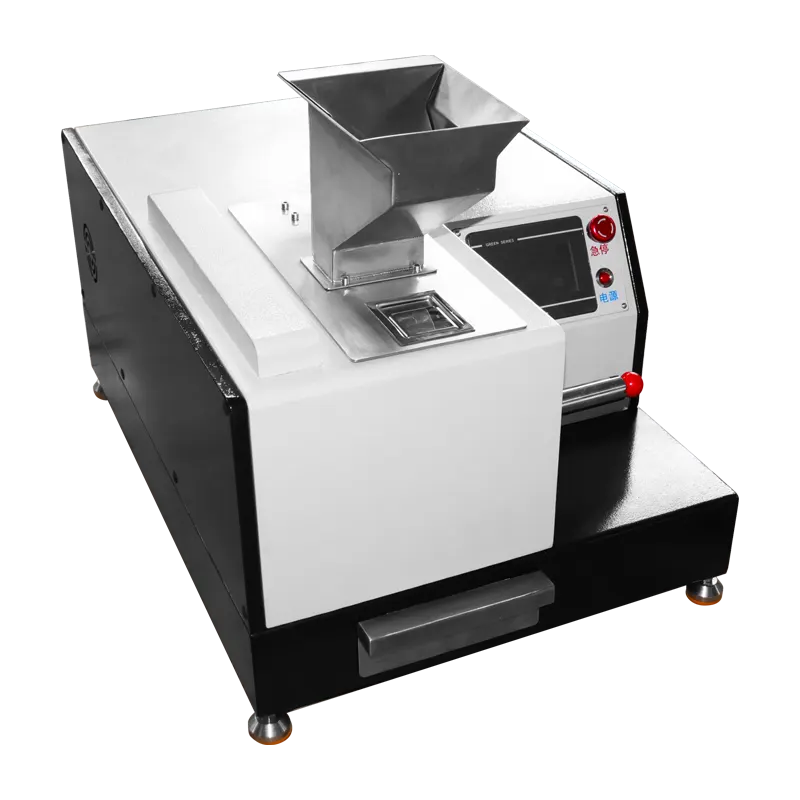
Key process parameters that affect the final particle size include the rotational speed of the eccentric shaft, the gap (discharge opening) between the jaws, and the hardness of the material being crushed. The discharge opening can be adjusted via wedge blocks or shims, allowing the operator to control the output size from a few millimeters to tens of millimeters.
Key Components and Technical Features
A lab jaw crusher consists of several critical components that work together to achieve reliable crushing performance:
- Frame (Body): A robust steel or cast iron structure that supports all other parts and absorbs crushing forces.
- Fixed Jaw and Moving Jaw: The fixed jaw is stationary, while the moving jaw is attached to an eccentric shaft. Both are lined with replaceable jaw plates (cheek plates) made of wear-resistant materials such as high manganese steel or alloy steel.
- Eccentric Shaft: The central rotating element that converts rotary motion from the motor into the reciprocating motion of the moving jaw.
- Toggle Plate (Pitman): A safety and adjustment component that transmits force and can break under overload to protect the crusher.
- Discharge Opening Adjustment Mechanism: Typically uses wedge blocks or hydraulic systems to vary the gap between the jaws.
- Dust Seal: Modern lab jaw crushers are designed with dust-tight enclosures to prevent leakage of fine particles, ensuring a clean working environment.
Different jaw plate materials are available for different hardness levels: white iron for low-abrasion materials, high manganese steel for general use, and wear-resistant alloys for tough ores. This flexibility makes the lab jaw crusher suitable for a wide range of sample types.
Key Performance Indicators and Selection Guide
When selecting a lab jaw crusher, consider the following performance indicators:
- Feed Opening Size: Determines the maximum lump size that can be accepted. Typical lab models have openings from 100×60 mm to 150×125 mm.
- Feed Particle Size: Should not exceed 60–80% of the feed opening to avoid clogging.
- Discharge Particle Size Range: Adjustable from 2 mm to 15 mm (or wider), depending on the model.
- Crushing Capacity: Ranges from a few hundred kilograms per hour to several tons per hour for larger lab units.
- Material Hardness: Most lab jaw crushers can handle materials with compressive strength up to 100–150 MPa, but some heavy-duty models can go up to 320 MPa.
- Noise and Dust Control: Look for models with low noise levels and effective dust sealing, especially for indoor laboratory use.
- Ease of Cleaning: Quick-release jaw plates and smooth surfaces simplify cleaning between different samples.
- Automation: Some models offer digital displays and programmable controls for repeatable settings.
For general lab sample preparation, a standard model with a 100×60 mm feed opening, high manganese steel jaws, and manual gap adjustment is sufficient. For heavy-duty applications or harder materials, consider a larger model with alloy steel jaws and hydraulic adjustment.
Application Areas and Selection Advice
Lab jaw crushers are widely used in:
- Power Generation: Crushing coal and coke for calorific value analysis.
- Metallurgy and Mining: Preparing ore samples for grade determination and flotation tests.
- Geology and Exploration: Crushing rock and mineral samples for petrographic analysis.
- Chemical Industry: Breaking down limestone, sulfur ore, and other raw materials.
- Building Materials: Crushing cement clinker, gypsum, and aggregates.
For users who need to crush a variety of materials with different hardness levels, a lab jaw crusher equipped with interchangeable jaw plates (e.g., high manganese steel and alloy steel) is recommended. For laboratories with high throughput requirements, opt for a model with a larger feed opening and motor power. If dust-free operation is critical, choose a sealed design with a dust collection port.
References
Related Products
Get In Touch
Our professional team will reply to you within one business day. Please feel free to contact us!