

What Is a Four Station Jar Mill? A Lab Grinding Device for Powder Processing
What Is a Four Station Jar Mill?
From its core definition, a four station jar mill is a specialized laboratory grinding device that allows multiple powder samples to be processed at the same time. Research laboratories, quality control departments, and small-scale production teams use it to reduce bulk materials into finer powders, to blend powders, and to prepare samples for testing. Instead of treating one sample at a time, this machine is built around four working stations, so users can load several jars and run them together under controlled conditions. The result is a practical balance between sample throughput, flexibility, and repeatability for laboratories that need to grind, mix, or homogenize a variety of materials.
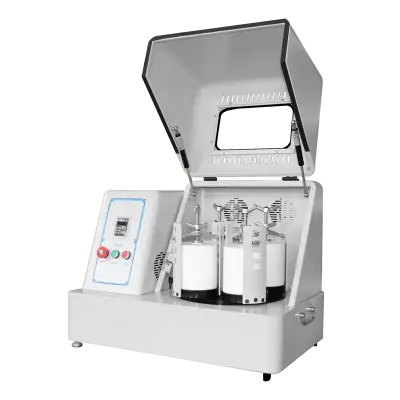
The name explains the basic idea. A jar mill uses a jar as the grinding chamber. The jar is partly filled with grinding media and the material to be processed. When the jar moves, the media tumble inside and apply impact, friction, and shear forces to the material. A four station jar mill expands this principle to four positions, so four jars can be mounted and operated in one machine. This makes it useful when a laboratory needs to compare several samples, test different formulations, or prepare multiple batches without purchasing several separate mills. For the specific product referenced here, the Four station jar mill is presented as a laboratory jar mill configuration with four working stations.
Core Functions and Working Principle
The basic function of a four station jar mill is to convert a material from a coarse or uneven state into a finer, more uniform powder. In some cases, the goal is particle size reduction; in others, the goal is mixing, homogenization, or mechanical activation. The machine relies on repeated interactions between the grinding media and the sample inside each jar. Over time, these interactions break down particles, reduce agglomerates, and distribute components more evenly.
From Material Loading to Ground Powder
The process begins with sample preparation. The user selects a suitable jar, adds the material, and then adds grinding media such as balls or cylinders. The amount of material and media, the size of the media, and the fill level all influence the final result. After the jar is sealed, it is placed on one of the four stations. The machine then moves the jars in a controlled way, causing the media to tumble, roll, and collide inside the jar. The material is trapped between moving media, pressed against the jar wall, and subjected to shear and impact. This repetitive action gradually reduces particle size and improves uniformity.
At the end of the run, the jars are removed and opened. The ground powder is separated from the grinding media, usually by sieving or by simple manual separation. Because four stations are available, the operator can run four different samples under similar conditions, or run the same sample in four jars to increase batch size. This flexibility is one of the main reasons a four station jar mill is attractive for laboratories that handle multiple projects.
Working Mechanism and Key Process Parameters
Although the four station jar mill is simple in concept, its performance depends on several process variables. These variables interact with one another. A change in one parameter can affect grinding efficiency, final particle size, contamination risk, and energy consumption.
Jar Motion and Grinding Media Action
In a jar mill, the jar itself is the grinding chamber. As the jar rotates or moves, the grinding media inside are lifted and then fall or roll back. The material is caught between the media and the jar wall. Impact forces break brittle particles, while friction and shear forces wear down softer or more ductile materials. The balance between impact and shear depends on jar motion, media shape, and media size. Larger media tend to produce more impact, while smaller media provide more surface contact and can be better for fine grinding. The four station design means that each station may hold a jar of the same size or different sizes, depending on the model and the user's needs.
Rotation Speed and Time
Operating speed and running time are two of the most important adjustable parameters. If the jar moves too slowly, the media may simply slide or roll without enough energy to break particles efficiently. If it moves too quickly, the media may be pinned against the jar wall by centrifugal force, which reduces the tumbling action and can lower grinding efficiency. The ideal speed depends on jar diameter, media size, and material properties. Running time also matters. A short run may only mix or lightly grind the sample, while a longer run can produce a finer powder. However, longer grinding also increases wear on the jar and media, raises the risk of contamination, and may cause excessive heat or particle agglomeration. Users should therefore optimize time rather than simply extending it.
Media Size, Shape, and Material
The choice of grinding media is critical. Media can be made from materials such as agate, zirconia, alumina, stainless steel, tungsten carbide, or other specialized ceramics and metals. Each material has a different density, hardness, and wear resistance. Dense media deliver more impact energy, which is useful for hard and brittle materials. Less dense media may be preferred when contamination must be minimized or when the sample is sensitive to metal contact. Media shape also matters: spherical balls roll smoothly and provide consistent wear, while cylindrical or mixed shapes can change the grinding dynamics. The media-to-powder ratio and the total fill level must be controlled so that there is enough free space for movement inside the jar.
Jar Material and Sample Compatibility
The jar material must be compatible with the sample. A hard, abrasive sample can wear down a soft jar and introduce contamination. A reactive sample may need an inert jar material. Common jar materials include stainless steel, agate, zirconia, alumina, nylon, polyurethane, PTFE, and tungsten carbide. The right choice depends on the hardness of the sample, the required purity, the risk of corrosion, and the budget. The four station format makes it possible to test several jar materials in one machine, which is useful during method development.
Core Components and Key Technologies
To evaluate a four station jar mill, it helps to understand its main components. While designs vary by manufacturer and model, most jar mills share a common set of functional parts. Each part contributes to reliability, ease of use, and the quality of the final powder.
Jar Holding Stations
The four stations are the defining feature of this machine. Each station is designed to hold a jar securely during operation. The holding mechanism must keep the jar centered and stable, because vibration or movement can reduce grinding efficiency and increase wear. A well-designed station allows the operator to load and unload jars quickly, which is important when many samples are processed each day.
Drive System and Speed Control
The drive system provides the motion that turns or rolls the jars. It usually includes a motor, transmission components, and a control interface. Speed control is important because different materials and jar sizes require different operating speeds. A basic machine may offer fixed speeds or simple step adjustment, while a more advanced model may include variable speed control, digital display, and programmable timing. For a four station jar mill, the drive must be strong enough to handle the combined load of multiple jars and media. Smooth operation reduces noise and vibration, which helps protect the sample and extends the life of the machine.
Control Panel and Timer
A control panel allows the user to set operating parameters such as speed and time. Even a simple timer improves repeatability because it ensures that each run follows the same schedule. More advanced controls may allow multiple steps, different speeds for different stages, or storage of common programs. For laboratories, repeatability is often as important as raw grinding power. If the same sample is processed under the same conditions, the results should be comparable from one run to the next. This is especially valuable in quality control, where small differences in particle size can affect later testing.
Safety Enclosure and Noise Reduction
Grinding can generate noise, dust, and vibration. A safety enclosure or cover helps contain any accidental spillage and reduces operator exposure to moving parts. Some machines also include sound insulation or vibration-damping feet. Safety features are not just about compliance; they also improve the working environment. A quieter machine is easier to operate for long periods, and a stable machine produces more consistent results. When selecting a four station jar mill, users should check whether the design includes protective covers, emergency stop functions, and secure jar locking.
The Four-Station Advantage
The most obvious advantage of a four station jar mill is parallel processing. Instead of running one jar at a time, the user can prepare four jars and process them together. This can significantly increase sample throughput in a laboratory. It also allows controlled comparisons. For example, a researcher can grind the same material for four different times, or use four different media sizes, and then compare the results. Because all four jars experience similar machine conditions, the comparison is more reliable than running four separate machines at different times.
Another advantage is flexibility. The four stations can be used for different tasks. One jar might be used for coarse grinding, another for fine grinding, and another for mixing. The user is not limited to a single process. This makes the machine useful for multi-project laboratories, teaching facilities, and contract research organizations. It also reduces the need to buy multiple single-station mills, which saves bench space and capital cost. For a product such as the four station jar mill, this multi-station design is the central value proposition.
Key Performance Indicators and Selection Points
When choosing a four station jar mill, buyers should look beyond the number of stations. The machine must match the laboratory's sample types, workload, and quality requirements. The following indicators are useful for comparing models and configuring the right setup.
Processing Capacity and Throughput
Capacity depends on the jar size and the number of stations. A four station mill can process four jars in one run, but the usable volume of each jar is limited by the media and the sample. The operator should not fill a jar completely, because the media need space to move. A practical working volume is usually a fraction of the jar's total volume. Throughput is therefore a function of jar volume, fill level, cycle time, and the number of runs per day. For laboratories with many samples, a four station machine can reduce the number of runs and shorten turnaround time.
Particle Size Control and Repeatability
The ability to reach a target particle size and reproduce it is a key performance indicator. Final particle size depends on the material, media, speed, time, and jar material. A good four station jar mill should provide stable motion and consistent speed so that all four stations behave similarly. If one station grinds differently from another, comparisons become unreliable. Users should test the machine with their own material and check the particle size distribution after repeated runs. For many applications, the goal is not only to make particles smaller but also to achieve a narrow distribution and avoid contamination.
Energy Efficiency and Heat Generation
Grinding consumes energy, and some of that energy becomes heat. Excessive heat can alter the sample, cause oxidation, or lead to agglomeration. A well-designed mill runs smoothly and avoids unnecessary friction. Energy efficiency is also related to run time: a machine that reaches the target fineness in less time uses less energy per sample. Users should consider the motor size, drive efficiency, and cooling or ventilation of the working area. If the sample is heat-sensitive, they may need to use lower speeds, shorter runs, or a cooled environment.
Automation and Programmability
Automation affects usability and repeatability. Basic models may have manual speed adjustment and a simple timer. Advanced models may offer digital control, programmable speed profiles, and memory for common recipes. For a laboratory, programmable control saves time and reduces operator error. It also makes it easier to document methods for reports and publications. When comparing four station jar mills, users should ask whether the control system can store multiple programs, whether it can run different speeds in sequence, and whether it provides clear readouts for speed and time.
Maintenance and Wear Parts
Jar mills have wear parts, especially jars, media, and moving components. Maintenance should be simple and predictable. The machine should allow easy access to jars and stations for cleaning. Belts, bearings, and rollers may need periodic inspection. The user should also consider the cost and availability of replacement jars and media. A machine that is difficult to clean may cause cross-contamination between samples. Stainless steel surfaces and smooth enclosures are easier to wipe down. For long-term reliability, choose a model with a robust frame and a drive system that is matched to the intended workload.
Material Compatibility and Contamination Control
Contamination is a major concern in powder processing. The jar and media are the main sources of contamination because they contact the sample directly. If the sample is intended for chemical analysis, even small amounts of wear can affect results. Users should select jar and media materials that are compatible with the sample and the required purity. In some cases, a softer jar may be acceptable for a short run, while in other cases a hard, wear-resistant material is necessary. A four station mill makes it easier to test different jar materials side by side, which helps optimize the process before scaling up.
Applications and Selection Advice
Four station jar mills are used in a wide range of laboratory and small-scale settings. They are common in materials science, geology, mining, ceramics, chemistry, pharmaceuticals, agriculture, and environmental testing. Typical tasks include preparing mineral samples for analysis, grinding ceramic powders, mixing battery materials, homogenizing soil samples, and reducing pharmaceutical ingredients. Because the machine can hold four jars, it is especially useful for method development, comparative studies, and quality control where multiple samples must be processed under similar conditions.
Selection should begin with the sample. Hard, brittle materials often require dense media and a robust jar, while soft or heat-sensitive materials may need gentler conditions and a different jar material. The next step is to define the required fineness and throughput. If the laboratory processes only a few samples per day, a basic four station jar mill may be sufficient. If many samples are processed daily, the user should focus on easy loading, repeatable speed control, and durable components. For applications where contamination is critical, the jar and media material should be chosen with care. Finally, consider bench space, noise, and maintenance. The product page for the Four station jar mill can provide the specific configuration details for that model.
Frequently Asked Questions
What materials can a four station jar mill process?
It can process many dry, brittle, and semi-hard materials, including minerals, ceramics, glasses, oxides, soils, and some chemicals. Soft or fibrous materials may require different preparation or may be better suited to another type of mill. The final decision depends on the sample properties and the jar and media materials selected.
How many samples can be processed at once?
The four station design allows up to four jars to be processed in one run. Each jar can hold a different sample, or the same sample can be split across multiple jars. This makes the machine useful for both parallel testing and small-batch production.
Can it be used for mixing as well as grinding?
Yes. By choosing the right media and operating conditions, a jar mill can blend and homogenize powders. Lower speeds and shorter times are often used for mixing, while higher energy and longer times are used for particle size reduction.
What affects the final particle size?
Final particle size depends on the material hardness, initial particle size, media size and density, jar material, rotation speed, grinding time, and the ratio of media to powder. Users should optimize these variables for their specific sample.
How do I maintain a four station jar mill?
Regular cleaning, inspection of jars and media, and checking of moving parts are important. Worn media should be replaced when it becomes too small or irregular. The machine should be kept dry and free of powder buildup. Following the manufacturer's maintenance schedule helps ensure consistent performance.
Conclusion
A four station jar mill is a practical laboratory tool for grinding, mixing, and homogenizing multiple powder samples in one machine. Its core value comes from combining the familiar jar milling principle with four working stations, which improves throughput and supports comparative testing. The machine works by moving jars so that grinding media tumble and interact with the sample, reducing particle size through impact, friction, and shear. Performance depends on careful selection of jar material, media, speed, time, and fill level. For laboratories that need flexibility, repeatability, and the ability to process several samples under similar conditions, a four station jar mill is a useful addition to the powder processing workflow. Buyers should match the machine to their sample types and workload, and they should review the specific product configuration before making a final decision.
Related Products
Get In Touch
Our professional team will reply to you within one business day. Please feel free to contact us!