

What is an Experimental Flotation Machine? A Device for Mineral Separation in Laboratory Research
What is an Experimental Flotation Machine?
At its core, an experimental flotation machine is a specialized laboratory device used by mining research institutes, university metallurgy departments, and mineral processing laboratories to perform froth flotation tests on small ore samples. It allows researchers to separate valuable minerals from gangue (waste rock) based on differences in surface hydrophobicity, enabling the evaluation of ore floatability, reagent optimization, and process design before scaling up to industrial production.
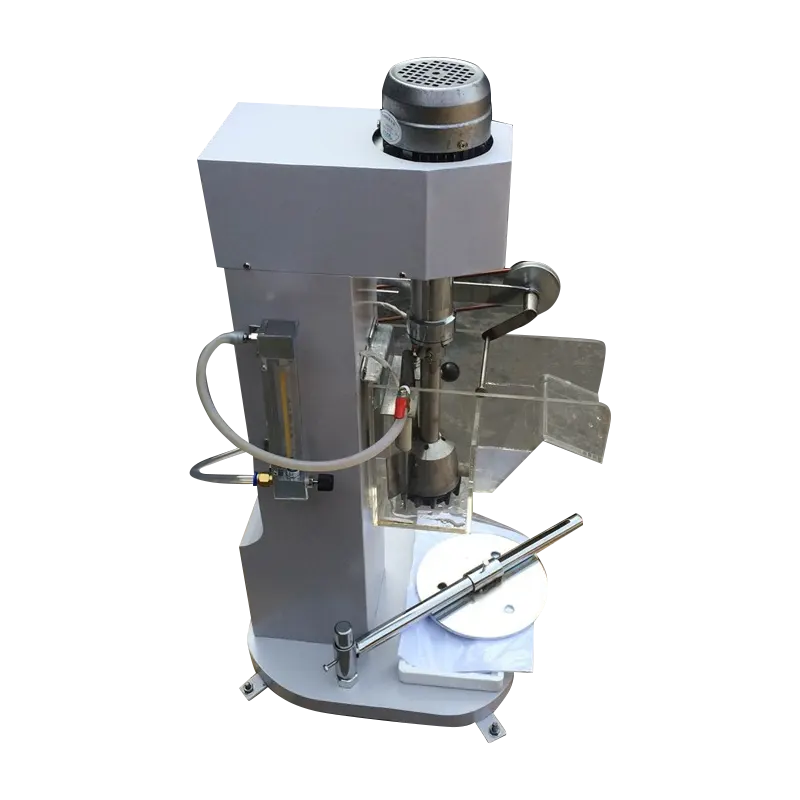
Core Function and Working Principle
The fundamental function of an experimental flotation machine is to convert a mixture of ground ore particles (pulp) into a concentrate enriched in target minerals and a tailings fraction. This is achieved through a physical-chemical process known as froth flotation. The machine consists of a tank (cell) that holds the pulp, an impeller for agitation and air dispersion, a froth collection system, and a mechanism for adjusting pulp level and froth removal.
The working principle can be summarized as follows: The impeller rotates at a controlled speed, drawing air from the atmosphere into the pulp through a central shaft. The intense turbulence breaks the air into fine bubbles, which rise through the slurry. Hydrophobic (water-repellent) mineral particles attach to the rising bubbles, forming a mineralized froth layer on the surface. A scraper or overflow mechanism then removes this froth as concentrate. Meanwhile, hydrophilic (water-loving) particles remain in the pulp and are discharged as tailings. Key operating parameters—such as impeller speed, aeration rate, pulp density, pH, and reagent dosage—can be precisely adjusted to optimize separation efficiency for different ore types.
Main Types of Experimental Flotation Machines
Experimental flotation machines are generally categorized into two main types based on the method of air introduction and the number of cells:
1. Mechanical Agitation Flotation Machines (Self-Aerating)
These are the most common type in laboratories. The impeller creates a vacuum that draws air from the atmosphere and disperses it into the pulp. The XFD series (e.g., XFD-0.5L, XFD-1L, XFD-1.5L, XFD-3L) is a typical example. They are suitable for most batch flotation tests, offering simple operation and reliable performance. The main advantage is that no external air compressor is required, making the setup compact and easy to use.
2. Forced-Aeration (Supercharged) Flotation Machines
These machines use an external air source (e.g., a compressor or blower) to inject air into the pulp through a hollow shaft or a separate sparger. This design allows fine control of bubble size and aeration rate, which is critical for certain mineral systems or when testing the effect of aeration independently. They are often preferred for research studies that require precise control of gas dispersion.
Additionally, machines can be categorized by the number of cells: single-cell (batch) machines for individual tests, and multi-cell machines (e.g., XFDM series) for continuous flotation tests simulating a full circuit. The choice between single-cell and multi-cell depends on the experimental objective: batch tests for quick screening, and continuous tests for process simulation.
Key Performance Indicators and Selection Criteria
When selecting an experimental flotation machine, researchers and procurement professionals should consider the following key performance indicators:
- Cell Volume and Versatility: Common capacities range from 0.5 L to 5 L. The suitable volume depends on the sample size. Machines with interchangeable cell kits (e.g., XFD models) allow one drive unit to work with multiple cell sizes, increasing flexibility.
- Impeller Speed Control: Variable speed control (e.g., via frequency converter) enables adjustment of impeller tip speed from 0 to 2800 rpm or more. This is critical for matching the agitation intensity to the ore characteristics.
- Aeration Rate Control: For forced-aeration machines, the ability to control airflow with a rotameter or mass flow controller is essential for reproducibility.
- Froth Removal Mechanism: Manual scrapers are common in basic models, while automated scrapers with adjustable speed and stroke improve consistency and reduce operator dependence.
- Material of Construction: The cell and impeller should be made of corrosion-resistant materials (e.g., stainless steel, polyurethane, or PVC) to withstand acidic or alkaline pulps.
- Ease of Cleaning and Maintenance: Quick-release clamps, removable cells, and smooth surfaces minimize cross-contamination between tests.
- Data Logging and Automation: Advanced models offer digital displays, programmable timers, and data logging for process parameters, enhancing reproducibility and enabling unattended operation.
Application Areas and Selection Advice
Experimental flotation machines are indispensable in the following fields:
- Mineral Processing Research: For evaluating the floatability of ores (e.g., copper, lead-zinc, gold, iron, and non-metallic minerals), reagent screening, and circuit design.
- University Education: Used in teaching labs to demonstrate flotation principles and train students.
- Metallurgy and Chemical Engineering: For studying the separation of fine materials, recycling of industrial wastes, or treatment of oily sludge.
- Exploration and Geological Surveys: To assess the economic viability of a mineral deposit.
For selection, we recommend the following:
- If you primarily perform batch tests on a wide variety of ores, choose a mechanical agitation machine with interchangeable cells (e.g., XFD series) for versatility.
- If your research requires precise control of aeration and bubble size, invest in a forced-aeration machine with an external air supply.
- For continuous process simulation, opt for multi-cell machines (e.g., XFDM) that can be configured as a flotation bank.
- Always verify that the machine's wetted parts are compatible with your pulp chemistry (e.g., acidic or alkaline).
References
Related Products
Get In Touch
Our professional team will reply to you within one business day. Please feel free to contact us!