
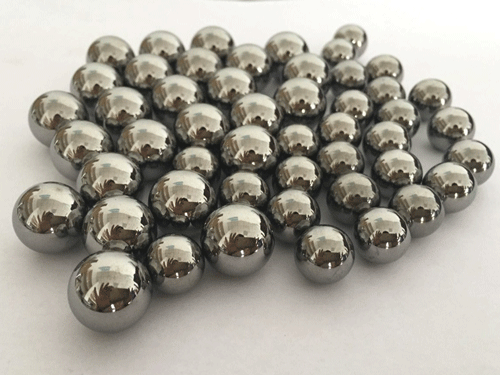
What is a Tungsten Carbide Mill Ball? A High-Density, Ultra-Hard Grinding Media for Planetary Ball Mills

Introduction
At its core, a tungsten carbide mill ball is a professional grinding media made from cemented carbide—typically tungsten carbide (WC) particles bonded with a cobalt (Co) binder—used in planetary ball mills and other high-energy ball mills for pulverizing, mixing, and fine grinding of hard, brittle, and abrasive materials. Its extreme hardness (up to 91.5 HRA) and high density (approximately 14.95 g/cm³) make it the preferred choice for applications requiring minimal contamination, rapid size reduction, and the ability to grind materials down to the nanometer scale.
Core Function and Working Principle
The primary function of tungsten carbide mill balls is to transfer kinetic energy from the mill motion to the material being ground. In a planetary ball mill, the mill balls are placed together with the sample inside a grinding jar. As the jar rotates on its own axis while simultaneously revolving around a central axis, the balls experience strong Coriolis and centrifugal forces. This causes the balls to collide with each other and with the jar walls, generating impact, friction, and shearing forces that break down the material particles.
Unlike conventional grinding media (e.g., steel or ceramic balls), tungsten carbide balls offer a unique combination of high density and extreme hardness. The high density increases the impact energy per collision, allowing faster grinding of even the hardest materials such as silicon carbide, silicon nitride, and cemented carbides. The extreme wear resistance ensures that the balls themselves suffer minimal abrasion, thereby reducing contamination of the powder sample. Key process parameters that influence grinding efficiency include ball-to-powder weight ratio (typically 10:1 to 20:1), rotation speed, grinding time, and the size of the balls (commonly available from 1 mm to 30 mm in diameter).
Key Components and Technical Characteristics
As a product, the tungsten carbide mill ball is defined by its material composition and manufacturing process. The main components are:
- Tungsten carbide (WC) grains: Provide extreme hardness (1600–1800 HV) and wear resistance.
- Cobalt (Co) binder: Adds toughness and prevents brittle fracture under high impact.
- Optional additives: Small amounts of other carbides (e.g., TaC, NbC) may be added to improve grain growth control and further enhance wear resistance.
The balls are produced by powder metallurgy: blending WC and Co powders, compacting into spherical shape, and sintering at high temperature (typically 1400–1500°C) in a controlled atmosphere. The result is a fully dense, isotropic material with a polished surface that minimizes friction and contamination. Compared to zirconia grinding balls (density ≈ 6.0 g/cm³) or 304 stainless steel grinding balls (density ≈ 7.9 g/cm³), tungsten carbide offers more than double the density, providing significantly higher impact energy.
Key Performance Indicators and Selection Criteria
When selecting tungsten carbide mill balls, users should pay attention to the following metrics:
- Density: ~14.95 g/cm³. Higher density means greater kinetic energy per ball, accelerating grinding of hard materials.
- Hardness: Typically 91–92 HRA (Rockwell A) or 1600–1800 HV (Vickers). This ensures minimal wear and long service life.
- Fracture toughness: Measured as KIC (e.g., 10–12 MPa·m^(1/2)). A balance of hardness and toughness prevents chipping or breakage under high-impact conditions.
- Surface finish: Polished balls reduce the risk of cross-contamination and improve the flow of powder between balls.
- Size range: From 1 mm (for nano-milling) up to 30 mm (for coarse grinding). The choice of size affects the final particle size distribution.
- Contamination level: Tungsten carbide balls may introduce a small amount of WC and Co into the sample. This is often acceptable for hard materials like ceramics and carbides, but for sensitive applications (e.g., semiconductor or biomedical samples), alternative media like agate balls or corundum grinding balls may be preferred.
Cost is also a factor: tungsten carbide balls are more expensive than steel or ceramic balls, but their superior durability often justifies the investment in high-throughput or high-purity applications.
Application Areas and Selection Recommendations
Tungsten carbide mill balls are primarily used in research laboratories and industrial R&D departments for:
- Ceramics and advanced materials: Grinding of alumina, zirconia, silicon nitride, boron carbide, and other hard ceramics.
- Cemented carbides and hard metals: Recycling or fine grinding of WC-Co scraps.
- Geology and mining: Pulverizing rock samples, ores, and minerals for chemical analysis.
- Energy storage materials: Preparation of battery electrode materials (e.g., lithium iron phosphate, silicon-carbon composites) where high-energy ball milling is required to achieve nano-scale mixing or alloying.
- Mechanical alloying: Synthesis of advanced alloys and intermetallic compounds through solid-state reactions.
For users who need to grind extremely hard materials (e.g., carbide powders, diamond composites) or require the highest possible grinding efficiency, tungsten carbide mill balls are the optimal choice. If the sample is softer or if contamination from cobalt is a concern, consider using zirconia grinding balls or agate balls. For a complete overview of available grinding media, visit the ball mill media collection.
References
Product page: Tungsten carbide mill ball
Related Products
Get In Touch
Our professional team will reply to you within one business day. Please feel free to contact us!