
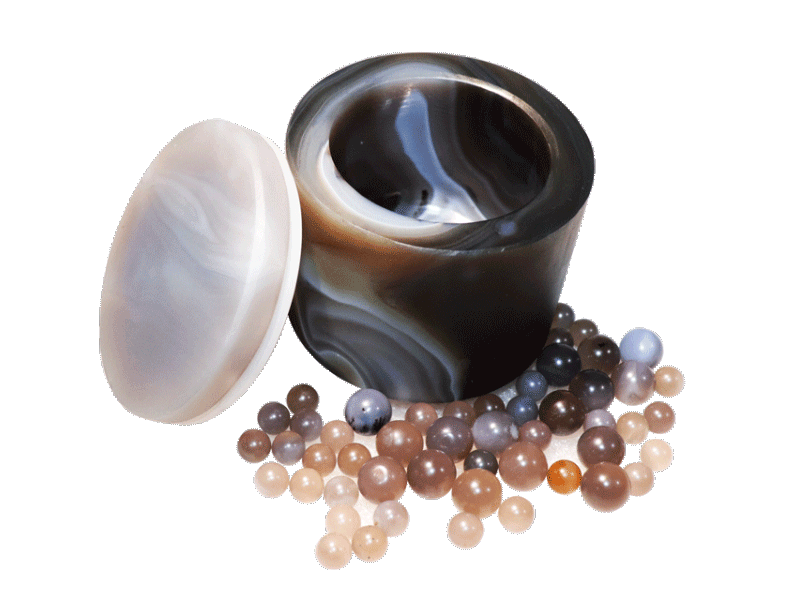
What is an Agate Planetary Mill Jar? A High-Purity Grinding Container for Contamination-Free Sample Preparation

Definition and Core Purpose
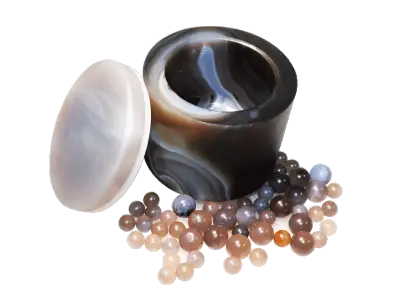
At its core, an agate planetary mill jar is a specialized grinding container crafted from natural agate, designed for use in planetary ball mills. It is primarily used by laboratories, research institutions, and quality control departments to achieve ultra-fine, contamination-free grinding of materials that require the highest purity. The unique properties of agate—its extreme hardness, chemical inertness, and natural purity—make it the ideal choice for grinding sensitive samples such as geological specimens, ceramics, pharmaceuticals, and electronic materials.
Working Principle and Function
From Bulk to Nano: The Mechanism
In a planetary ball mill, the agate jar is mounted on a rotating platform (the sun wheel) that revolves in one direction while the jar itself rotates in the opposite direction. This planetary motion generates high centrifugal forces, causing grinding balls inside the jar to collide with each other and against the jar walls. The repetitive impact and friction progressively reduce the particle size of the material from millimeters down to the sub-micron or even nanometer range.
The agate material itself plays a crucial role: its high density (2.65 g/cm³) and Mohs hardness of 7.2–7.5 ensure efficient energy transfer during grinding, while its natural composition (over 97% SiO₂) guarantees that no metallic contaminants are introduced into the sample. This makes the agate jar indispensable for applications where trace element analysis or high-purity final products are required.
Key Process Parameters
- Rotational Speed: Typically ranges from 300 to 800 rpm, depending on the mill model. Higher speeds increase impact energy, accelerating size reduction.
- Grinding Time: Varies from minutes to hours, depending on desired fineness and material hardness.
- Ball-to-Powder Ratio: Usually 10:1 to 20:1 by weight, which affects grinding efficiency and final particle size distribution.
- Grinding Mode: Dry grinding or wet grinding (with appropriate solvents) can be performed, offering flexibility for different sample types.
Core Material and Design Features
Natural Agate: The Prime Material
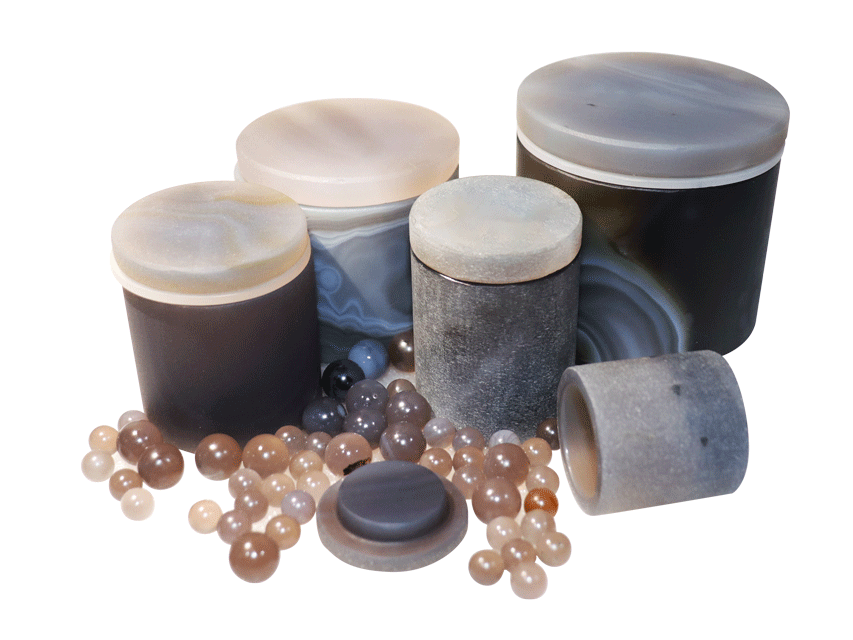
Agate is a microcrystalline variety of quartz, characterized by its fine grain, high hardness, and exceptional chemical resistance. The agate used in premium planetary mill jars is sourced from high-quality deposits, ensuring minimal impurities and consistent physical properties. Key characteristics include:
- Chemical Composition: SiO₂ > 97%, with trace amounts of MgO, CaO, and Mn₂O₃.
- Hardness: Mohs 7.2–7.5, making it one of the hardest natural materials suitable for grinding.
- Inertness: Resistant to most acids (except hydrofluoric acid) and organic solvents, preventing chemical reactions with the sample.
- Thermal Stability: Can withstand moderate temperature increases during grinding, but should not be heated or subjected to rapid temperature changes.
Design and Construction
Typical agate planetary mill jars feature a cylindrical body with a tight-fitting lid, often equipped with a sealing gasket to prevent leakage. The interior surface is polished to a smooth finish, minimizing friction and wear. Jars are available in various capacities, from 50 ml to 500 ml, to accommodate different batch sizes. The lid may include threaded ports for vacuum or atmosphere control, enabling grinding under protective gas conditions.
Key Performance Indicators and Selection Guide
Performance Metrics to Consider
- Capacity and Scalability: Choose a jar size that matches your typical sample volume. For most applications, 100 ml to 250 ml jars are common. Larger jars up to 500 ml are available for pilot-scale work.
- Grinding Fineness: Agate jars can consistently achieve particle sizes down to 0.1 µm (100 nm) or even smaller, depending on mill settings and material properties.
- Wear Resistance: Agate has excellent abrasion resistance, ensuring long service life even with hard materials like quartz or corundum. However, avoid grinding materials harder than agate (e.g., diamond, sintered alumina) to prevent excessive wear.
- Chemical Compatibility: Agate is inert to most chemicals, making it safe for pharmaceutical, food, and environmental samples. Avoid contact with hydrofluoric acid or strong alkalis.
Selection Tips
- For ultra-high purity requirements: Agate jars are the best choice. They introduce virtually no contamination, unlike metal or plastic jars.
- For very hard materials (e.g., corundum, silicon carbide): Consider using a zirconia or tungsten carbide jar instead, as they offer higher hardness.
- For vacuum or atmosphere grinding: Ensure the agate jar is fitted with a vacuum-compatible lid and seals. Standard agate jars may not be vacuum-tight unless specified.
- For wet grinding: Agate is non-porous and easy to clean, but prolonged exposure to acidic or alkaline slurries should be avoided.
Applications and Recommendations
Where Agate Planetary Mill Jars Excel
- Geology and Mining: Grinding rocks, minerals, ores, and soil samples for XRF, XRD, and ICP analysis without introducing contamination.
- Ceramics and Glass: Processing ceramic powders, glazes, and glass frits for research and quality control.
- Pharmaceuticals and Life Sciences: Milling active pharmaceutical ingredients (APIs), herbal extracts, and biological samples.
- Chemicals and Materials: Preparing catalysts, pigments, electronic materials, and advanced composites.
- Food and Environmental: Grinding food products, plant materials, and environmental samples for analysis.
Recommendations for Different Users
- Academic Labs: Start with a 100 ml agate jar for general-purpose research. It offers a good balance of capacity and purity.
- Industrial QC: Choose a 250 ml or 500 ml agate jar for routine sample preparation, especially when multiple samples are processed daily.
- High-Throughput Facilities: Consider using multiple jars of the same size to run parallel experiments, ensuring consistent results.
References
Related Products
Get In Touch
Our professional team will reply to you within one business day. Please feel free to contact us!