
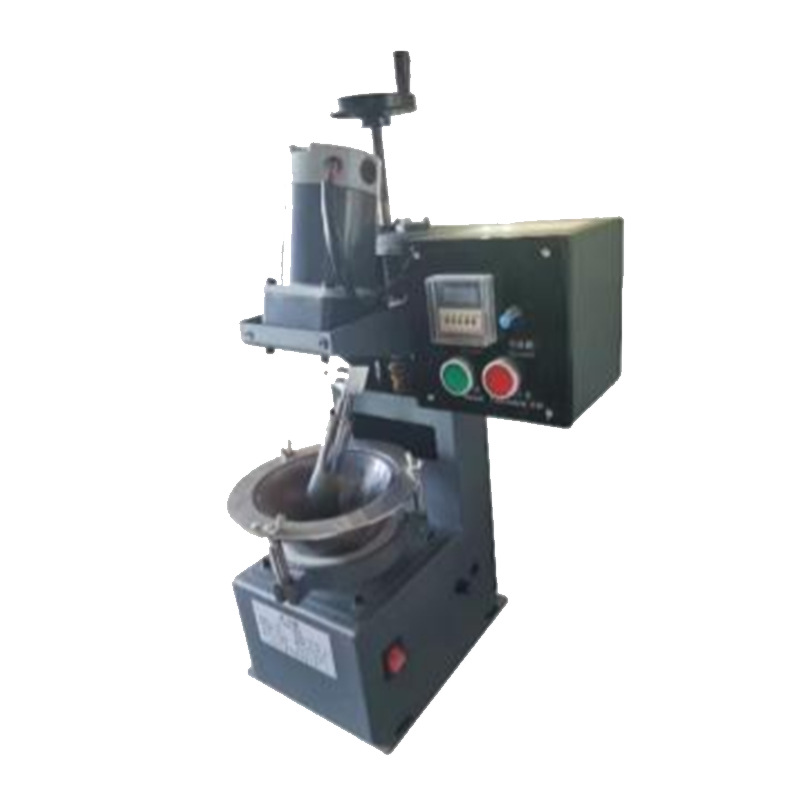
What is an Agate Grinder? A Precision Grinding Equipment for Lab Sample Preparation to Achieve Ultra-Fine, Uniform Powders

Introduction
At its core, an agate grinder is a specialized laboratory grinding instrument designed to transform coarse solid particles into extremely fine, uniform powders. It is widely used in materials science, geology, chemistry, pharmaceuticals, and other fields where sample purity and particle size consistency are critical. By employing a precisely machined agate mortar and pestle, this device achieves a gentle yet effective rolling and pressing action that minimizes contamination and delivers reproducible results.
Core Function and Working Principle
The primary function of an agate grinder is to reduce particles from a coarse state to a fine powder through a unique combination of rotational and compressive forces. The grinding chamber consists of an agate mortar (a hemispherical bowl) and an agate pestle (a rod with a hemispherical tip). The mortar is driven by a slow-speed motor to rotate at a controlled rate (typically around 10 rpm), while the pestle rotates at a higher speed (around 80 rpm) along an inclined axis. The pestle is spring-loaded to maintain constant contact with the mortar's inner surface. As the two components move in coordinated but different motions, the material trapped between them is subjected to a rolling and pressing action that uniformly grinds every particle.
This mechanism ensures that all particles receive equal grinding opportunities, leading to extremely narrow particle size distributions. The grinding time can be set automatically via a digital timer, allowing users to achieve the desired fineness—from micron to even nanometer scale—by adjusting the duration. The process is dry (no liquid added), which is ideal for analyzing samples that must remain chemically unchanged.
Key Components and Technology
An agate grinder typically consists of the following main parts:
- Agate Mortar and Pestle: Made from natural agate (hardness ~7 Mohs), these components are chemically inert, extremely wear-resistant, and have a very smooth surface. The mortar's inner surface is a perfect hemisphere, and the pestle tip is also a hemisphere, ensuring consistent contact geometry.
- Drive System: Two independent motors—one for the mortar (slow rotation) and one for the pestle (fast rotation). The pestle motor is mounted on a movable arm that allows the pestle to be lifted and lowered.
- Spring Mechanism: A compression spring inside the pestle assembly maintains constant pressure between the pestle tip and the mortar bottom, compensating for wear and ensuring uniform grinding force.
- Control Box: Digital timer and speed control (on some models) allow users to set grinding duration and monitor operation.
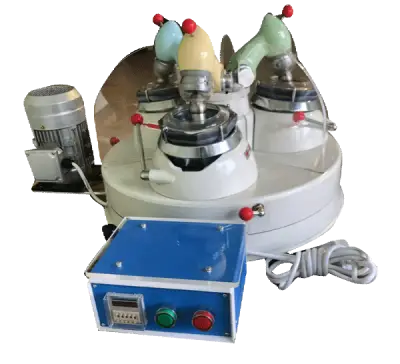
Some models, such as the agate grinder with three working stations, feature multiple mortars to process several samples simultaneously, increasing throughput for laboratories that need to handle multiple materials in parallel.
Key Performance Indicators and Selection Criteria
When selecting an agate grinder for your laboratory, consider the following factors:
- Mortar Diameter and Capacity: Common sizes range from 80 mm to 150 mm in diameter. The JB-120 model, for example, has a 120 mm mortar diameter and a depth of 34 mm, suitable for sample volumes of a few grams to tens of grams. Choose a size that matches your typical sample quantity.
- Grinding Fineness: The achievable particle size depends on grinding time and material hardness. With optimal settings, agate grinders can produce powders with D50 below 1 micron. The uniformity of the grinding action ensures that the final product has a very narrow size distribution.
- Automation: Digital timers allow repeatable processes. Some advanced models offer programmable speed settings for both mortar and pestle, enabling fine-tuning for different materials.
- Material of Construction: Agate is the standard because of its hardness and chemical inertness. However, for some applications, other materials like zirconia or tungsten carbide might be used. For most high-purity requirements, agate is the best choice.
- Noise Level: Quality agate grinders are designed to operate quietly; the JB-120 is described as low-noise, which is important for laboratory environments.
- Maintenance: Agate components are durable but brittle. They should be cleaned with water and a soft brush after each use. Avoid thermal shock or mechanical impact.
Applications and Selection Advice
Agate grinders are essential in fields where sample purity is paramount. Typical applications include:
- Superhard Materials: Grinding diamond abrasive powders, silicon carbide, etc.
- Electronic Materials: Semiconductor powders, polysilicon, ceramic precursors.
- Pharmaceuticals: Fine grinding of active ingredients and excipients.
- Food and Chemistry: Coffee powder, pigments, iodine, resin powders.
- Geology and Mining: Preparation of rock and mineral samples for XRF, XRD, or other analytical techniques.
For laboratories that process only a few samples per day, a single-station agate grinder (like the JB-120) is sufficient. For higher throughput, consider a three-station version. Always match the mortar size to your sample volume—larger mortars are more efficient for bulk samples, but smaller ones offer better control for trace amounts. If you are working with materials that are extremely hard or abrasive, agate may experience wear; in such cases, periodic inspection of the mortar and pestle surfaces is recommended.
For more information, visit the Agate Grinder product page.
Related Products
Get In Touch
Our professional team will reply to you within one business day. Please feel free to contact us!