

What Is a Vertical Production Planetary Ball Mill? A Fine Powder Grinding System
Definition: What It Is and What It Does
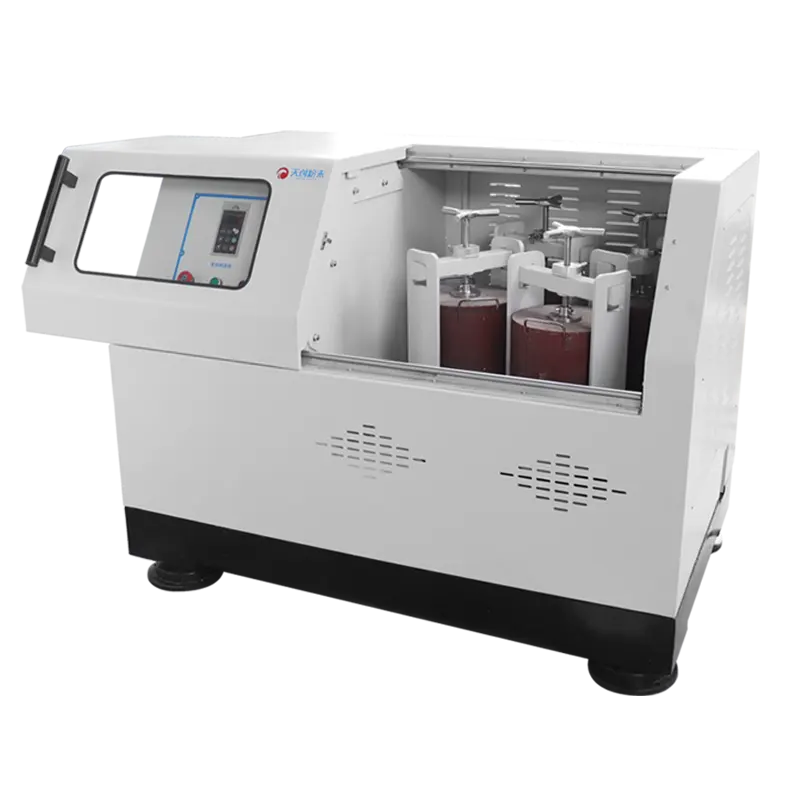
From its core, a vertical production planetary ball mill is a professional grinding system used to reduce solid materials from coarse feed to fine or ultrafine powder. In this design, the grinding jars are arranged vertically, and the machine uses planetary motion to transfer energy into the powder bed. It is intended for users who need repeatable fine grinding, mixing, and homogenization at a larger working scale than a typical laboratory unit, while keeping the process contained and controllable.
Core Function and Working Principle
From feed material to fine powder
The mill receives material inside sealed grinding jars together with grinding balls. When the machine runs, the jars rotate around their own axes and around a common central axis. The resulting centrifugal and gravitational forces move the balls inside each jar. The balls collide with the feed particles and rub against them, so larger particles are progressively broken into smaller ones. The output is a fine powder, a homogeneous mixture, or a mechanically activated material, depending on the feed and the chosen process conditions.
Planetary motion and energy transfer
Planetary motion is the key mechanism. Because each jar both spins and revolves, the grinding media follow complex paths rather than simply tumbling. High-energy impacts provide fracture, while rolling and sliding contact provide attrition. This combination is useful for hard, brittle, and fibrous materials when the jar and ball materials are matched to the application. The vertical production layout allows multiple jars to operate in parallel, which helps connect laboratory results with larger batch preparation.
Process parameters that shape the result
Final particle size and batch consistency depend on several variables: rotation speed, running time, ball size and ball-to-powder ratio, jar fill level, and the material of the jar and balls. A higher energy input generally accelerates size reduction, but it can also raise temperature and increase wear. A longer run can improve uniformity, but it may broaden the particle size distribution or cause agglomeration. For this reason, the process should be developed with controlled trials and recorded parameters rather than by speed alone.
Main Configurations and Key Components
Vertical production layout
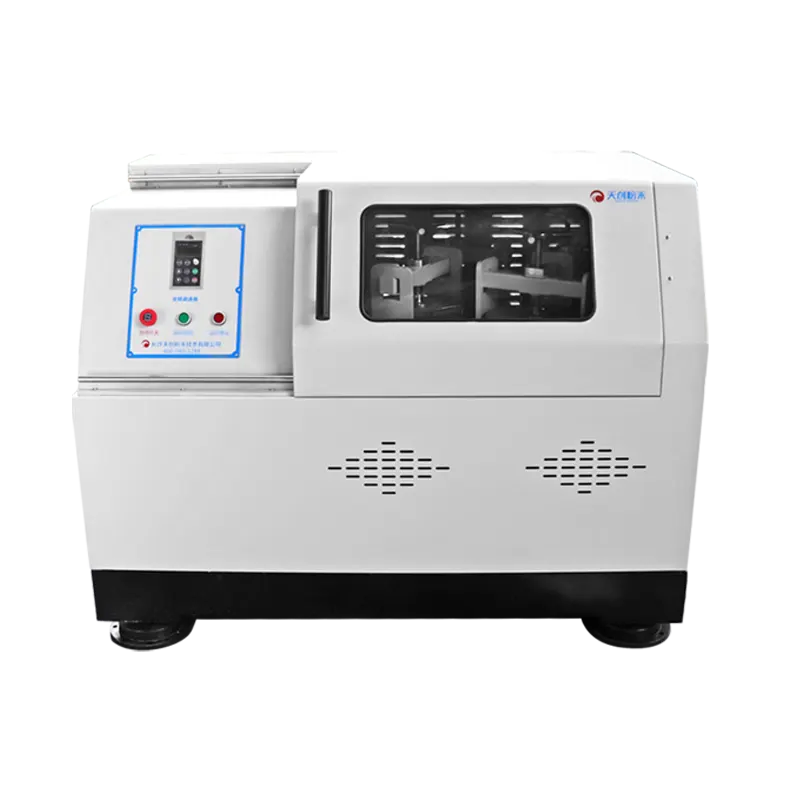
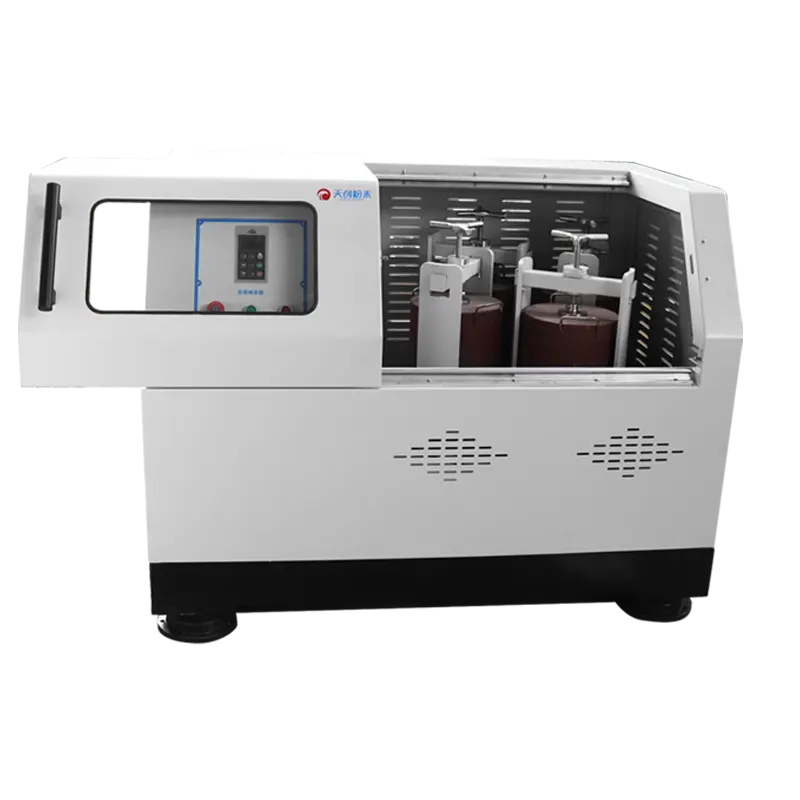
The vertical arrangement is the defining feature of the production planetary ball mill. It supports a compact footprint and a structured loading and unloading workflow. The main assembly includes the drive system, jar holders, transmission components, safety enclosure, and control panel. Production-oriented users should check how jars are clamped, how batch records are kept, and how easily the working area can be cleaned between materials.
Jars, balls, and material compatibility
The grinding jar and ball material must be compatible with the feed. Harder media reduce contamination but may change the impact energy; softer or reactive materials may introduce wear or chemical effects. Users should consider hardness, density, chemical inertness, and the risk of cross-contamination. Sealed jars also help control dust and protect moisture-sensitive or oxygen-sensitive powders.
Control, discharge, and maintenance
Modern production mills benefit from programmable speed and time settings, repeatable recipes, and clear safety interlocks. Maintenance attention should focus on seals, jar fixtures, drive components, and wear parts. Because fine powders can migrate, good access for cleaning and inspection is as important as the nominal grinding capacity.
Key Performance Indicators and Selection Points
Selection should be based on the process, not only on the largest available number. The following indicators help compare options:
- Throughput and batch size: match the working volume and jar count to realistic daily output, including loading and cleaning time.
- Particle size control: confirm that the mill, media, and jar set can reach the target fineness without excessive contamination.
- Energy and efficiency: consider grinding time, power demand, cooling needs, and media wear together.
- Automation and repeatability: look for recipe storage, parameter logging, and safety controls that reduce operator variation.
- Maintenance and uptime: check spare-part availability, seal life, cleaning access, and service requirements.
Applications and Selection Advice
This type of mill is commonly evaluated for fine grinding, mixing, homogenization, and mechanical activation of rigid or brittle materials. It suits laboratories and production teams that need a contained process and flexible batch scheduling. For small research programs, a laboratory planetary mill may be sufficient; for larger or repeated batches, a vertical production planetary ball mill offers a more practical platform. The final choice should be confirmed with material trials, because feed hardness, target fineness, contamination limits, and cleaning requirements vary widely.
Common Questions Before Purchase
Is it the same as a laboratory planetary mill? The principle is similar, but a production model is selected for larger working volumes, repeatable operation, and production workflow. Can one mill handle different materials? Yes, provided the jars, balls, and cleaning procedure are changed appropriately to prevent cross-contamination. What information is needed for a quotation? Feed material, target particle size, batch size, allowable contamination, and any temperature or atmosphere limits are the key starting points.
For current configuration details, visit the product page.
Related Products
Get In Touch
Our professional team will reply to you within one business day. Please feel free to contact us!