
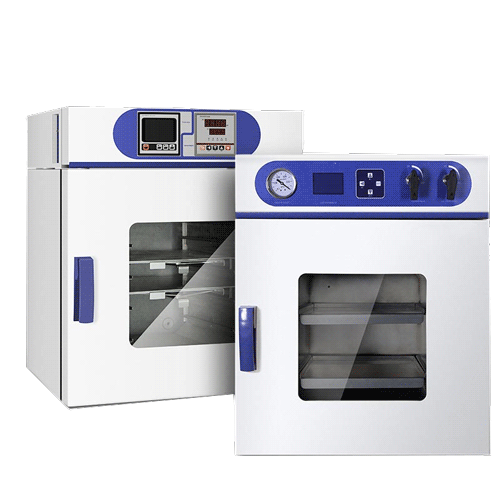
What is a Vacuum Drying Oven? A Professional Device for Drying Heat-Sensitive Materials Under Low Pressure

Introduction
At its core, a vacuum drying oven is a professional thermal processing device used by laboratories, pharmaceutical companies, chemical plants, and research institutions to remove moisture or solvents from materials under a controlled low-pressure environment. It is particularly designed for drying heat-sensitive, easily decomposed, easily oxidized, or toxic substances that would be damaged or altered by conventional drying methods at atmospheric pressure.
Core Function and Working Principle
The fundamental function of a vacuum drying oven is to transform wet or solvent-laden materials into a dry, stable state by applying heat under vacuum conditions. The working principle relies on two key physical phenomena: first, under reduced pressure, the boiling point of water or organic solvents is significantly lowered (e.g., water boils at 46°C at 0.098 MPa vacuum), which enables evaporation at much lower temperatures; second, the vacuum environment removes oxygen, preventing oxidation, combustion, or degradation of the material.
Inside the oven, a vacuum pump continuously extracts air and vapor from the sealed chamber, creating a stable negative pressure. Heating elements (typically electric resistance heaters wrapped around the chamber or embedded in shelves) provide controlled thermal energy. The material is placed on stainless steel trays that conduct heat evenly. The combination of low pressure and gentle heat allows moisture to evaporate rapidly without overheating the sample. Key process parameters include temperature (typically RT+10°C to 250°C), vacuum degree (usually ≤133 Pa or 0.098 MPa), and drying time, all of which are precisely regulated by a microcomputer PID controller to ensure repeatability and uniform results.
Main Types and Classifications
Vacuum drying ovens are available in several configurations to suit different application scales and requirements. The most common laboratory series is the DZF type, which includes models like DZF-6020, DZF-6030, DZF-6050, DZF-6090, and DZF-6210. These models differ in chamber volume (from 24L to 210L), heating power, and included accessories such as vacuum pumps.
Desktop vs. Floor-Standing Models
Smaller units (e.g., DZF-6020, DZF-6050) are compact desktop designs suitable for limited bench space, while larger units (e.g., DZF-6090, DZF-6210) are floor-standing with higher capacity and often include a built-in vacuum pump. The choice depends on sample volume and available workspace.
Standard vs. Explosion-Proof Configuration
For applications involving flammable solvents, explosion-proof vacuum ovens are available with special electrical components and sealed construction to prevent ignition. Standard models are sufficient for aqueous drying or non-flammable materials.
Related Vacuum Drying Technologies
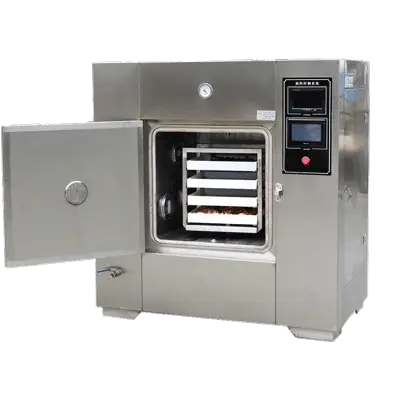
Beyond the classic resistive-heating vacuum oven, specialized variants exist: microwave vacuum drying ovens combine microwave energy with vacuum for rapid internal heating, and vacuum freeze-drying ovens (lyophilizers) freeze the material first then sublime ice under vacuum, ideal for biological samples.
Key Performance Indicators and Selection Criteria
When selecting a vacuum drying oven, users should consider the following critical specifications:
- Temperature Control Range and Accuracy: Typical range is RT+10°C to 250°C (or 200°C for some models), with a resolution of 0.1°C and fluctuation of ±1°C. High-precision models offer better stability for sensitive materials.
- Vacuum Performance: Maximum vacuum degree is usually ≤133 Pa (absolute pressure). A lower ultimate vacuum allows faster drying at lower temperatures. Some models offer 0.098 MPa (≈ 98% vacuum).
- Chamber Volume and Shelf Configuration: Available sizes range from 20L to 210L. The number of shelves (1 to 3) and their area determine how many samples can be processed simultaneously.
- Heating Power and Uniformity: Power consumption varies from 350W to 2000W. Uniform heating is ensured by multi-sided heating elements and quality insulation (mineral wool >100 mm thick).
- Control and Automation: Modern units feature microcomputer PID controllers with dual digital displays (set and actual temperature), self-tuning, and optional programmable timers/ramps. Some models include RS485 communication for data logging.
- Construction and Cleanability: Stainless steel (1Cr18Ni9Ti) chambers resist corrosion and are easy to clean. Silicon rubber door seals maintain vacuum integrity. Tempered glass observation windows allow safe viewing.
Application Areas and Selection Advice
Vacuum drying ovens are indispensable in pharmaceuticals (drying of active ingredients, sterilization), chemical engineering (drying of catalysts, pigments, explosive materials), biotechnology (dehydration of enzymes, biological samples), electronics (baking of moisture-sensitive components), and materials science (preparation of powders, ceramics, and composites). For most routine laboratory work, a standard DZF model with a 40-70L chamber and 200°C max temperature is sufficient. For high-value heat-sensitive materials, opt for a model with fine temperature control (±0.1°C) and a higher vacuum rating. If the material contains flammable solvents, choose an explosion-proof configuration. For large-scale production, consider a floor-standing model with a built-in vacuum pump and programmable cycles.
References
Related Products
Get In Touch
Our professional team will reply to you within one business day. Please feel free to contact us!