

What is Tungsten Carbide Mill Ball? An Ultra-Hard Grinding Media for High-Efficiency Fine Milling
What is Tungsten Carbide Mill Ball? An Ultra-Hard Grinding Media for High-Efficiency Fine Milling
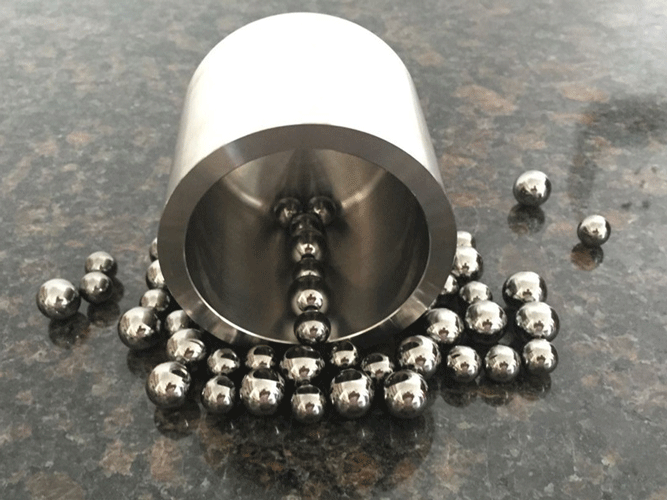
At its core, a tungsten carbide mill ball is a specialized grinding media made from cemented tungsten carbide, used in ball mills—especially planetary ball mills—to pulverize, mix, and grind hard and brittle materials down to micron or even nanometer sizes. Unlike conventional steel or ceramic balls, tungsten carbide balls offer extreme hardness (HRA 88-92) and high density (14.5-15.0 g/cm³), making them the preferred choice for milling high-hardness substances such as cemented carbide, silicon nitride, zirconia, and other advanced ceramics. They are indispensable in laboratories and industries where contamination-free, high-efficiency grinding is required.
Core Function and Working Principle
Tungsten carbide mill balls serve as the primary grinding medium in ball mills. When the mill rotates, the balls are lifted and then cascade or cataract, creating impact and shear forces that break down the feed material. The extreme density of tungsten carbide (nearly twice that of steel) generates higher kinetic energy per ball, allowing for faster and finer grinding. The working principle relies on the synergistic effect of impact, compression, and attrition between the balls, the mill jar wall, and the material.
Key parameters influencing grinding efficiency include ball size, ball-to-powder weight ratio, rotational speed, and milling time. For planetary ball mills, the centrifugal acceleration can reach 20–40 g, enabling the tungsten carbide balls to deliver intense impact energy. This makes it possible to reduce hard materials from coarse particles (e.g., 5 mm) to sub-micron or nano-scale within a few hours, while maintaining low contamination due to the balls' high wear resistance.
Key Material Properties and Manufacturing Process
Tungsten carbide mill balls are not a single product but a category defined by material composition and manufacturing method. The primary material is cemented carbide, typically composed of tungsten carbide (WC) powder bonded with a metallic binder such as cobalt (Co) or nickel (Ni). The binder content affects hardness and toughness: lower binder (e.g., 6% Co) gives higher hardness but more brittleness; higher binder (e.g., 10% Co) improves toughness but reduces hardness slightly.
Manufacturing involves powder metallurgy: mixing WC and binder, pressing into spherical shapes, sintering at high temperatures (1400–1600°C), and then precision grinding to achieve tight tolerances (e.g., ±0.1 mm diameter). The final product features a smooth, dense surface with minimal porosity, ensuring long service life and consistent performance.
Key Performance Indicators and Selection Guide
When selecting tungsten carbide mill balls, consider the following metrics:
- Hardness: Typically HRA 88–92, suitable for grinding materials with Mohs hardness up to 9.5.
- Density: 14.5–15.0 g/cm³, providing high impact energy per ball.
- Wear Resistance: Extremely low wear rate (0.01–0.1 mg per hour under standard conditions), reducing contamination.
- Size Range: Available from 0.5 mm to 30 mm diameter; choose ball size based on feed particle size and target fineness. General rule: ball diameter should be 10–20 times the feed size.
- Surface Finish: Polished or ground surface to minimize friction and improve milling efficiency.
- Compatibility: Must match the mill jar material (e.g., tungsten carbide jar, stainless steel jar) to avoid cross-contamination.
For ultra-fine grinding of hard materials, smaller balls (0.5–3 mm) are used with high ball-to-powder ratios (e.g., 10:1). For coarse grinding, larger balls (10–20 mm) are preferred. Automation-ready mills with programmable control can store multiple recipes, ensuring repeatable results.
Application Fields and Selection Advice
Tungsten carbide mill balls are widely used in:
- Advanced Ceramics: Grinding of alumina, zirconia, silicon nitride, and boron carbide.
- Cemented Carbide and Hard Metals: Recycling and fine milling of tungsten carbide powder.
- Battery Materials: Nano-grinding of cathode and anode materials for lithium-ion batteries.
- Powder Metallurgy: Alloying and homogenization of metal powders.
- Geological and Mining: Sample preparation for hard rock and ore analysis.
- Pharmaceutical and Food: Where contamination-free milling is critical (e.g., using tungsten carbide with low binder leachability).
For labs requiring nano-scale results, combine tungsten carbide balls with a planetary ball mill and a matching tungsten carbide jar. For high-volume production, consider drum ball mills with larger ball charges. Always verify the binder composition to ensure chemical compatibility with your material (e.g., avoid cobalt binder for acidic slurries).
References
Related Products
Get In Touch
Our professional team will reply to you within one business day. Please feel free to contact us!