

What Is a Trough Mixer? A Powder Blending Machine for Uniform Dry Batch Mixing
What Is a Trough Mixer?
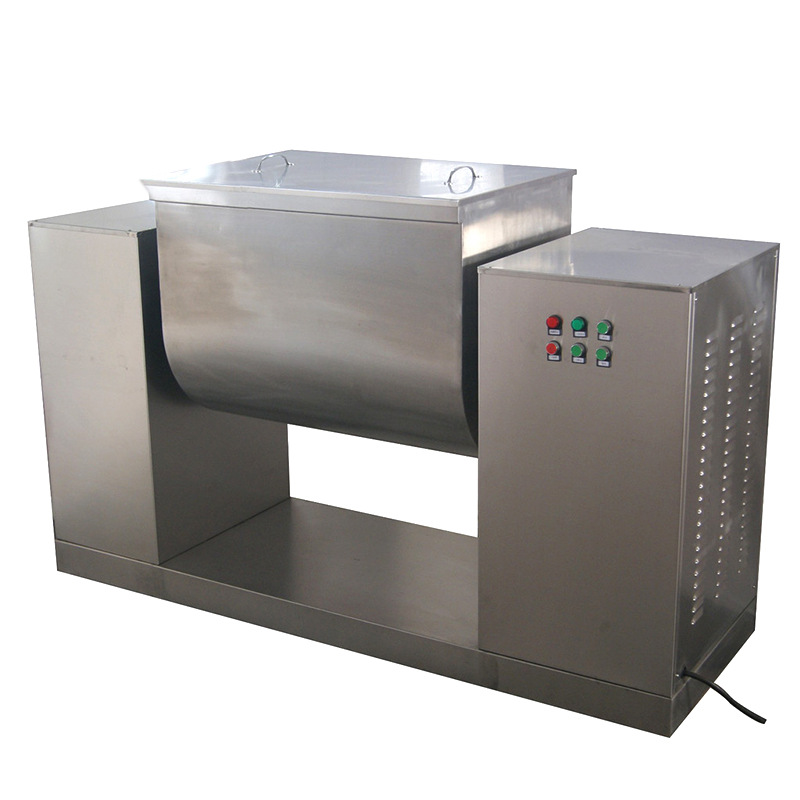
At its core, a trough mixer is a professional bulk-solids blending machine that powder-processing industries use to homogenize dry powders, granules and paste-like compounds inside a horizontal, U-shaped vessel. The trough is the stationary container that holds the batch, while one or more rotating agitator shafts running along its length do the real work: they sweep through the material, lift it from the bottom of the trough, fold it back into the bed, and shear it against the trough wall and against neighbouring particles. The result is a blend in which any scoop of material carries roughly the same proportion of every ingredient as any other scoop.
This is what separates a trough mixer from low-intensity tumble blenders such as V-blenders, double-cone mixers and plain rotating drums. Tumble blenders depend on gravity: the vessel itself turns, and the powder cascades inside it. That approach is gentle and easy to clean, but it becomes slow and unreliable when ingredients differ widely in particle size, particle shape or bulk density, because segregation and dusting can compete with the mixing action. A trough mixer injects mechanical energy directly into the powder bed, so it can break up soft agglomerates, wet a powder with a sprayed liquid, and reach a uniform blend in a fraction of the time.
In a typical powder-handling line, the trough mixer sits between weighing and dosing on one side and shaping or packaging on the other. Material is charged, blended, and then discharged into a granulator, tablet press, extruder, sintering furnace or filling station. Because the machine works in batches, each batch can be traced, sampled and released individually — an important property in pharmaceutical, food, battery and fine-chemical production.
Core Functions and Working Principle
A trough mixer has one primary job: to convert a set of separately weighed ingredients into a single, uniform batch. Every detail of its design — the shape of the trough, the geometry of the agitator, the speed of the shaft, the position and size of the discharge opening — exists to make that conversion fast, repeatable and complete.
The Trough, the Shaft and the Agitator
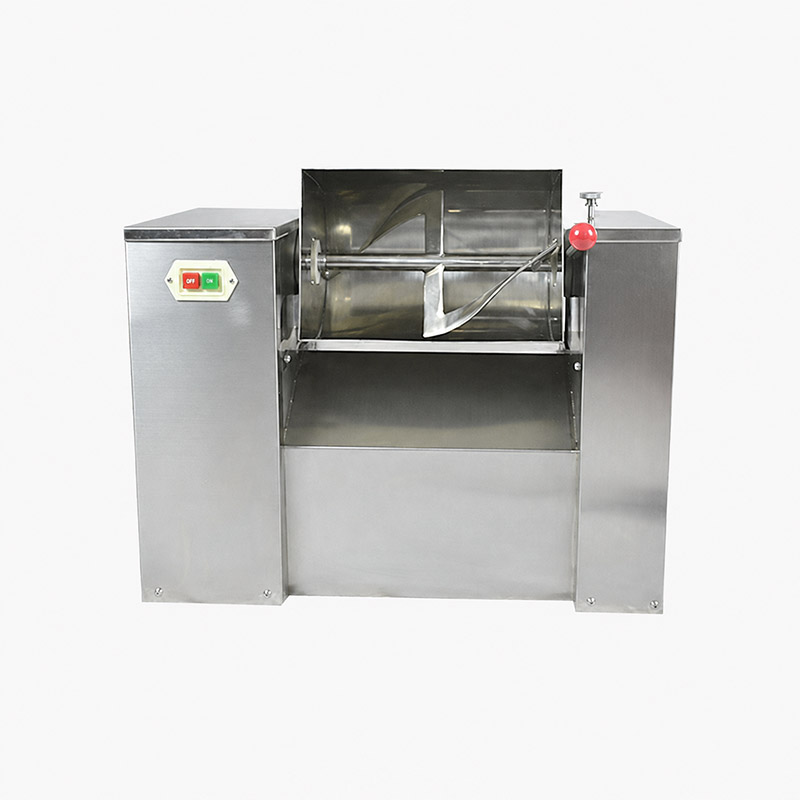
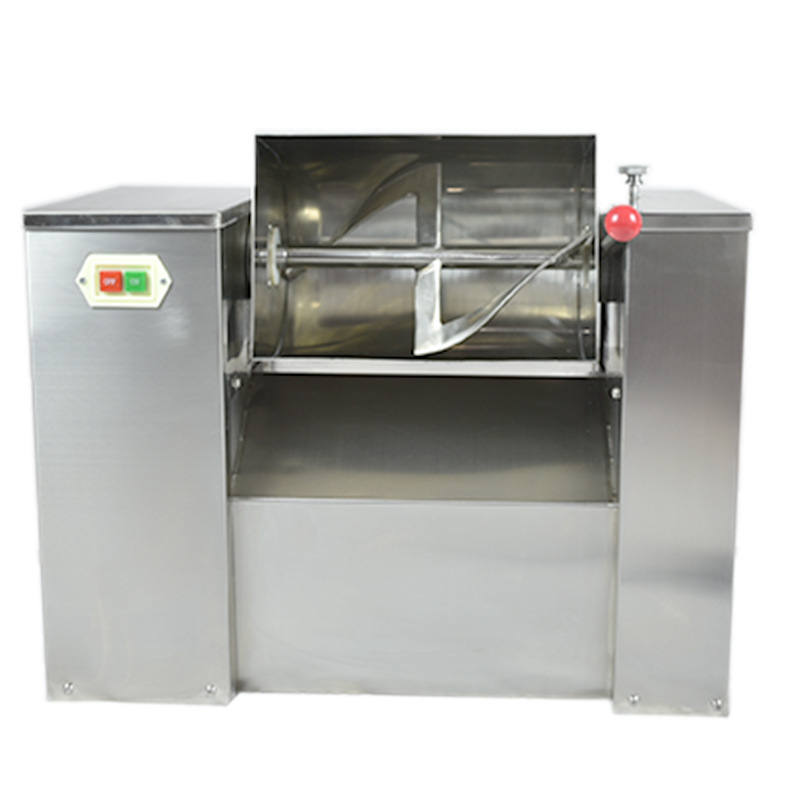
The body of the machine is a horizontal trough, usually a U-shaped or half-cylindrical shell fabricated from carbon steel or stainless steel. The trough is stationary; only the shaft turns. Along the shaft, radial arms carry the mixing elements — helical ribbons, flat paddles or plough-shaped blades — arranged so that the outermost edge of each element runs close to the trough wall. That small running clearance matters: it prevents a stagnant layer of material from building up against the shell and provides a scraping action that helps to empty sticky or slightly moist products.
At one end of the trough there is normally a discharge opening — a slide gate, flap valve or full-width door — sized so that the blended batch can be emptied quickly and completely. At the other end the shaft passes through a sealed bearing housing and connects to the drive train: an electric motor, a gearbox or belt reduction, and, on more advanced units, a variable-frequency drive that allows the shaft speed to be matched to the product being blended.
From Separate Ingredients to a Uniform Blend
Mixing inside a trough proceeds through three mechanisms at the same time. Convective mixing — the bulk transport of groups of particles from one region of the bed to another — is produced by the rotating elements lifting material up the trough wall and letting it fall or be pushed back into the centre of the bed. Shear mixing occurs in the thin layers of powder trapped between the moving element and the trough wall, where particles slide past one another and soft agglomerates are broken down. Diffusive mixing happens at the scale of individual particles, as random collisions gradually redistribute them throughout the bed.
In a well-designed machine these three mechanisms are balanced. If convection dominates and the agitator simply pushes material from one end of the trough to the other, the batch may travel as a plug and leave poorly mixed pockets behind the shaft or near the end plates. If shear dominates, the product may be overworked, heated, or — in the case of fragile granules — broken down more than intended. The practical goal is a machine that circulates the whole bed several times per minute, so that every particle has many chances to change neighbours before the batch is discharged.
The final state of the material is therefore not simply "mixed". A trough mixer can also be used to coat particles with a small percentage of liquid or fine additive, to de-agglomerate a caked raw material, to homogenize a paste, to temper a batch by gentle shearing, or simply to hold a blend in a buffer vessel before the next process step. In each case the same physical principle applies: mechanical agitation repeatedly rearranges the bed until the required degree of uniformity is reached.
Key Process Parameters That Control the Outcome
Operators and process engineers control a trough mixer through a small number of variables, and understanding them is the fastest route to a stable process:
- Filling coefficient. The fraction of the trough volume actually occupied by material. Too little material and the agitator throws powder instead of folding it; too much and the bed becomes compacted, the motor draws excessive current and mixing slows down. Most designs are intended to run within a moderate fill range that leaves free space above the bed.
- Shaft speed. Higher speeds increase shear and shorten mixing time, but they also raise power consumption, product temperature and dust generation. Low speeds suit fragile granules and dense powders; higher speeds suit cohesive or agglomerated materials.
- Mixing time. Blending curves follow a typical pattern — uniformity improves quickly at first and then flattens out. Beyond that plateau, extra time adds cost without improving quality, and in some products it promotes segregation or attrition.
- Agitator geometry and wall clearance. Ribbon, paddle and plough elements impose different shear levels and different axial transport patterns. The clearance between element and wall determines how much material is scraped and how much remains in a slow-moving boundary layer.
- Addition sequence. Adding a small ingredient on top of a large one, or spraying a liquid onto a moving bed rather than a static one, can change blend quality more than any other single factor.
- Discharge behaviour. A blend that is uniform inside the trough can still segregate while it is being emptied. Discharge geometry and discharge speed therefore belong to the mixing specification, not to the packaging specification.
Main Configurations and Key Components
Trough mixers are built in several configurations, and the differences between them are practical rather than cosmetic: they determine which materials the machine handles well, how it is cleaned, and how easily it can be integrated into an automated line. A typical trough mixer combines a stainless steel trough, a shaft-mounted agitator, a geared drive and a manual or powered discharge, and can be supplied with additional options depending on the duty.
Agitator Geometry: Ribbon, Paddle and Plough
The ribbon agitator is the classic choice for free-flowing powders and granules. Two or more helical ribbons are mounted on the same shaft, often in opposite hands, so that one ribbon pushes material in one axial direction while another pushes it back. The result is a continuous circulation loop that is efficient and gentle. Paddle and plough configurations use discrete blades instead of continuous ribbons; they produce more localized shear and are often preferred when the product tends to cake, when short mixing times are required, or when the machine must also handle a paste or a damp mass. Some designs combine both, using a ribbon for bulk circulation and separate high-speed choppers to break down lumps.
Single-Shaft and Double-Shaft Designs
A single-shaft machine is the simplest and most common layout: one agitator shaft, one drive, one discharge. Double-shaft designs add a second, parallel shaft, usually running at a different speed, which creates an additional zone of high shear between the two rotors. These units are chosen when the process involves difficult ingredients, when a liquid must be dispersed into a powder, or when a very short cycle time is essential. The trade-off is greater mechanical complexity, higher power demand and a more demanding cleaning procedure.
Auxiliary Systems: Jackets, Nozzles and Seals
Because mixing generates heat and because many products need more than simple blending, trough mixers are frequently fitted with auxiliary systems. A jacketed trough allows heating or cooling fluid to circulate around the shell so that the product can be kept below a temperature limit or held at a controlled temperature during mixing. Spray nozzles or lance ports let a liquid binder be introduced gradually and evenly, which is the usual way to produce a pre-granulated or coated powder. Shaft seals, meanwhile, are chosen according to the product: standard packings for dry powders, and more elaborate gas-purged or mechanical seals when fine dust, solvents or vacuum operation are involved.
Laboratory and Production Scale Configurations
The same working principle is applied across a wide range of sizes, from compact laboratory units used to develop a formulation on a few litres of material, through pilot-scale machines used to confirm that a recipe scales up, to production mixers that handle full batches in a plant. Scale-up is not simply a matter of enlarging the trough: as vessels grow, the ratio of surface area to volume falls, the distance a particle must travel to change neighbours increases, and the power needed per unit volume changes. For that reason, engineers usually keep geometric similarity between scales and then adjust shaft speed and mixing time experimentally.
Key Performance Indicators and Selection Points
When comparing trough mixers, buyers tend to focus on price and volume. In practice, five performance indicators decide whether a machine will still be satisfactory after two years of production: capacity, uniformity, power, controllability and cleanability.
Batch Capacity and Throughput
The nominal volume of the trough and its usable working volume are not the same thing, and the difference matters. A machine is normally rated by the batch size it can blend properly rather than by the geometric volume of its shell, because overfilling degrades mixing quality and overloads the drive. Throughput is then simply batch size multiplied by the number of cycles per shift, so a slightly smaller machine with a fast discharge and short mixing time can outperform a larger one. Questions to ask include: what is the working volume, what is the minimum fill at which the agitator still works correctly, and how long does a complete charge–mix–discharge cycle take?
Mixing Uniformity and Blend Homogeneity
Uniformity is usually expressed as a coefficient of variation measured on samples taken from several positions in the batch, or as a specification for a key ingredient such as an active pharmaceutical ingredient or a conductive additive. The achievable uniformity depends on particle size distribution, density difference, moisture content and electrostatic behaviour as much as on the machine itself. A vendor who understands the process will ask for a sample of the actual formulation, because a trough mixer that blends a free-flowing mineral filler perfectly may struggle with a cohesive pigment or a fibrous additive.
Power, Torque and Energy Efficiency
The installed motor power must be sufficient for the worst case the machine will ever see — a dense powder, a slightly overfilled trough, or a cold paste that is stiff at start-up. Under-sizing shows up as nuisance tripping and reduced batch size; over-sizing wastes energy and can damage fragile products. Efficiency in a trough mixer is therefore less about a single efficiency figure than about matching drive power, shaft speed and mixing time to the job: a well-matched machine reaches specification in fewer revolutions, and revolutions are what the electricity bill pays for.
Automation, Controllability and Data Logging
Modern trough mixers are increasingly supplied with variable-frequency drives, timers, recipe storage and interlocks that prevent the discharge valve from opening while the agitator is running, or the agitator from starting while the discharge is open. For regulated industries, the ability to record shaft speed, mixing time and motor load for each batch is as valuable as the mixing itself, because it turns a manual operation into a documented, repeatable one. Consider whether the control panel needs to talk to a plant-level system, and whether the same recipe must be reproduced on several machines.
Discharge, Cleaning and Maintenance
Cleaning is where trough mixers differ most in day-to-day cost. A machine with large inspection openings, smooth internal surfaces, minimal dead corners and a full-width discharge can be cleaned and product-changed in a fraction of the time required by a unit with narrow access and internal crevices. Bearing housings, shaft seals and drive components should be accessible without dismantling the trough. For multi-product plants handling allergens, pigments or active ingredients, cleanability is not a convenience — it is a hard requirement.
Applications and Selection Advice
Typical Industries and Materials
Trough mixers are used wherever powders or pastes must be homogenized in batches. In the chemical and fine-chemical industry they blend pigments, dyes, fillers, catalysts and detergents. In pharmaceuticals and nutraceuticals they prepare dry blends and pre-granulation mixtures under controlled, documented conditions. In the food industry they handle flour, spices, premixes, cocoa and powdered additives. In metallurgy and powder metallurgy they homogenize metal powders and their additives before pressing or sintering. In battery and electronic-materials production they blend active materials, conductive additives and binders. In ceramics and building materials they prepare glazes, frits and dry mortars. The common denominator is a batch of solids that must leave the machine as one uniform material.
How to Choose the Right Trough Mixer
The most reliable selection method is to work backwards from the product. Start with the formulation: particle size range, bulk density, moisture, flowability, abrasiveness, temperature sensitivity and the number of ingredients. Then define the process: batch size, required uniformity, cycle time, whether a liquid is to be added, and whether the blend must be kept hot, cold, dust-free or under vacuum. Only then choose a machine that offers the matching agitator geometry, drive power, construction material, seal type and discharge arrangement.
For laboratories and formulation development, small units with interchangeable agitators and clearly measurable mixing parameters are the most useful, because they let the process be defined before money is spent on production equipment. For pilot and production plants, the priority shifts to repeatability, cleanability, safe discharge and integration with upstream dosing and downstream packaging. In both cases it is worth asking the supplier for the working volume, the recommended fill range, the achievable uniformity on a trial sample and the maintenance intervals — and to insist that the machine be tested with the real material rather than a surrogate powder.
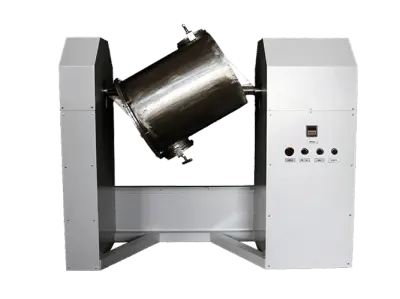
Detailed configuration information, including available sizes, drive options and discharge arrangements, is published on the TENCAN trough mixer product page, and comparing those specifications with the requirements of your own formulation is the quickest way to narrow the choice.
Frequently Asked Questions
Is a trough mixer a batch machine or a continuous machine?
Most trough mixers are batch machines: a weighed quantity of ingredients is charged, blended for a defined time, and discharged as one homogeneous lot. Batch operation makes traceability and sampling straightforward, which is why regulated industries prefer it.
Can a trough mixer handle liquids and pastes?
Yes, within limits. With a suitable agitator geometry, a jacketed shell and spray nozzles, a trough mixer can disperse a liquid binder into a powder, blend pastes, or homogenize damp masses. Highly fluid slurries, however, are normally handled by other types of equipment.
How long does a typical mixing cycle take?
Cycle time depends on batch size, fill level, shaft speed and how different the ingredients are, so it should always be confirmed by a trial with the real material. Charging and discharging often take as long as the mixing itself, which is why discharge design matters.
Reference
Product information used in this article: Trough mixer.
Related Products
Get In Touch
Our professional team will reply to you within one business day. Please feel free to contact us!