
What is a Shear Emulsifier? A High-Efficiency Equipment for Emulsifying and Homogenizing Liquids

Introduction
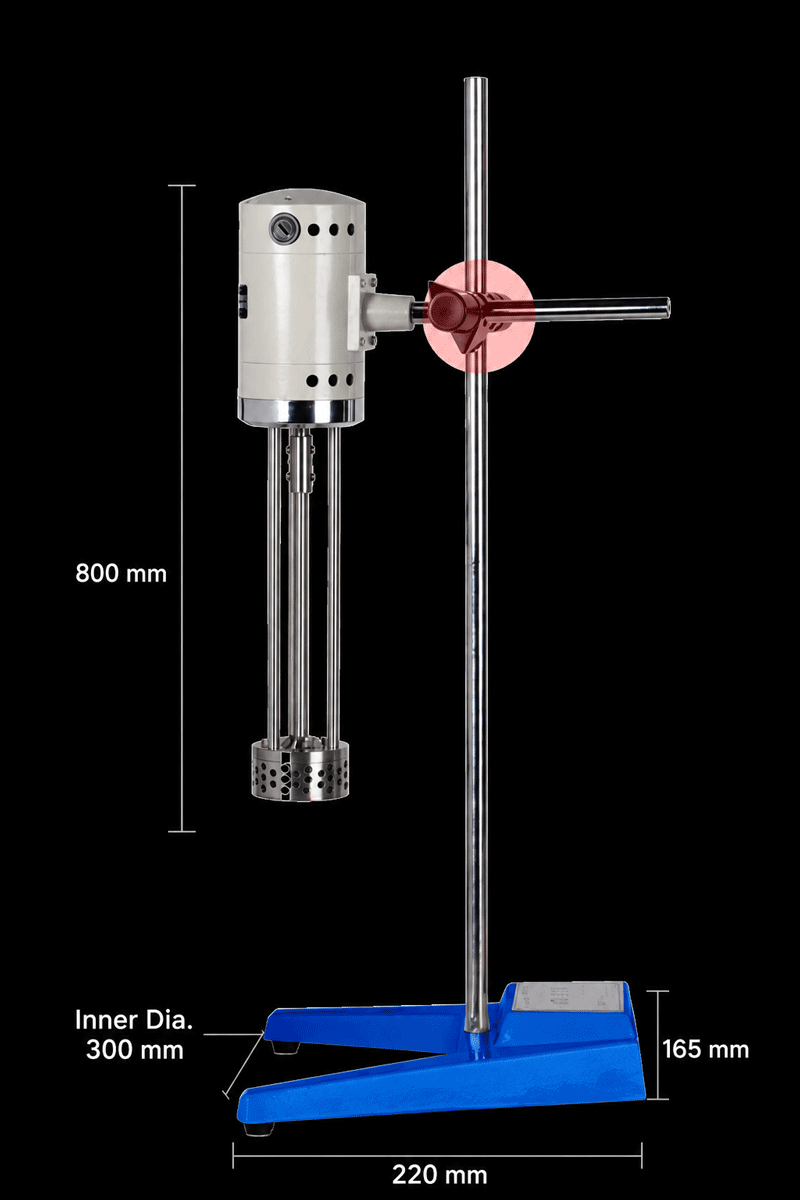
At its core, a shear emulsifier is a specialized piece of mixing equipment that laboratories and industries use to transform immiscible liquids (such as oil and water) into stable, uniform emulsions or to finely disperse solid particles in a liquid medium. By applying intense mechanical shear forces, this device can reduce droplet or particle sizes down to the micron or even submicron range, achieving a level of homogeneity that ordinary stirring cannot match.
Core Function and Working Principle
The fundamental function of a shear emulsifier is to convert a coarse mixture of two or more immiscible phases into a fine, stable emulsion or dispersion. The core working mechanism relies on a high-speed rotor that rotates at thousands of revolutions per minute inside a stationary stator. The gap between the rotor and stator is extremely narrow – typically ranging from a few tenths of a millimeter to a few millimeters.
As the rotor spins, it creates a powerful suction that draws the liquid mixture into the rotor-stator assembly. The material is then subjected to intense hydraulic shear, turbulence, and cavitation as it passes through the precision gap. This combination of forces breaks down large droplets or agglomerates into extremely fine particles, resulting in a uniform and stable product. Key process parameters include rotor speed, processing time, gap size, and the number of passes through the emulsifier head.
Main Types / Core Components and Technology
Shear emulsifiers are available in several configurations:
Laboratory Scale Shear Emulsifiers
These compact units are designed for R&D, small-batch formulation, and quality control. They typically feature a single-stage or multi-stage rotor-stator head, variable speed control, and easy disassembly for cleaning. For example, models like the TENCAN shear emulsifier offer power ranges from 0.55 kW to 1.1 kW and processing capacities up to 200 L/h (water-based).
Industrial Production Shear Emulsifiers
For large-scale manufacturing, these units are built with more robust construction, higher motor power, and continuous operation capability. They often include features like inline processing, CIP (clean-in-place) systems, and explosion-proof motors for hazardous environments.
Mobile High Shear Emulsifiers
Some models are mounted on movable carts, allowing flexibility to serve multiple production lines or batch vessels. They are common in cosmetics and food facilities where different formulations need to be processed in different tanks.
Key Performance Indicators and Selection Criteria
When selecting a shear emulsifier, consider the following critical parameters:
- Processing Capacity: Determine the required throughput – from small laboratory batches (e.g., 1-10 L) to continuous industrial production (e.g., hundreds of liters per hour).
- Shear Intensity and Particle Size Control: The ability to achieve the desired droplet or particle size depends on rotor tip speed, gap size, and residence time. Models with multi-stage rotors provide finer emulsification.
- Power and Energy Efficiency: Higher power enables processing of higher viscosity materials and faster results, but also increases energy consumption.
- Automation and Programmability: Advanced units offer digital speed display, programmable timers, and data logging for reproducible results.
- Material of Construction: Stainless steel (SS304 or SS316L) is standard for corrosion resistance and hygiene, especially in food and pharmaceutical applications.
- Ease of Maintenance: Quick-disassembly designs simplify cleaning and changeover between batches.
Application Fields and Selection Advice
Shear emulsifiers are indispensable in industries where stable emulsions, dispersions, or homogenized products are required:
- Cosmetics & Personal Care: Creams, lotions, sunscreens, and serums often require fine, stable oil-in-water or water-in-oil emulsions.
- Food & Beverage: Mayonnaise, salad dressings, sauces, and dairy products benefit from uniform texture and long shelf life.
- Pharmaceuticals: Topical ointments, oral suspensions, and injectable emulsions demand precise particle size control and sterility.
- Chemicals & Coatings: Paints, adhesives, and lubricants frequently utilize emulsifiers for consistent quality.
For first-time buyers, start with a laboratory disperser or a small-scale shear emulsifier to test your formulation. Once the process is optimized, scale up to an industrial model with similar rotor-stator geometry to ensure consistent results. If your application involves high-viscosity pastes, consider a vacuum kneading machine or a combination system.
References
Related Products
Get In Touch
Our professional team will reply to you within one business day. Please feel free to contact us!