
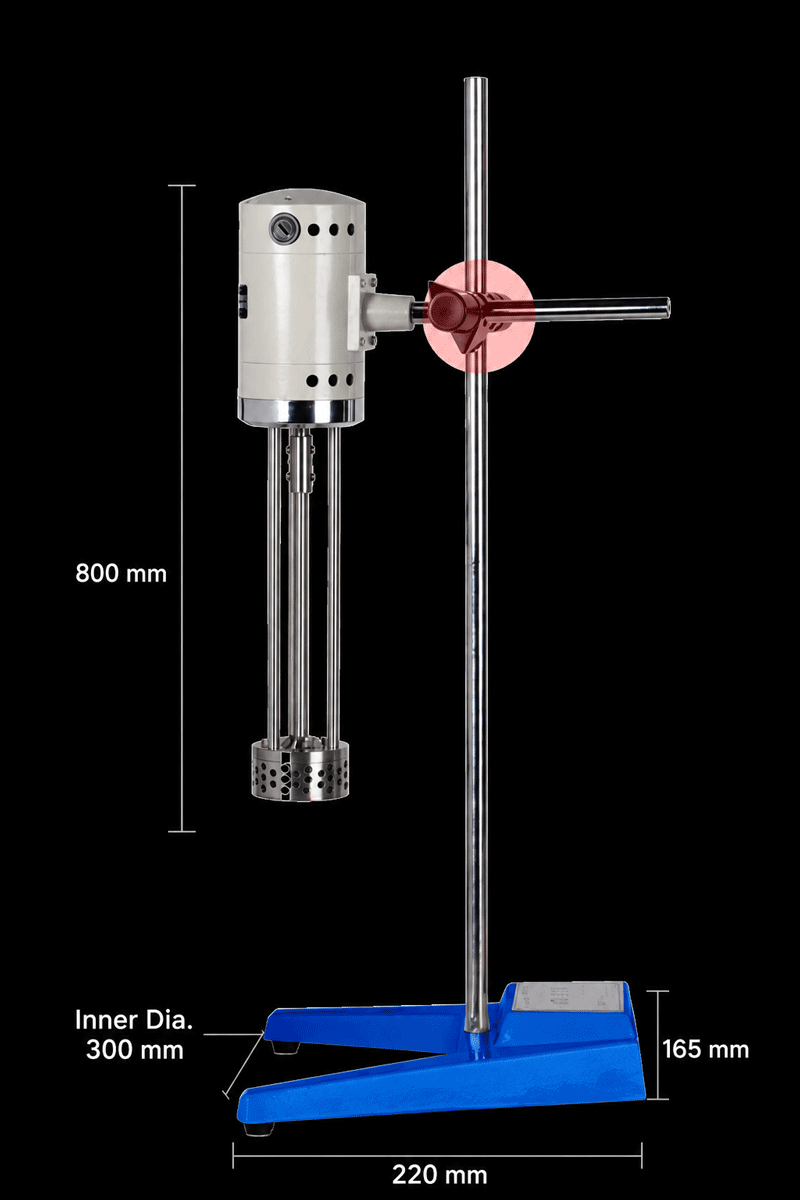
What is a Shear Emulsifier? A High-Precision Mixing Device for Emulsifying and Homogenizing Liquids

What is a Shear Emulsifier?
At its core, a shear emulsifier is a professional high-shear mixing device used by industries such as cosmetics, pharmaceuticals, food, and fine chemicals to achieve fine emulsification, dispersion, and homogenization of immiscible liquids or solid-liquid mixtures. The equipment transforms coarse mixtures into stable, uniform emulsions or suspensions with droplet sizes typically ranging from 0.2 to 2 microns, ensuring product consistency and quality.
Core Function and Working Principle
The primary function of a shear emulsifier is to break down large droplets or agglomerates into fine, uniform particles through intense mechanical shear forces. The key working component is a rotor-stator assembly: a high-speed rotating rotor (typically with multiple stages of teeth) closely fits inside a stationary stator with precisely machined slots or holes. When the motor drives the rotor at speeds up to 2800 rpm or higher, the liquid or slurry is drawn into the gap between the rotor and stator, where it experiences severe hydraulic shear, turbulence, collision, and cavitation. This process rapidly reduces droplet size and ensures intimate mixing, resulting in a stable emulsion or homogeneous dispersion.
Critical process parameters include rotor speed, gap clearance, number of rotor-stator stages, and processing time. Adjusting these parameters allows operators to control the final particle size distribution, viscosity, and stability of the product. Many modern shear emulsifiers also feature a vacuum system for deaeration, a heating/cooling jacket for temperature control, and a programmable logic controller (PLC) for automation.
Main Types of Shear Emulsifiers
Shear emulsifiers are available in various configurations to suit different scales and applications:
1. Laboratory Shear Emulsifiers
Compact benchtop units designed for small batches (0.5 L to 5 L). They are ideal for formulation development, quality control, and research. Features include variable speed control, easy disassembly for cleaning, and often a transparent vessel for visual observation.
2. Pilot and Production Shear Emulsifiers
Larger floor-standing machines with working volumes from 50 L to 1000 L or more. These are built with robust construction materials (e.g., SS316L), sanitary design (GMP-compliant), and advanced automation. They often include integrated vacuum, heating/cooling, and discharge systems for direct connection to filling lines.
3. Inline Shear Emulsifiers
Continuous processing units that are installed directly in a pipeline. They handle high flow rates and are suitable for large-scale production where the emulsion must be processed in a single pass or recirculated. Inline models minimize batch-to-batch variation and save space.
Key Performance Indicators and Selection Criteria
When selecting a shear emulsifier, consider the following metrics:
- Processing Capacity: Determine the required batch size or throughput. Laboratory units handle milliliters to a few liters, while production units range from tens to thousands of liters.
- Particle Size Control: Specify the target droplet or particle size. Multi-stage rotor-stator designs can achieve finer emulsions (0.2 µm).
- Speed and Shear Rate: Higher rotor speed generates stronger shear forces, but also increases heat and energy consumption. Look for frequency inverters for precise speed adjustment.
- Material of Construction: For corrosive or hygienic applications, choose SS316L or other chemically resistant alloys. Ensure all wetted parts are easy to clean and sterilize.
- Automation Level: Modern units offer PLC touch-screen control with recipe storage, data logging, and remote monitoring capabilities, reducing operator error and improving repeatability.
- Maintenance and Service: Check for easy access to seals, bearings, and the rotor-stator assembly. Dual mechanical seals with a barrier fluid system extend service life and prevent leakage.
Application Areas and Selection Advice
Shear emulsifiers are indispensable in industries where stable emulsions are critical. In cosmetics, they are used for creams, lotions, and ointments. In pharmaceuticals, they produce topical formulations, injectable emulsions, and liposomes. The food industry uses them for salad dressings, sauces, and beverages. Chemical plants rely on them for adhesives, coatings, and lubricants.
For laboratory R&D, a compact lab shear emulsifier with variable speed and a small batch vessel is recommended. For pilot trials, a mid-range unit with a jacketed vessel and vacuum system helps scale up formulations. For full-scale production, an inline or multi-tank system with full automation and CIP (clean-in-place) capability is the most efficient choice. Always consult the manufacturer's technical datasheets and request a trial with your specific material to validate performance.
References
Related Products
Get In Touch
Our professional team will reply to you within one business day. Please feel free to contact us!