
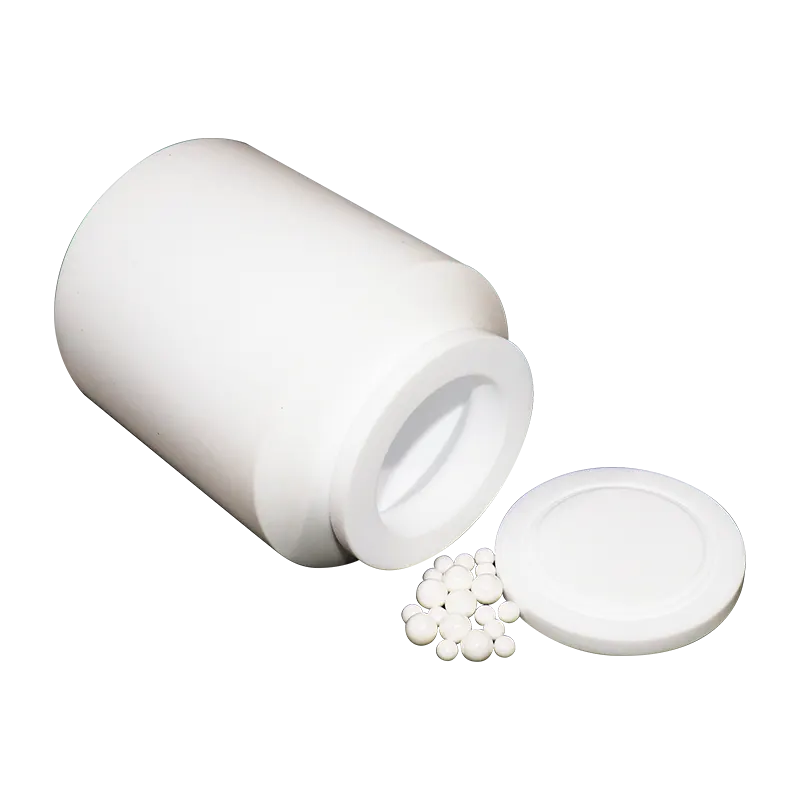
What is a PTFE Roll Mill Jar? A Specialized Corrosion-Resistant Grinding Container for Roll Ball Mills

Introduction
At its core, a PTFE roll mill jar is a cylindrical grinding container made from polytetrafluoroethylene (PTFE), designed specifically for use in roll ball mills—also known as jar rolling mills. Laboratories and small-scale production facilities use it to mill, mix, and homogenize powders and slurries, especially when dealing with highly corrosive or chemically sensitive materials. The PTFE construction offers a unique combination of chemical inertness, non-stick surface, and thermal stability, making it the preferred choice for processes where contamination from metal ions or other impurities must be strictly avoided.
Unlike traditional stainless steel or ceramic jars, PTFE roll mill jars excel in applications involving strong acids, alkalis, organic solvents, or high-purity formulations. They are widely employed in the development of advanced battery materials, pharmaceuticals, fine chemicals, and electronic ceramics.
Core Function and Working Principle
The PTFE roll mill jar serves as the vessel that holds the material to be ground along with the grinding media (typically balls made of zirconia, agate, or PTFE). In a roll ball mill, the jar is placed on rotating rollers; the friction between the jar and the rollers causes the jar to rotate. As the jar turns, the grinding media inside are lifted and then cascade or cataract, imparting impact and shear forces to the powder particles. This action reduces particle size, breaks agglomerates, and achieves uniform mixing.
Key parameters influencing the grinding efficiency include the jar rotation speed (typically 50–410 rpm), the size and density of the grinding media, the fill volume of the jar (usually 30–50% of jar capacity), and the grinding duration. The PTFE material itself does not participate in the chemical reaction, ensuring that the final product remains free from metallic contamination. Additionally, the non-stick surface of PTFE minimizes material adhesion to the inner walls, facilitating easy cleaning and reducing cross-contamination between batches.
Key Features and Material Advantages
While the PTFE roll mill jar is a single type of container, its material properties set it apart from other roll mill jars (such as nylon, stainless steel, ceramic, or PU jars). Understanding these features is crucial for selecting the right jar for your application.
Chemical Resistance
PTFE is virtually inert to all common chemicals except molten alkali metals and fluorine gas. This makes the PTFE roll mill jar ideal for grinding acidic or alkaline materials, such as battery cathode precursors (NMC, LFP) or pharmaceutical intermediates, without risk of corrosion or leaching.
Non-Stick and Low Friction
The extremely low surface energy of PTFE prevents powders from caking on the jar walls. This property is especially beneficial for sticky, hygroscopic, or waxy materials, ensuring consistent recovery and easy cleaning.
Thermal Stability
PTFE can withstand continuous operating temperatures from -200°C to +260°C. This allows the jar to be used in processes that require pre-heating, cooling, or even cryogenic grinding (when combined with liquid nitrogen).
High Purity
PTFE does not contain plasticizers, stabilizers, or other additives that could leach into the product. It is FDA-compliant and suitable for food and pharmaceutical applications.
Mechanical Limitations
It is important to note that PTFE is softer than ceramic or metal. Therefore, the PTFE roll mill jar is best suited for applications where the grinding media is not overly aggressive (e.g., zirconia balls of moderate size). Excessive impact from large, heavy balls may cause deformation or wear of the jar. For high-energy grinding, a reinforced PTFE or a composite jar might be necessary.
Key Performance Indicators and Selection Criteria
When evaluating a PTFE roll mill jar, consider the following factors to ensure optimal performance and longevity:
- Capacity Range: PTFE roll mill jars are commonly available in volumes from 0.05L to 20L. Choose a size that matches your batch quantity and the capacity of your roll ball mill (which typically supports 1 to 16 working positions).
- Wall Thickness and Rigidity: Thicker walls provide better dimensional stability and resistance to deformation under load. Check the manufacturer's specifications for maximum recommended ball size and fill ratio.
- Sealing and Closure: A well-designed lid with a silicone or PTFE O-ring ensures a leak-proof seal, especially when milling volatile solvents or under vacuum/inert gas. Some jars offer optional vacuum or gas purge ports.
- Compatibility with Mill: Ensure the outer diameter and length of the jar fit the roller spacing of your roll ball mill. Standard jars have a cylindrical shape with flat ends to roll smoothly.
- Ease of Cleaning: The non-stick property of PTFE already simplifies cleaning, but consider whether the jar can be disassembled for thorough cleaning. Most PTFE jars are one-piece molded with a removable lid.
- Customization: Some suppliers offer custom dimensions, thread types, or additional ports for special requirements.
Applications and Selection Recommendations
PTFE roll mill jars are extensively used in the following fields:
- Battery Material Research: Grinding and mixing of cathode/anode active materials, solid electrolytes, and conductive additives under inert atmosphere to prevent oxidation.
- Pharmaceutical and Biotech: Milling of active pharmaceutical ingredients (APIs), excipients, and herbal extracts where metal contamination is unacceptable.
- Fine Chemicals and Pigments: Dispersion of pigments, dyes, and catalysts in aggressive solvents.
- Ceramics and Glass: Pre-mixing of ceramic powders with binders or additives, especially when the formulation contains corrosive components.
- Food and Cosmetics: Grinding of spices, flavors, and cosmetic powders that require high purity and no metallic taste.
For typical laboratory-scale grinding, a PTFE jar with a capacity of 0.5L to 2L is sufficient. If you plan to process large batches, consider a 5L or 10L jar. For materials that are very hard or require high-energy milling, you may need to combine the PTFE jar with a PTFE roll mill jar from a reputable manufacturer that offers thicker walls or reinforced design. Always match the grinding media to the jar material: for PTFE, zirconia or agate balls are recommended to avoid excessive wear.
Conclusion
The PTFE roll mill jar is an indispensable tool for any laboratory or pilot plant that demands high purity, chemical resistance, and easy handling in roll ball milling. By understanding its unique properties and limitations, you can select the right jar to achieve consistent, contamination-free results in your powder processing applications.
Related Products
Get In Touch
Our professional team will reply to you within one business day. Please feel free to contact us!