

What is a PTFE Roll Mill Jar? A Mill Jar for High-Purity, Corrosion-Resistant Grinding in Roll Ball Mills
What is a PTFE Roll Mill Jar?
At its core, a PTFE roll mill jar is a cylindrical grinding container crafted from polytetrafluoroethylene (PTFE), a high-performance fluoropolymer known for its exceptional chemical resistance and non-stick surface. Laboratories and industries use it to mill, mix, and homogenize materials that are highly corrosive, sensitive to metallic contamination, or require ultra-high purity. The jar is designed to be used on roll ball mills (also known as jar mills or roller mills), where the rotating action of the rollers causes the jar to spin, thereby grinding the material inside through the tumbling of grinding media.
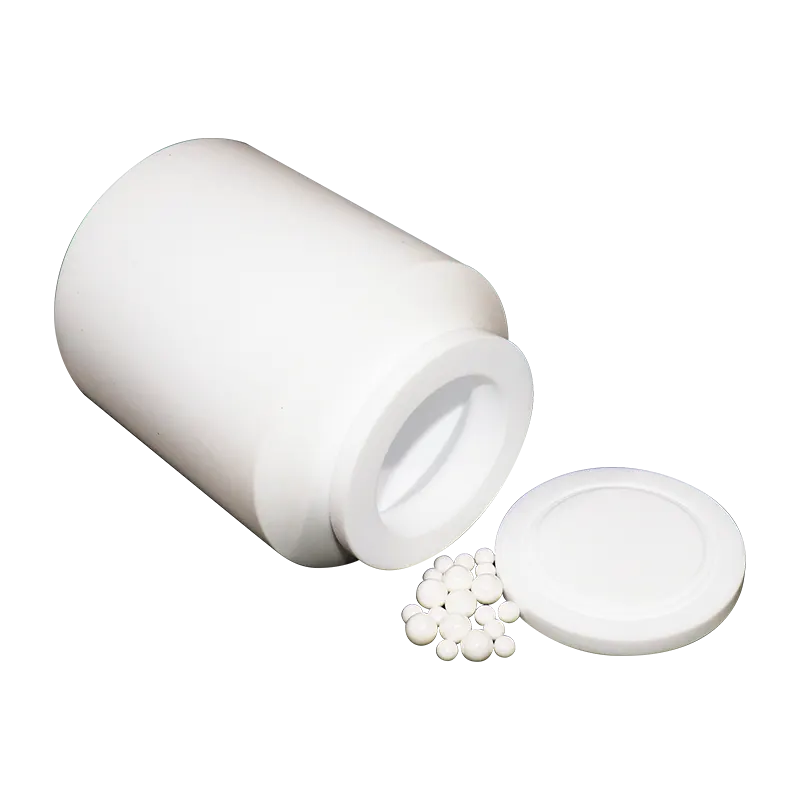
Core Function and Working Principle
The primary function of a PTFE roll mill jar is to serve as a pristine environment for size reduction. The jar is loaded with the material to be ground and appropriate grinding media (such as balls made of zirconia, agate, or PTFE itself). The jar is then placed on the rollers of a roll ball mill, which rotates the jar at a controlled speed. As the jar rotates, the grinding media are lifted and then cascade down, impacting and shearing the material, thereby reducing its particle size. The PTFE material of the jar itself is chemically inert, meaning it does not react with even the most aggressive acids, alkalis, or solvents. This ensures that the sample remains pure and uncontaminated by any metallic ions or other impurities from the jar walls.
Key process parameters that affect the final particle size include the rotation speed of the mill, the size and density of the grinding media, the filling ratio of the jar, and the duration of milling. For example, higher speeds generally increase the energy input, leading to finer particles, but excessive speed can cause the media to centrifuge rather than tumble, reducing efficiency. The non-stick nature of PTFE also prevents material from caking on the inner walls, which is a common problem with other jar materials when processing sticky or moist samples.
Core Components and Key Technology
Unlike multi-part grinding systems, a PTFE roll mill jar is a single, integral container. However, its performance depends on several design features:
- PTFE Material Grade: High-quality, virgin PTFE with no fillers or additives ensures maximum chemical resistance and purity. Some jars may be made from modified PTFE (e.g., with glass fiber or carbon reinforcement) for increased dimensional stability, but pure PTFE is preferred for maximum inertness.
- Wall Thickness: Adequate wall thickness is necessary to withstand the mechanical stresses of milling without deformation or cracking. Thicker walls also provide better wear resistance over time.
- Sealing Mechanism: Many PTFE roll mill jars come with a PTFE or silicone O-ring seal and a screw-on lid to prevent leakage of liquids or fine powders during milling. This is critical for wet grinding or when handling hazardous materials.
- Capacity and Shape: Jars are available in various capacities, typically from 0.1 L to 20 L, and are shaped as cylinders with rounded ends to facilitate efficient tumbling action. The inner surface is smooth to minimize wear and cleaning effort.
Key Performance Indicators and Selection Criteria
When selecting a PTFE roll mill jar, consider the following factors:
- Chemical Compatibility: PTFE is virtually inert to all chemicals except molten alkali metals and fluorine gas at high temperatures. For most laboratory applications, it offers the broadest chemical resistance among all jar materials.
- Temperature Range: PTFE can operate continuously from -200°C to +260°C, making it suitable for cryogenic milling or high-temperature processes (though roll mills typically operate at ambient temperature).
- Purity and Contamination: PTFE is the best choice for trace analysis and pharmaceutical applications because it does not leach metal ions. However, it is softer than ceramic or steel jars, so it may wear more quickly when grinding very hard materials (e.g., silicon carbide). In such cases, consider using a harder jar material like ceramic roll mill jar or stainless steel roll mill jar.
- Ease of Cleaning: The non-stick surface of PTFE makes cleaning very easy. Most residues can be wiped off, and the jar can be cleaned with solvents or detergents without risk of corrosion.
- Weight and Durability: PTFE is a relatively soft polymer, so jars may be lighter than ceramic or steel counterparts. However, they are still durable under normal laboratory use. Avoid dropping or using excessive force when tightening the lid.
Application Areas and Selection Advice
PTFE roll mill jars are widely used in:
- Pharmaceuticals and Biotechnology: For grinding active pharmaceutical ingredients (APIs), excipients, and biological samples where metal contamination is unacceptable.
- Chemical and Petrochemical Research: For milling corrosive catalysts, organic compounds, and polymers.
- Electronics and Advanced Materials: For preparing high-purity powders for semiconductors, battery materials, and ceramics.
- Food and Flavor Industry: For grinding sensitive food additives or flavors without altering taste or introducing contaminants.
For users who need to grind extremely hard materials (e.g., 9+ Mohs hardness), a nylon roll mill jar or PU roll mill jar may offer a good balance of hardness and chemical resistance. For maximum corrosion resistance and purity, PTFE remains the top choice. When selecting a jar, also consider the compatibility with your specific roll ball mill model (e.g., number of rollers, roller spacing, and speed range).
References
Related Products
Get In Touch
Our professional team will reply to you within one business day. Please feel free to contact us!