
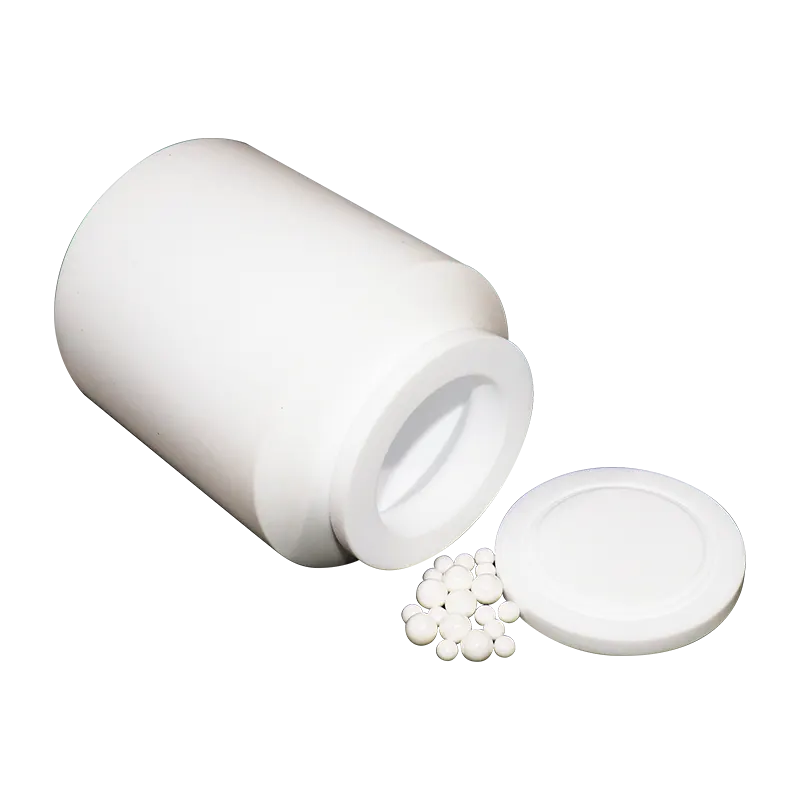
What is a PTFE Roll Mill Jar? A Specialized Grinding Container for Corrosion-Resistant and High-Purity Milling

Introduction
From its core, a PTFE roll mill jar is a specialized grinding container designed for use in roll ball mills, where it holds the material and grinding media to achieve fine particle size reduction through tumbling action. The unique material of construction—polytetrafluoroethylene (PTFE), also known as Teflon—makes it the ideal choice for milling corrosive chemicals, high-purity materials, and samples that must avoid metallic contamination. Laboratories and production facilities in the chemical, pharmaceutical, battery, and advanced ceramics industries rely on PTFE roll mill jars to safely process aggressive substances without compromising sample integrity.
Core Function and Working Principle
Like other roll mill jars, the PTFE roll mill jar operates on a simple yet effective principle: when placed on a roll ball mill, the jar rotates around its horizontal axis. Inside the jar, the material to be ground is combined with grinding balls (typically made of zirconia, agate, or PTFE itself). As the jar rotates, the balls are lifted and then cascade down, impacting and shearing the particles. This process, repeated over time, reduces the particle size to the desired fineness.
The key distinction of the PTFE roll mill jar lies in its material properties. PTFE is chemically inert, resisting attack from almost all acids, alkalis, and organic solvents. It can withstand temperatures from -190°C to +260°C, making it suitable for both cryogenic and moderate-temperature grinding. Additionally, PTFE has an extremely low coefficient of friction (0.04–0.10), which minimizes wear on both the jar and the grinding media, and its non-stick surface prevents material adhesion—a critical advantage when processing sticky or cohesive powders.
Working Process
During operation, the jar is sealed with a leak-proof lid to prevent contamination or loss of volatile materials. The rotational speed of the roll mill determines the grinding intensity; slower speeds favor gentle mixing and attrition, while higher speeds enhance impact forces. The grinding time and ball-to-material ratio are adjustable parameters that directly influence the final particle size distribution. For optimal results, it is common to use grinding balls of a diameter roughly one-third to one-half the jar diameter, and to fill the jar to about 30–40% of its volume with media and material.
Key Material Properties and Design Features
Since the PTFE roll mill jar is a single product type, understanding its critical design aspects is essential for proper application. The jar is typically manufactured from high-purity, virgin PTFE, ensuring no leachable additives or fillers that could contaminate the sample. The wall thickness is designed to provide sufficient mechanical strength while maintaining reasonable weight—PTFE is softer than metals or ceramics, so thicker walls may be needed for larger capacities.
Another important feature is the sealing mechanism. PTFE jars often come with a threaded or snap-on lid that incorporates an O-ring or gasket made of PTFE or a compatible elastomer to ensure a tight seal. This is vital when milling volatile solvents, hazardous chemicals, or moisture-sensitive materials. Some models also offer a vacuum-tight version for applications requiring inert atmosphere grinding.
Compared to other roll mill jar materials—such as nylon, stainless steel, ceramic, or polyurethane—PTFE excels in chemical resistance and purity but has lower hardness and abrasion resistance. Therefore, PTFE jars are best suited for soft to medium-hard materials (Mohs hardness below 3–4) and for processes where contamination control is paramount, rather than for heavy-duty grinding of very hard substances.
Key Performance Indicators and Selection Criteria
When selecting a PTFE roll mill jar, consider the following factors:
- Capacity: Typical capacities range from 0.5 L to 20 L or more. Choose a size that matches your batch volume and the roll mill's jar capacity limit.
- Purity Level: For semiconductor or pharmaceutical applications, specify medical-grade or ultra-high-purity PTFE to minimize any trace elements.
- Temperature Range: Ensure the jar can handle the grinding temperature, especially if using high-speed milling that generates heat. PTFE remains stable up to 260°C, but prolonged exposure near the limit may cause deformation.
- Sealing Performance: For wet grinding or hazardous materials, opt for a jar with a reliable sealing system. Vacuum or pressure-rated lids are available for specialized needs.
- Compatibility with Grinding Media: PTFE jars work well with alumina, zirconia, agate, and PTFE balls. Avoid using very hard media like tungsten carbide in PTFE jars, as the jar may wear faster.
- Ease of Cleaning: PTFE's non-stick nature simplifies cleaning, but the jar should be designed with smooth internal surfaces and no sharp corners to prevent residue buildup.
Applications and Selection Advice
The PTFE roll mill jar is widely used in:
- Chemical Industry: Grinding of corrosive pigments, catalysts, and specialty chemicals.
- Pharmaceuticals: Milling active pharmaceutical ingredients (APIs) that require inert contact surfaces.
- Battery Materials: Processing of electrode materials (e.g., NMC, LFP, solid electrolytes) where contamination by metals must be avoided.
- Advanced Ceramics: Mixing and grinding of precursors for zirconia, alumina, and silicon nitride powders.
- Environmental Testing: Homogenization of soil, sludge, and sediment samples for heavy metal analysis.
For users who need to handle extremely corrosive substances or require the highest purity, the PTFE roll mill jar is the optimal choice. If your application involves very hard materials (Mohs >6), consider a ceramic or hardened steel jar instead. For applications requiring UV resistance or higher mechanical strength, nylon or polyurethane jars may be alternatives. Always consult the manufacturer's specifications to ensure the jar's dimensions and neck design are compatible with your roll ball mill. For more information, visit the PTFE roll mill jar product page or explore other jar options like the nylon roll mill jar and stainless steel roll mill jar.
References
- PTFE roll mill jar: https://www.planetaryballmills.com/products/grinding-series/roller-ball-mill-jar/ptfe-roll-mill-jar.html
- Nylon roll mill jar: https://www.planetaryballmills.com/products/grinding-series/roller-ball-mill-jar/nylon-roll-mill-jar.html
- Stainless steel roll mill jar: https://www.planetaryballmills.com/products/grinding-series/roller-ball-mill-jar/stainless-steel-roll-mill-jar.html
- Ceramic roll mill jar: https://www.planetaryballmills.com/products/grinding-series/roller-ball-mill-jar/cetamic-roll-mill-jar.html
Related Products
Get In Touch
Our professional team will reply to you within one business day. Please feel free to contact us!