
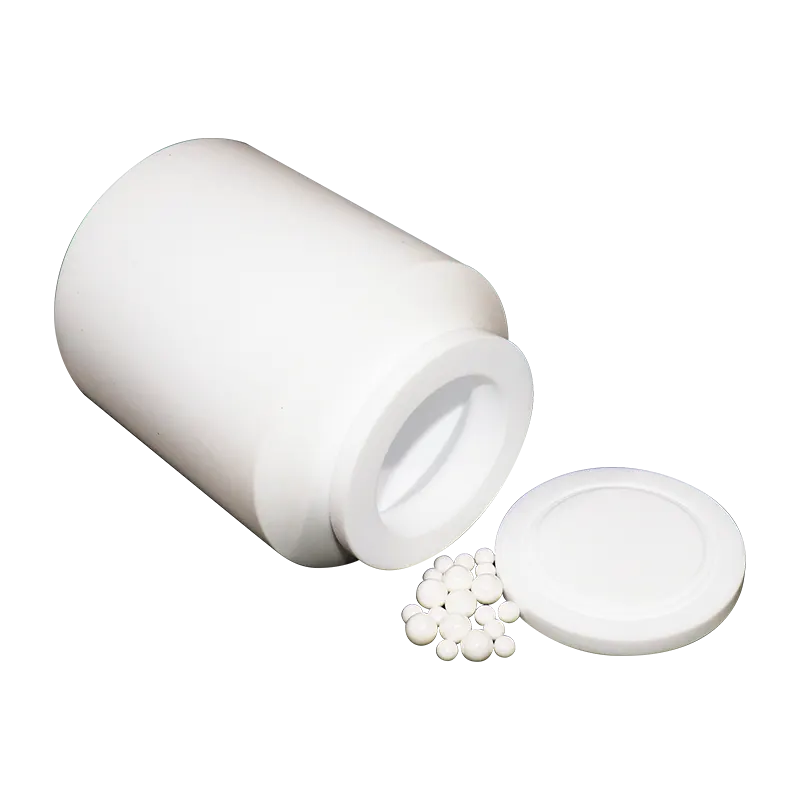
What is a PTFE Roll Mill Jar? A Chemical-Resistant Grinding Container for Contamination-Free Fine Milling

Introduction
At its core, a PTFE roll mill jar is a precision-engineered cylindrical container crafted from premium polytetrafluoroethylene (PTFE), specifically designed for use with roller ball mills (also known as jar mills or roll ball mills). Laboratories and production facilities in the chemical, pharmaceutical, battery, and advanced materials industries use it to perform fine grinding, mixing, and dispersion of powders and slurries while maintaining absolute chemical inertness and preventing contamination. The unique properties of PTFE make this jar the go-to choice for processes where even trace metal ions or reactive interactions with the container wall cannot be tolerated.
Core Function and Working Principle
The primary function of a PTFE roll mill jar is to serve as a closed grinding chamber that, when mounted on a roller ball mill, rotates around its horizontal axis. Inside the jar, grinding media (such as zirconia, agate, or alumina balls) and the material to be processed are loaded. As the jar rotates, the rolling motion of the media generates impact and shear forces, breaking down particles into finer sizes. The PTFE material itself contributes a non-stick inner surface, which minimizes material buildup and facilitates easy cleaning between batches.
The working principle relies on the gentle but effective tumbling action. Unlike planetary ball mills that use high-energy centrifugal forces, roller ball mills operate at moderate rotational speeds, making them ideal for materials that are sensitive to excessive heat or mechanical stress. The PTFE jar's excellent thermal stability (continuous use up to 260°C) and low coefficient of friction further enhance the efficiency of the milling process by reducing heat generation and allowing smooth media movement. The sealing design typically includes a leak-proof lid to prevent volatile solvents or fine powders from escaping.
Key Components and Material Advantages
A PTFE roll mill jar consists of three main components: the jar body, the lid (often with a silicone or PTFE O-ring seal), and optional internal baffles. The body is molded or machined from high-purity PTFE resin, ensuring a dense, non-porous structure that resists absorption of chemicals. The lid is secured with a clamping mechanism or threaded fasteners, providing a reliable seal for wet or dry grinding.
The material itself—PTFE—is the star. It offers:
- Chemical inertness: Resistant to almost all acids, bases, and organic solvents, making it suitable for aggressive chemical environments.
- Non-stick surface: Prevents material adhesion, reducing cross-contamination and improving yield.
- High purity: No metallic ions or leachables, critical for pharmaceutical and electronic grade materials.
- Wide temperature range: Functions reliably from -200°C to +260°C, accommodating cryogenic milling or high-temperature processes.
Key Performance Indicators and Selection Criteria
When selecting a PTFE roll mill jar, users should consider the following parameters:
- Capacity: Typically available in sizes from 0.5L to 20L or more. Choose based on batch volume and mill capacity.
- Wall thickness and rigidity: Thicker walls provide better mechanical strength but reduce internal volume. High-quality PTFE jars maintain dimensional stability under load.
- Sealing effectiveness: A leak-proof design is essential for wet grinding with solvents or for handling toxic powders. Look for O-ring grooves and robust clamping.
- Compatibility with grinding media: PTFE is soft relative to ceramic or steel media, so avoid sharp-edged media that could abrade the inner wall. Use rounded media.
- Temperature and pressure rating: Verify the jar can withstand the expected thermal and pressure conditions during milling (e.g., when using volatile liquids).
- Ease of cleaning: The non-stick property of PTFE simplifies cleaning, but the jar should have smooth internal surfaces without crevices.
Applications and Selection Recommendations
PTFE roll mill jars are widely used in:
- Battery materials: Grinding and mixing of cathode and anode materials (e.g., NMC, LFP, silicon) where metal contamination can degrade battery performance.
- Pharmaceuticals: Milling of active pharmaceutical ingredients (APIs) and excipients that require high purity and chemical compatibility.
- Advanced ceramics: Preparation of ceramic slurries and powders for electronic substrates, insulators, and structural parts.
- Pigments and dyes: Dispersion of colorants in organic solvents without corrosion or discoloration.
- Chemical synthesis: As a reaction vessel for mechanochemical synthesis where PTFE's inertness is beneficial.
For users who need to mill materials that are highly corrosive or sensitive to metal ions, the PTFE roll mill jar is the optimal choice. If higher mechanical strength or abrasion resistance is required, consider alternatives like ceramic roll mill jars or stainless steel roll mill jars. For general-purpose grinding without extreme chemical demands, nylon roll mill jars offer a cost-effective alternative.
References
Related Products
Get In Touch
Our professional team will reply to you within one business day. Please feel free to contact us!