

What Is a Portable Mini Magnetic Blender? A Compact Tool for Lab Sample Mixing
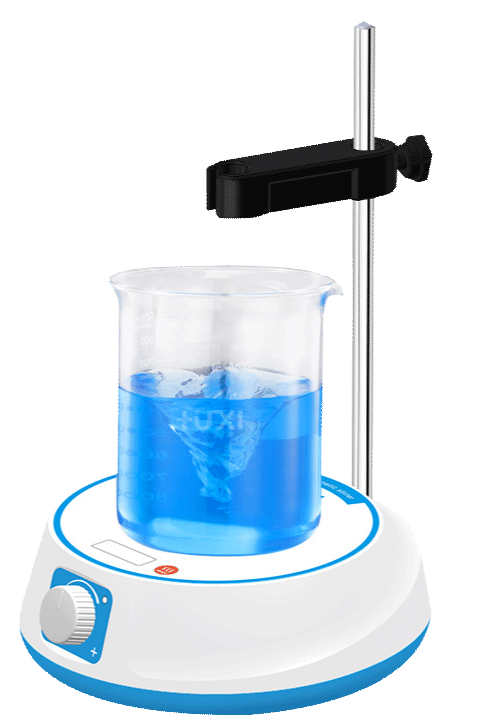
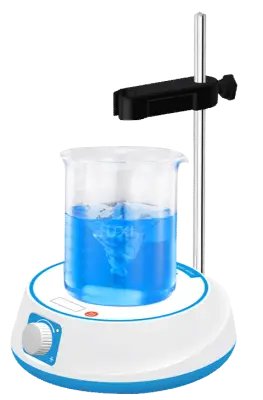
From its core, the Portable Mini Magnetic Blender is a compact laboratory mixing device that uses a rotating magnetic field to drive a small stir bar inside a vessel. Laboratories, teaching rooms, and small-scale preparation areas use it to stir, dissolve, suspend, and gently blend small liquid samples when a full-size mixer would be unnecessary or inconvenient.
What the Portable Mini Magnetic Blender Is
The product name combines three practical ideas: portability, a small working format, and magnetic mixing. Unlike a kitchen blender that uses high-speed blades, a magnetic blender creates motion through a magnetic coupling. A magnetic stir bar, often coated in inert plastic, is placed in the sample vessel. The device beneath the vessel generates a rotating magnetic field, causing the bar to spin and the liquid to move.
In practical terms, the Portable Mini Magnetic Blender is best understood as a compact magnetic mixing station for bench work. It is intended for tasks where the sample volume is modest, the required mixing is gentle to moderate, and the user needs a device that can be placed close to the work area. It is not a high-shear homogenizer, a ball mill, or a heavy-duty industrial mixer. Its value lies in simple, repeatable liquid motion rather than in grinding, pulverizing, or aggressive emulsification.
How Magnetic Mixing Works
The magnetic drive
Magnetic mixing begins with a rotating magnetic field in the base of the device. The field passes through the vessel wall and couples with the magnetic stir bar inside. As the field rotates, the bar follows it. Because the bar is in direct contact with the liquid, its rotation creates a moving boundary that drags adjacent liquid with it. The result is a circulating flow pattern that can be gentle enough for biological samples or strong enough to keep particles suspended, depending on the speed setting and the vessel geometry.
From rotary motion to sample mixing
The stir bar does not act like a blade. It creates a combination of rotational flow, radial movement, and, at higher speeds, a small vortex. This flow can bring different liquid layers together, dissolve soluble solids, disperse fine powders, and prevent settling. In a well-matched vessel, the motion is steady and reproducible. In a poorly matched vessel, the bar may jump, chatter, or lose coupling with the drive field.
Process variables that shape results
The most important variables are stir-bar size and shape, vessel diameter and bottom profile, liquid volume, viscosity, and speed. A bar that is too small may not move the full sample; a bar that is too large may not start reliably. A flat-bottomed vessel usually gives more stable rotation than a round-bottomed one. Higher viscosity increases load on the magnetic coupling and may require a slower speed, a stronger bar, or a different mixing method. These are general principles, so the exact working range of the Portable Mini Magnetic Blender should be confirmed from its product information.
Core Components and Key Technologies
Magnetic drive and base
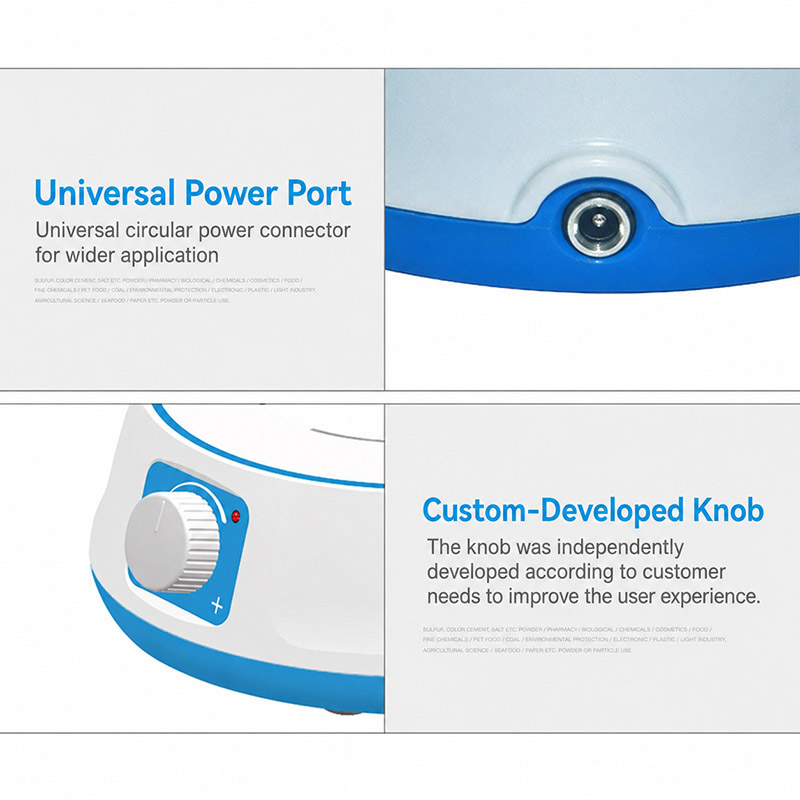
The base contains the motor, the magnetic drive assembly, and the controls. The top surface must be flat and clean so that the vessel sits squarely and the magnetic field can couple efficiently with the stir bar. A stable base also reduces walking or vibration during mixing. Because the drive is magnetic rather than shaft-driven, there is no rotating seal to leak and no blade shaft to align inside the vessel.
Control interface
A compact magnetic blender may use a simple dial or a digital control, depending on its configuration. The control sets the rotation speed and therefore the intensity of mixing. For reproducible work, the user should record the setting, vessel type, bar size, and sample volume. If the model offers only a relative scale rather than a calibrated speed display, comparisons should be made with the same setup rather than between different vessels.
Vessel and stir-bar compatibility
The vessel is part of the mixing system, not an accessory that can be ignored. Glass beakers, flasks, and purpose-made mixing vessels can all work if their bottoms are flat enough and their walls are not too thick for the magnetic field. The stir bar should be chemically compatible with the sample and should be sized to the vessel. A bar with a pivot ring may help in some vessels, while a plain bar may be easier to clean. The product page is the right place to check recommended accessories.
Power, portability, and placement
Portability is useful when bench space is limited or when a mixer must be moved between preparation areas. Before placing the unit, check that the surface is level, dry, and free from ferromagnetic objects that could distort the magnetic field. Keep the device away from spills and from strong external magnetic fields. The exact power requirement and any battery or adapter details should be verified in the supplied product documentation rather than assumed from the name alone.
What the Device Does to a Sample
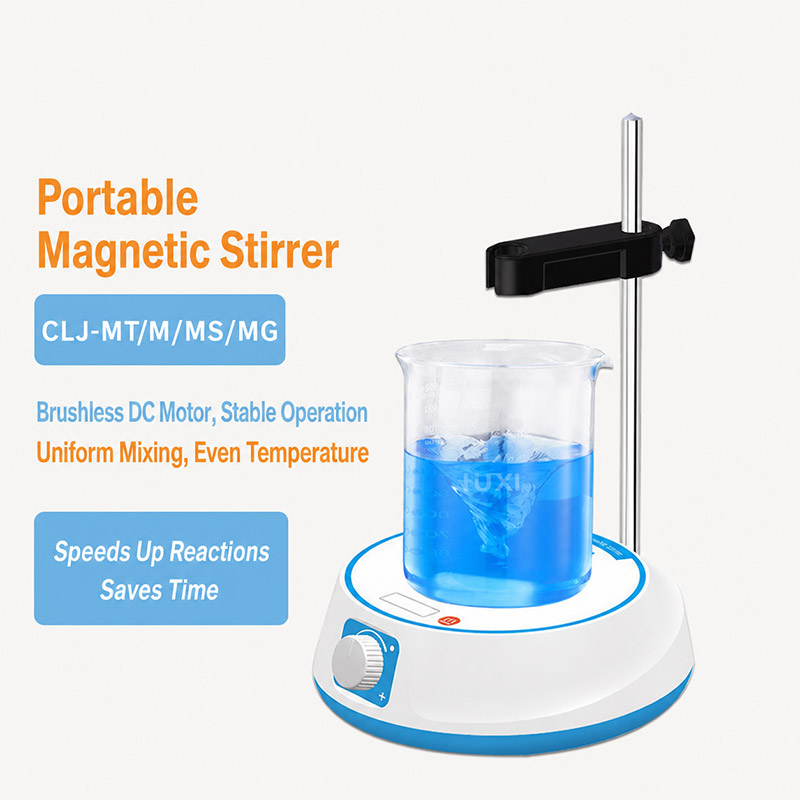
The basic transformation is from a sample with separate phases to a sample with more uniform composition. At the start, a liquid may contain dissolved salts, settled particles, or an added powder that is sitting on the bottom. During mixing, the rotating bar creates flow that erodes the settled layer, carries particles upward, and distributes them through the liquid. At the end, the sample may be a clear solution, a uniform suspension, or a gently blended mixture, depending on what was added and how long mixing continues.
For dissolution, the device increases contact between solvent and solute. It does not make an insoluble material soluble, but it can reduce the time needed for a soluble material to dissolve by preventing local concentration gradients from slowing the process. For suspension, the device provides enough motion to keep fine particles from settling immediately. For gentle blending, it can combine miscible liquids without introducing the high shear of a rotor-stator tool.
The result is not automatically a stable formulation. If the sample contains coarse or dense particles, they may settle again soon after mixing stops. If the sample is viscous, the bar may turn slowly or lose coupling. If the sample is foamy, a vortex may introduce air. Users should therefore judge success by the required endpoint: a clear solution, a temporarily uniform suspension, a well-mixed reaction, or a representative sample for analysis.
Key Performance Indicators and Selection Points
Working volume and vessel fit
Working volume is one of the first practical limits to check. The vessel must fit on the platform, the stir bar must sit inside the vessel, and the liquid must be deep enough for the bar to rotate without splashing. A vessel that is too wide may leave dead zones near the walls, while one that is too narrow may cause the bar to rub. Users should select a vessel that matches the intended sample size and confirm the supported range from the product information.
Speed range and control resolution
Speed control determines whether the device can mix gently enough to avoid foaming and strongly enough to keep particles moving. A useful control allows smooth adjustment from a slow start to a stable working speed. Abrupt starts can cause the stir bar to jump. For repeatable work, it helps to have a control that holds a setting consistently. The displayed or marked speed may be relative, so the same setting should be used with the same vessel and bar for comparisons.
Magnetic coupling, viscosity, and load
The magnetic coupling must be strong enough to start and maintain rotation under the intended load. Viscosity, vessel thickness, and bar size all affect that load. A sample that looks thin at rest may become much more resistant once particles are added. If the bar stalls, the user should not immediately force a higher speed. It is better to reduce volume, use a smaller or better-shaped bar, warm the sample if safe, or choose a different mixing method for high-viscosity work.
Stability, noise, and thermal effects
A well-placed unit should run without excessive walking or rattling. Noise can indicate that the bar is chattering, the vessel is not flat, or the base is not stable. Magnetic mixing is not designed as a heater, but slight warming can occur from motor operation and fluid friction during long runs. For temperature-sensitive work, users should monitor the sample separately and avoid assuming that the mixer provides temperature control.
Cleaning, safety, and maintenance
Cleaning is straightforward when the base is kept dry and the vessel and stir bar are washed separately. The base should be unplugged before wiping, and liquids should never be allowed to enter the housing. The stir bar should be inspected for cracks or damaged coating because a worn bar can expose its inner magnet to the sample. Safe operation also means matching the vessel to the sample, avoiding overfilling, and following laboratory rules for hazardous materials.
Applications and Selection Advice
The Portable Mini Magnetic Blender is suited to general laboratory tasks such as dissolving reagents, mixing small liquid samples, keeping fine suspensions uniform during sampling, blending miscible liquids, and preparing solutions for teaching demonstrations. It can also be useful in quality-control benches, environmental sample preparation, and small-scale formulation work where a compact mixer is preferred over a larger stirrer. It is less suitable for dry powders, thick pastes, large volumes, or applications that require high-shear disruption.
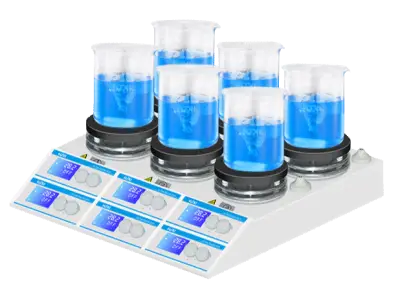
When choosing a compact magnetic mixer, match the device to the sample first and the bench second. Confirm the working volume, vessel compatibility, speed control, and power arrangement from the product page. If the work involves viscous materials, strong foaming, or abrasive solids, consider whether a different mixing principle is more appropriate. If the work involves many small samples, check whether the platform can accommodate the vessels and whether the controls allow quick, repeatable changes.
Good operating practice improves results more than a long list of features. Start at a low speed and increase gradually. Center the vessel over the drive. Use a stir bar that is appropriate for the volume and viscosity. Keep the vessel bottom flat and clean. Record the setting, bar type, and mixing time so that the procedure can be repeated. For sensitive samples, avoid unnecessary aeration and check the temperature during long mixing periods.
Frequently Asked Questions
Can the Portable Mini Magnetic Blender mix powders into liquids?
It can help disperse fine, wettable powders that are added gradually to a liquid, but it is not a dry powder blender. Powder should be sprinkled in slowly to avoid clumping, and the stir bar should be strong enough to maintain flow as the mixture thickens. Dense or poorly wettable powders may settle quickly or overload the magnetic coupling. For heavy powder loads, a different mixing method may be more reliable.
Does the device heat the sample?
Magnetic mixing is a stirring method, not a heating method. Any warming comes from motor operation and fluid friction, and it is usually modest. The Portable Mini Magnetic Blender should not be treated as a hotplate unless the product documentation explicitly states that it has a heating function. Temperature-sensitive samples should be monitored with a separate thermometer.
Can it handle viscous or thick samples?
Viscous samples are the most common limit for magnetic mixing. As viscosity rises, the stir bar must overcome more resistance, and the magnetic coupling may slip or stall. A smaller volume, a different bar, or gentle warming may help within safe limits. Thick pastes and gels are generally better handled by overhead stirring, planetary mixing, or another method designed for high load.
Why does the stir bar jump or spin out?
A jumping bar usually means that the magnetic coupling is losing sync. Common causes include starting at too high a speed, using a bar that is too large or too small, placing the vessel off center, using a vessel with a curved or uneven bottom, or mixing a sample that is too viscous. Reduce the speed, recenter the vessel, change the bar, or reduce the volume before trying again.
How should the unit be cleaned?
Unplug the unit before cleaning. Wipe the base with a damp cloth and avoid letting liquid enter the housing. Remove the stir bar with a suitable tool, clean the vessel and bar according to laboratory procedure, and let them dry. Do not immerse the base in water. If a spill occurs, clean it promptly and check that the top surface is dry before the next use.
Is it a replacement for a homogenizer or ball mill?
No. A homogenizer uses high shear to break up droplets, cells, or agglomerates, and a ball mill uses grinding media to reduce particle size. The Portable Mini Magnetic Blender provides gentle to moderate liquid motion. It is a useful complement to those methods for routine mixing, but it is not a substitute when the process requires particle-size reduction, intense emulsification, or high-shear disruption.
Product Information and Further Reading
For the current configuration, accessory options, and technical details of this compact laboratory mixer, consult the official Portable Mini Magnetic Blender product page. The page should be treated as the primary source for specifications, since the principles above describe magnetic mixing in general and do not replace the manufacturer's operating instructions.
Related Products
Get In Touch
Our professional team will reply to you within one business day. Please feel free to contact us!