

What is a Plastic Crusher? A Crushing Equipment for Recycling Plastic Waste and Scrap
What is a Plastic Crusher?
At its core, a plastic crusher (also known as a plastic shredder or plastic granulator) is a specialized crushing machine used to break down various plastic materials—such as plastic pipes, sheets, films, bottles, containers, and production scrap—into smaller, uniform granules. These granules can then be directly fed into extruders or injection molding machines for remanufacturing, or further processed for recycling. In industries like plastic recycling, injection molding, and packaging, a plastic crusher plays a vital role in waste reduction and material recovery.
Core Function and Working Principle
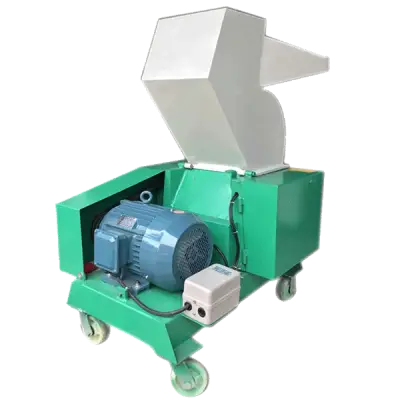
The basic function of a plastic crusher is to convert large, irregular plastic waste into controlled particle sizes through mechanical force. The machine typically consists of a hopper, a crushing chamber, a rotating knife disc (rotor) equipped with multiple cutting blades, stationary knives fixed on the chamber, a screen mesh, and a motor. When the motor drives the rotor at high speed, the rotating blades interact with the stationary knives to shear, cut, and tear the plastic material. The process can involve impact, compression, and shear forces depending on the plastic type.
The crushed particles fall through a screen mesh at the bottom of the chamber, which determines the final particle size. By adjusting the mesh size, rotor speed, and blade geometry, operators can control the output granularity from coarse chips (10-20 mm) to fine particles (1 mm or less). Key parameters such as motor power, blade material (commonly alloy steel), and clearance between blades directly affect crushing efficiency, energy consumption, and product quality. For instance, harder plastics like ABS or polycarbonate require higher torque and more robust blade designs, while softer materials like LDPE films may need specialized anti-wrapping features.
Main Types of Plastic Crushers
Plastic crushers can be categorized based on the material type and application. The three common types are:
Hard Plastic Crusher
Designed for crushing rigid and thick plastic materials such as ABS, PE, PP sheets, and engineering plastic scraps. These crushers feature a rectangular feeding port to accommodate long sheets, and they often use thick, durable blades to withstand heavy loads. They are ideal for recycling production waste from sheet extrusion and thermoforming lines.
Heavy-Duty Plastic Crusher
A versatile option that handles a wide range of plastic forms—scrap parts, pipes, profiles, bottles, and packaging materials. The blade design is a hybrid between claw and flat blades, offering balanced cutting performance. This type is suitable for general recycling facilities and injection molding workshops that process mixed plastic waste.
Plastic Pipe Crusher
Specially built for crushing plastic pipes and tubes (PE, PVC, silicone pipes). The feeding port is round or oval to allow long pipes to enter easily. The machine is optimized to handle cylindrical shapes without jamming, often equipped with a pneumatic or hydraulic pusher to feed long pipes automatically.
Additionally, crushers are classified by blade style: claw-type (片刀) blades deliver a scissor-like cut for thin-walled materials, while flat blades (平刀) are better for thick-walled or solid plastics. The choice depends on the physical form and hardness of the incoming material.
Key Performance Indicators and Selection Criteria
When selecting a plastic crusher, buyers should evaluate several critical specifications:
Processing Capacity
Measured in kilograms per hour (kg/h), capacity ranges from small units (e.g., 100-200 kg/h for a 4 kW motor) to industrial machines (over 1000 kg/h). Match the capacity with your daily production volume to avoid bottlenecks.
Motor Power and Energy Efficiency
Higher power (e.g., 7.5 kW to 30 kW) allows processing tougher materials but increases energy costs. Look for models with low specific energy consumption (below 0.15 kWh/kg for optimal efficiency).
Feeding Opening Size
The inlet dimensions (e.g., 410×235 mm for a 400 model) must accommodate the largest scrap pieces. For long pipes or sheets, a larger opening is essential.
Blade Material and Durability
Common blade steels include 9CrSi (9 silico-manganese) and SKD-11 (tool steel). Hardened alloy steel blades last longer and maintain sharpness, reducing replacement frequency. Some crushers use imported tool steel for demanding applications.
Noise and Dust Control
Many modern crushers feature soundproofed chambers (e.g., sandwich structure with sound-absorbing material) and dust-sealed designs to create a cleaner working environment.
Maintenance and Safety
Modular designs that allow easy access to the blades, screen, and chamber simplify cleaning and blade replacement. Safety features like overload protection, emergency stop, and interlocked covers are important for operator protection.
Application Areas and Selection Advice
Plastic crushers are widely used in:
- Recycling plants: to process post-consumer waste like bottles, containers, and films for reuse.
- Injection molding and extrusion factories: to granulate defective parts, sprues, and edge trimmings for immediate re-feed.
- Packaging companies: to break down plastic packaging waste (shrink wrap, strapping) for volume reduction.
- Waste management facilities: to pre-crush mixed plastics before further sorting or washing.
For small workshops, a compact model with 5-10 kW motor and a 400×250 mm opening is often sufficient. Large recyclers should consider a heavy-duty crusher with 22 kW or more, a feeding opening over 600×400 mm, and automatic feeding systems. If your material contains high percentages of films and thin sheets, choose a claw-blade design; for thick profiles or purgings, a flat-blade or hybrid model is more effective.
References
Please visit the product page for more details: Plastic Crusher - TENCAN
Related Products
Get In Touch
Our professional team will reply to you within one business day. Please feel free to contact us!