

What Is an Oblique Mixer? A Tilted Drum Device for Homogeneous Powder Blending
What Is an Oblique Mixer?
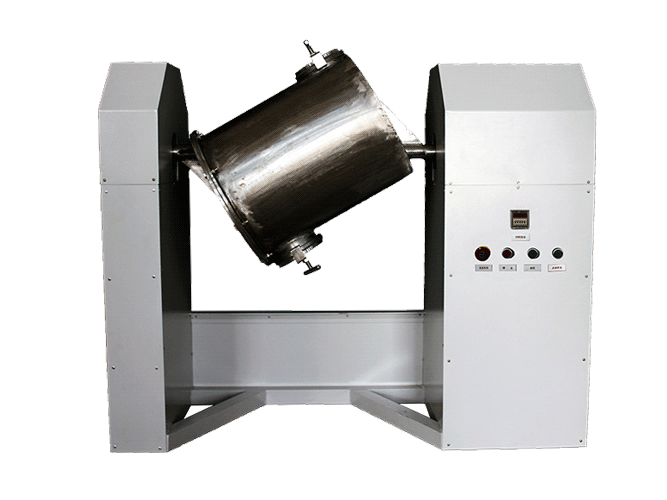
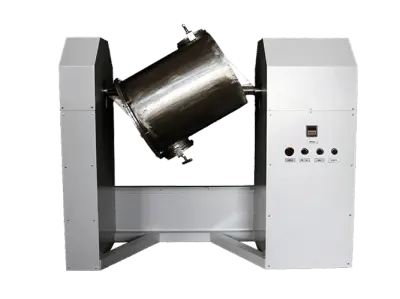
In plain terms, an oblique mixer is a professional powder blending machine whose mixing drum is mounted at an inclined angle instead of sitting horizontally or vertically. Industries such as pharmaceuticals, food processing, battery materials, ceramics, chemicals and metallurgy use it to turn several separate ingredients into a single uniform batch. Because the drum rotates about a tilted axis, the material inside does not simply slide or settle at one end of the vessel; it is lifted, folded and circulated through the whole drum in a smooth three-dimensional path. The result is a gentle but effective blending action suited to free-flowing powders, granules and other dry or slightly moist solids, where the goal is uniformity rather than size reduction. Unlike high-shear equipment, an oblique mixer keeps particles largely intact, which matters when fragile granules or heat-sensitive powders must not be crushed or overworked during processing.
How an Oblique Mixer Works
An oblique mixer changes material from a set of unevenly distributed components into a homogeneous mixture. The feedstock arrives as two or more streams — a main powder plus minor additives, colourants, binders, lubricants or active ingredients — and leaves as one batch in which the concentration of every component is close to its target value throughout the drum. The machine achieves this without blades, paddles or screws inside the product zone, because the only surface the powder touches is the rotating drum itself.
The Tilted Drum and the Flow It Creates
The defining feature is the angle of the drum axis. When a vessel rotates about a tilted axis, gravity and the drum wall continually disagree about where the material should sit. Particles are carried up the rising wall, then slide or cascade back toward the lower part of the drum, where they meet material moving in the opposite direction. This repeated lift-and-cascade cycle keeps exchanging material between the top and bottom of the bed and between the front and rear of the drum, so no region remains static for long. Changing the tilt angle alters the balance between axial and radial movement, which in turn affects how quickly a cohesive, very light or unusually shaped powder becomes uniform.
Convection, Diffusion and Shear
Blending in a rotating drum is usually described through three actions that happen at the same time. Convection moves large groups of particles from one zone to another and does most of the work early in the cycle. Diffusion works at a smaller scale, as individual particles migrate through the voids between their neighbours and gradually erase local differences in concentration. Shear, which is relatively mild in this type of machine, acts along the sliding layers where the bed moves over itself. A well-designed oblique mixer balances all three. Too little motion and the batch never becomes uniform; too much and the powder may segregate, generate dust or break down fragile granules. The tilted geometry is what allows the machine to keep these actions working together without an internal agitator.
A Complete Mixing Cycle
The process follows a simple sequence: the drum is loaded through its opening, the port is closed and sealed, the vessel rotates for the programmed time at the set speed, and the batch is discharged once the drum is positioned to let the powder flow out. Between batches the interior is cleaned or purged so that no residue from the previous recipe remains. Keeping this sequence identical from batch to batch is what makes the operation reproducible.
Key Process Parameters That Determine Mixing Quality
Four variables account for most of the difference between a batch that meets specification and one that does not: rotational speed, fill ratio, mixing time and the properties of the material itself. None of them can be set sensibly in isolation, because each one changes the effect of the others.
Rotational Speed
Drum speed is the first parameter operators adjust. At low speeds the bed simply slides over itself and mixing is slow. As speed rises, particles are carried further up the wall before cascading, and the exchange between layers becomes more vigorous. Beyond a certain point — often described as the critical speed, where material would be pinned to the wall by centrifugal force — the bed stops tumbling altogether and mixing efficiency collapses. Practical operating ranges therefore sit well below that limit, and the right value depends on drum diameter, the angle of the axis and the flow properties of the powder. Variable-frequency drives are common because a single fixed speed rarely suits every recipe.
Fill Ratio
The proportion of the drum volume occupied by material strongly influences both mixing speed and consistency. A very light load tends to slide rather than tumble and can leave a batch under-mixed, while an over-filled drum leaves no free space for particles to move into, so circulation stalls. Many operators work within a moderate fill band that leaves a clear air space above the bed, and they keep that ratio constant from batch to batch. Reproducibility across production runs often depends more on disciplined loading than on any single machine setting.
Mixing Time
Mixing improves quickly at first and then levels off. Most batches reach a practical degree of uniformity well before theoretical perfection, and extending the cycle further mainly adds heat, abrasion and wear. Determining the correct time is therefore an experimental exercise: sample the batch at intervals, measure the concentration of a tracer or key component, and plot the result until the curve flattens. That point becomes the validated mixing time, with a safety margin agreed between production and quality teams.
Material Properties
Particle size distribution, bulk density, shape, moisture content and surface charge all affect how a powder behaves in a tilted drum. Narrow, free-flowing granules blend quickly, while fine cohesive powders may form lumps or cling to the wall, and ingredients with very different densities or particle sizes can separate again once motion stops. Pre-blending minor ingredients, controlling humidity in the working area, or selecting an appropriate internal surface finish can all help. Because these factors are recipe-specific, trials with the actual materials remain the most reliable way to fix the parameters.
Core Components and Key Technologies
Although an oblique mixer looks simple from the outside, its performance depends on a small number of well-matched components working together.
The Mixing Drum
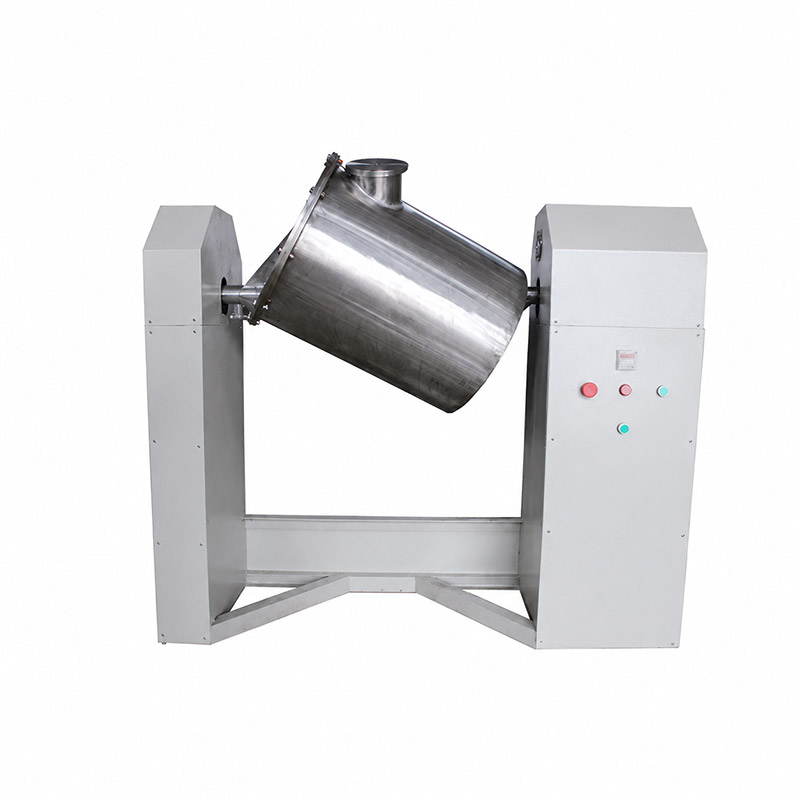
The drum is the heart of the machine. It is normally a cylindrical or slightly conical vessel made from stainless steel, with an internal surface smooth enough to stop powder from clinging yet robust enough to resist abrasion from hard, sharp particles. Some units are supplied with a liner or a polished finish to suit a particular industry; food and pharmaceutical users typically require crevice-free welds and surfaces that can be cleaned and inspected easily. The diameter, length and working volume of the drum define the batch size, while wall thickness determines how much mechanical duty the vessel can take over years of rotation.
Drive, Frame and Control System
The drum sits in a frame that holds it at the designed angle and carries the bearings on which it turns. A geared motor and, in most modern designs, a variable-frequency drive rotate the vessel at a controlled speed. The frame must absorb the dynamic loads of an off-centre, partly filled rotating mass, so rigidity and correct alignment matter as much as motor power. The control panel ties speed, running time and, on automated models, loading and discharge sequences into a repeatable recipe that an operator can recall at the touch of a button.
Discharge, Sealing and Dust Control
Because the drum is inclined, discharge is normally arranged through a port or valve positioned so that the blended batch flows out completely when the vessel is indexed to the correct position. A clean, complete discharge reduces cross-contamination between products and shortens cleaning time. Seals around the drum opening protect the product from lubricants and outside contamination, while an enclosed design keeps fine dust inside the equipment. For powders that are toxic, moisture-sensitive or prone to static build-up, an inert-gas purge or a sealed discharge arrangement can be specified.
Key Performance Indicators and Selection Criteria
When comparing machines, it helps to separate the numbers that describe capacity from those that describe results, and to weigh both against the cleaning and maintenance workload the equipment will create.
Capacity and Batch Size
Capacity is usually expressed as the working volume of the drum rather than its total volume, because a certain free space is always needed for the bed to move. Match that figure to the batch sizes you actually run. A large machine operated at a very small fraction of its capacity may not mix reliably, because the bed is too shallow to tumble properly. Where several products share one line, choose a size that covers the largest routine batch while still allowing a sensible fill ratio for the smaller ones.
Homogeneity and Particle Integrity
Uniformity is normally expressed as a coefficient of variation, or as the deviation of a key component from its target value, measured on samples taken from several positions in the discharged batch. A good machine reaches the agreed specification within a realistic cycle time and repeats that result batch after batch. Just as important is what the machine does not do: with no internal agitator and a low running speed, an oblique mixer tends to preserve granule shape and coating integrity, which is an advantage when the product is a fragile agglomerate rather than a powder to be milled.
Energy Use, Automation and Cleaning
Tumbling mixers are generally low-energy devices compared with high-shear or fluidised systems, because they turn the whole vessel slowly instead of spinning a fast impeller through the product. Real consumption depends on batch size, cycle time and how often the machine starts and stops. Automation features worth asking about include recipe storage, controlled acceleration and deceleration, and interlocks that prevent the drum from turning while an access port is open. On the cleaning side, look at how easily the drum empties, whether the interior can be reached for inspection, and whether the design supports the cleaning validation your sector requires.
Construction Materials and Compliance
Stainless steel is the usual choice, but grades, surface finishes and liner options vary with the application. Abrasive minerals may justify a wear-resistant liner, while corrosive chemicals may call for a higher alloy. Regulated industries will also want documentation: material certificates, surface roughness values and evidence that the equipment can be cleaned to the standard their auditors expect.
Applications and Selection Advice
Oblique mixers appear wherever dry solids must be blended gently but thoroughly. Typical users include pharmaceutical and nutraceutical producers preparing dry blends before tableting or capsule filling; food manufacturers combining premixes, spices, instant powders and flavourings; battery and electronic-materials plants blending cathode, anode and conductive additive powders; ceramic and glass producers homogenising bodies and glazes; and chemical companies preparing pigments, detergents, fertilisers and plastic compounds. Small units are equally common in laboratories and pilot plants, where experimental formulations are blended under conditions that can later be scaled up to production.
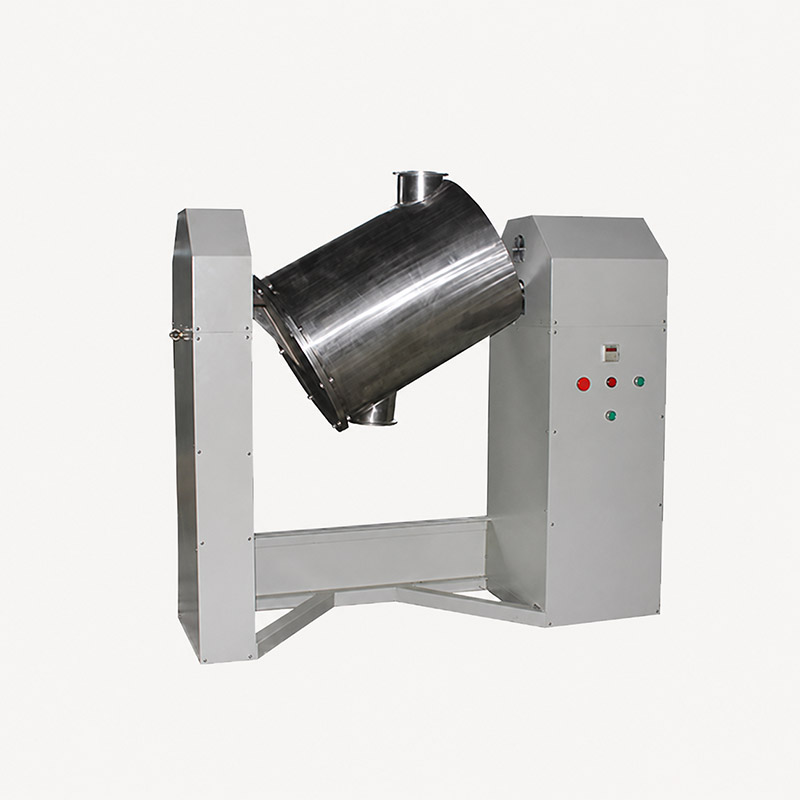
When choosing a machine, start from the material rather than the specification sheet. Ask whether the powder is free-flowing or cohesive, whether granules must survive intact, how abrasive or corrosive it is, and what level of uniformity the finished product needs. Then consider batch sizes, how many recipes will run on the same machine, and the cleaning regime between products. Laboratory and small-scale users should value flexibility, easy sampling and quick changeover, while production users should prioritise repeatability, dust-tight operation, discharge efficiency and service access. Where a new formulation is involved, a trial in the actual drum with the actual powder is worth more than any generic capacity table.
Frequently Asked Questions
Does an oblique mixer grind or crush the powder?
No. Its purpose is to blend, not to reduce particle size. With no internal blades and a slow drum speed, particles are tumbled gently against one another, so the effect on particle size is minimal. If size reduction is the objective, a mill rather than a mixer is the right tool.
How long does a typical mixing cycle take?
Cycle time depends on the drum, the load and the material, so it is best established by trial. In practice most batches reach the required uniformity within a period measured in minutes rather than hours, and the optimum is the point at which the uniformity curve levels off.
Can one machine handle several different products?
Yes, provided the cleaning and validation requirements of each product can be met between batches. Recipe-controlled drives simplify changeover, but avoiding cross-contamination still depends on complete discharge and thorough cleaning.
How does it compare with a V-shaped or double-cone mixer?
Each geometry has strengths. V-type and double-cone mixers generate strong cross-flow for free-flowing powders, while a tilted drum tends to cope better with a wide range of fill levels and with slightly cohesive materials. The right choice depends on the powder and the batch size.
Which materials can be processed?
Free-flowing powders, granules, pellets and many slightly moist solids are suitable. Very sticky or wet pastes, and materials that must be heated or reacted during mixing, usually need different equipment.
Where to Learn More
If you want to see how an inclined-drum blender is built and which configurations are available, the oblique mixer page presents the machine in detail, including its drum, frame and control arrangement. You can also review the oblique mixer product page to compare sizes against your own batch requirements. Where a powder sits at the edge of what tumbling can handle, it is worth discussing the material with the manufacturer before ordering, so that drum size, surface finish and discharge arrangement are matched to the job from the start.
Related Products
Get In Touch
Our professional team will reply to you within one business day. Please feel free to contact us!