

What Is a Nylon Roll Mill Jar? A Lightweight Jar for Contamination-Free Milling
What Is a Nylon Roll Mill Jar?
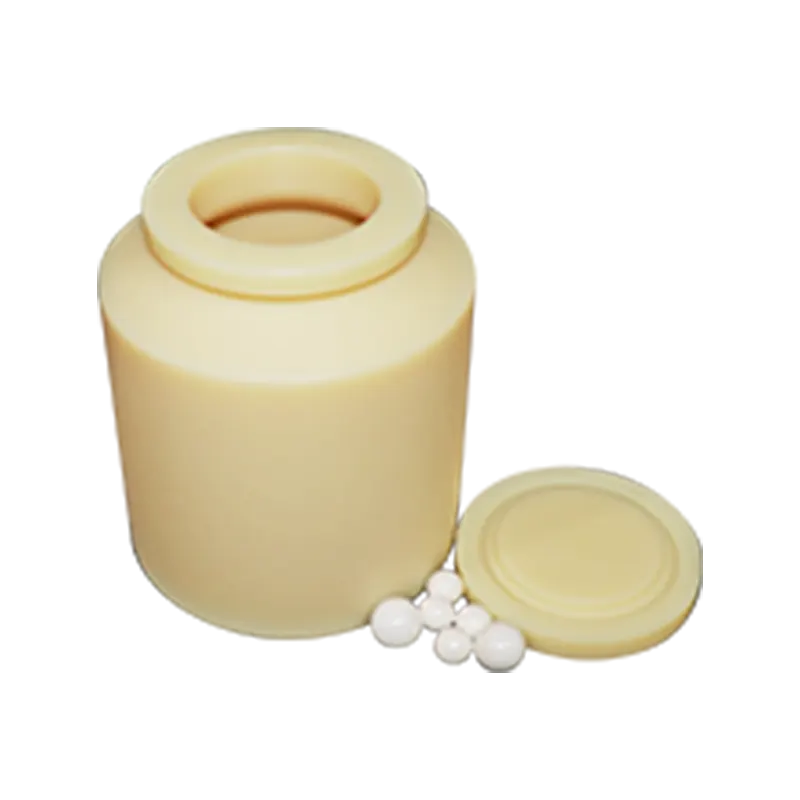
From its core, a nylon roll mill jar is a cylindrical grinding vessel made of engineering-grade nylon that serves as the working chamber of a roller ball mill, and laboratories, ceramic workshops, pigment producers and chemical plants use it to turn small batches of brittle or semi-hard material into fine, uniform powder without introducing metallic contamination. Instead of being clamped to a vibrating arm or rotated around a central axis the way a planetary jar is, this vessel is simply laid on two parallel power-driven rollers. Friction between the rollers and the jar wall spins the jar, the grinding media inside tumble and cascade, and the sample is progressively crushed and rubbed down to the target particle size. The nylon wall is the defining feature of the design: it is light, quiet, non-sparking, tolerant of many solvents and mild chemicals, and soft enough that it cannot rust or shed iron flakes into the powder. In practice, the jar decides how clean the finished powder will be, while the roller mill decides how fast and how fine the grinding will be.
Core Functions and Working Principle
From Coarse Feed to Fine Powder
The primary function of a roll mill jar is to convert a coarse, often inhomogeneous feed into a homogeneous fine powder. The jar is charged with grinding media until roughly one third to one half of its internal volume is occupied, a measured quantity of sample is added, the lid is closed and sealed, and the whole vessel is placed on the rotating rollers of the mill. Once the rollers start turning, the jar rotates at a controlled speed and each revolution lifts the media up the rising inner wall before gravity pulls the charge back down onto the material bed at the bottom of the jar. Powder trapped between two colliding balls is fractured by impact, while powder trapped between a ball and the nylon wall is sheared and rubbed. Because this cycle repeats thousands of times per hour, particle size falls steadily, and after the programmed milling time the powder is discharged through the jar mouth. The same mechanism blends multi-component formulations, so grinding and homogenisation usually happen in a single step.
What Happens Inside the Jar as It Rotates
The motion of the grinding media is the heart of the process, and it is governed mainly by rotational speed. At low speed the balls simply roll over one another in a cascading pattern, which produces gentle attrition and is well suited to soft or heat-sensitive samples. As speed increases, the media are carried higher up the wall and then fall in steep trajectories, a condition known as cataracting; this adds strong impact energy and accelerates size reduction considerably. If the speed is pushed too far, the centrifugal force pins the entire charge against the wall and the balls rotate with the jar instead of tumbling, so almost no grinding takes place. The threshold at which this happens is called the critical speed, and it depends on the internal diameter of the jar: larger jars reach their critical speed at lower revolutions per minute than small ones. Practical operation therefore stays in the range of about fifty to seventy-five percent of critical speed. A nylon jar is normally run in the moderate part of that window, because nylon is a relatively soft polymer and excessive impact energy both wears the wall and generates heat that a polymer body cannot easily dissipate.
Key Process Parameters That Shape the Final Powder
Once the jar and mill are chosen, a handful of variables decide whether the batch meets specification. They interact with one another, so changing one usually requires re-checking the others:
- Rotational speed: controls whether the media cascade or cataract, and therefore whether attrition or impact dominates the grind.
- Jar filling ratio: media typically occupy one third to one half of the jar volume. Too little media wastes capacity; too much crowds the charge and reduces the free fall that creates impact.
- Media diameter and density: larger, denser media deliver more impact energy and break coarse particles faster, while smaller media create more contact points and are better for fine grinding.
- Ball-to-powder ratio: the mass ratio between media and sample commonly ranges from about five to one up to twenty to one. A higher ratio grinds faster but reduces the batch size the jar can hold.
- Milling time: particle size decreases quickly at first and then levels off; beyond the useful point, extra time only adds wear, heat and possible re-agglomeration.
- Wet or dry milling: a liquid medium suppresses dust and prevents fine particles from re-sticking together, but the slurry must be dried afterwards; dry milling is simpler and keeps the product free-flowing.
- Temperature: friction heats the charge, and nylon has a much lower heat tolerance than steel or ceramic, so long high-speed runs should be interrupted or kept moderate.
Core Components and Key Technologies of a Nylon Roll Mill Jar
The Jar Body and Wall Thickness
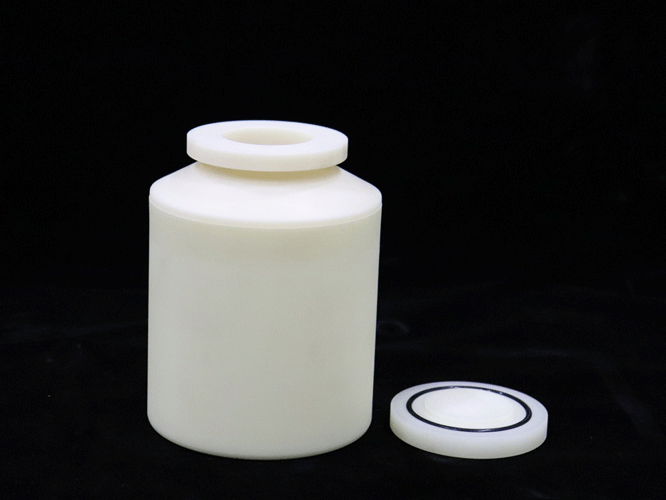
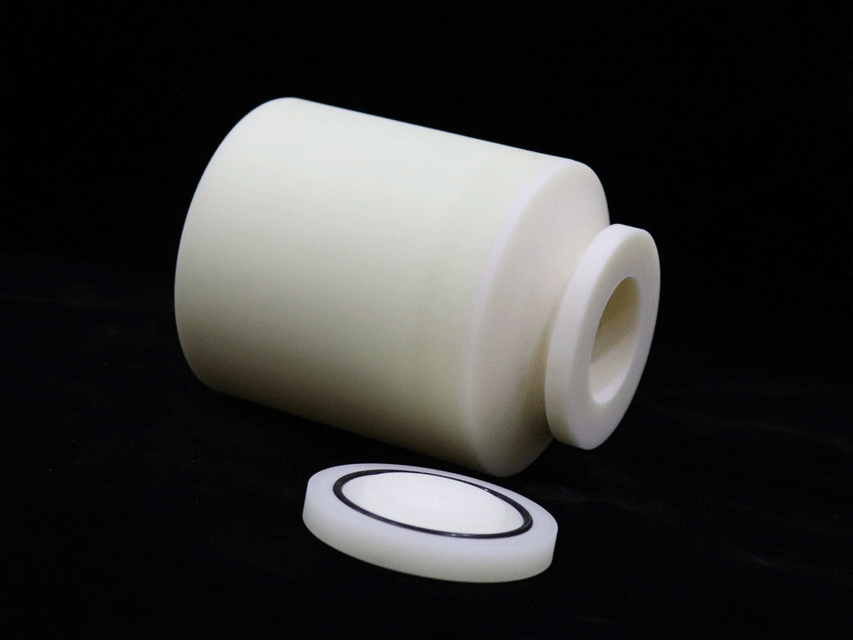
The body is a one-piece cylinder, usually with a flat or slightly profiled base so that it seats stably on the rollers. Nylon is machined or moulded into a smooth, non-porous bore that releases powder easily and does not scratch the sample. Wall thickness is a compromise: a thicker wall resists deformation and lasts longer, while a thinner wall transmits roller friction more efficiently and keeps the jar light enough for one operator to lift. The inner surface is deliberately kept free of sharp corners, because material tends to pack into crevices and is then difficult to recover completely.
The Lid, Gasket and Sealing System
A roll mill jar spends its working life rotating, so the closure has to stay tight without being over-engineered. The lid is pressed onto the jar mouth against a gasket, and the assembly is locked by a screw ring, clamp or bolted flange depending on the size of the jar. A good seal matters most for wet grinding, where any leakage means lost sample and a contaminated roller station, and it also keeps fine dry powders inside the vessel. Gaskets are usually made of an elastomer or PTFE so that they tolerate solvents and can be replaced cheaply when they harden.
Grinding Media Selection
Media choice must satisfy two rules: the media must be harder than the sample, and they must not react with it. Zirconia and agate balls are the common companions for nylon jars because they are chemically stable and cover a wide hardness range, while steel or tungsten carbide media are reserved for hard, tough feeds where a small amount of iron pickup is acceptable. Density matters too, since heavy media deliver more impact energy but also press harder against the nylon wall and shorten jar life. For soft polymers, resins, pigments and biological or organic samples, lighter media and a slower rotation give the cleanest result.
Rollers, Friction Drive and Speed Control
The mill itself contributes two driven rollers, usually rubber-coated to grip the jar, mounted on a frame that may accept one or several jars at a time. Speed is set through a variable-frequency drive, and a digital timer stops the run at the programmed moment. Many units also offer reversing rotation, which keeps the charge from settling into a single track and improves blend uniformity. Because the jar is a removable vessel, a laboratory can dedicate one jar to one material family, which is the simplest way to avoid cross-contamination between campaigns.
Key Performance Indicators and Selection Criteria
Jar Volume and Batch Capacity
Nominal jar volume is the first number to check, because it sets the realistic batch size rather than the nominal figure printed on the label. After deducting the space taken by media and the free volume needed for tumbling, the workable sample charge is usually a fraction of the jar volume. Buyers should therefore match the jar to the smallest useful batch they expect to run and to the loading capacity of their roller mill, then confirm that the mill frame can carry the combined mass of jar, media and powder.
Contamination Control and Material Compatibility
This is where a nylon jar earns its place. Because the bore is a polymer, it cannot rust, cannot chip like ceramic, and will not release iron or chromium into the powder, which matters for pigments, battery materials, pharmaceutical excipients and anything that will later be analysed for trace metals. Compatibility is the other half of the question: nylon resists water, alcohols, alkalis and many organic solvents, but it is attacked by strong acids and some aggressive solvents, and it softens at elevated temperatures. Users should confirm that their process liquid and their milling temperature fall inside the range the polymer can tolerate.
Wear Life, Cleaning and Maintenance
Nylon wears more quickly than steel or alumina, so the jar should be treated as a consumable that is inspected periodically rather than a permanent fixture. Visible scoring, a loose lid thread or a swollen gasket are signals to replace parts before the seal fails in the middle of a run. Cleaning is quick: rinse with water and a mild detergent, avoid aggressive solvents and abrasive pads that dull the surface, and dry the jar thoroughly before the next charge, because nylon can absorb moisture and carry odours from one sample to the next.
Speed, Time and Energy Efficiency
Energy consumption in a roller mill is modest compared with high-energy planetary equipment, so the main efficiency question is time. Running the highest safe speed with the correct ball-to-powder ratio usually shortens a batch more than simply extending the milling time, and it also limits the total heat the nylon has to absorb. A jar that is filled correctly will grind faster at a given speed than one that is under- or over-charged, which is why filling ratios are worth standardising as a written procedure.
Applications and Selection Advice
Typical Industries and Sample Types
Nylon roll mill jars are used wherever a clean, moderate-energy grind is required. Ceramic and glass producers use them to prepare glaze frits and oxide powders; pigment and coating manufacturers use them to disperse and reduce colourants; chemical and pharmaceutical laboratories use them for excipients, salts and organic crystals; and material science groups use them for polymers, resins, carbon black and other soft mineral or composite samples that would smear in a steel mill. Food and agricultural laboratories also use them for grain, seed and dry biomass samples where metal pickup would distort later analysis. In each case the combination of a sealed vessel, low noise and a non-sparking body makes the process easy to fit into a normal laboratory environment.
How to Choose the Right Jar for Your Process
Start with the sample: if it is soft, organic or analysed for trace metals, a nylon jar is usually the right first choice, while hard minerals and cemented carbides belong in ceramic or metal vessels. Next, fix the batch size and select a jar volume that leaves room for media and free movement, then match the media material and diameter to the target particle size, remembering that fine grinding wants many small balls rather than a few large ones. Finally, consider workflow: a laboratory running many different materials will benefit from several small jars on the same mill, whereas a production environment may prefer fewer, larger vessels and a written cleaning routine between campaigns. Once the sizes and materials are decided, the practical details of the vessel itself can be reviewed on the roller ball mill jar product page before ordering.
Further Reading
Engineering data, dimension options and ordering information for this consumable are listed on the nylon roll mill jar page, where the vessel can be matched to the roller mill and grinding media used in a given laboratory or production line.
Related Products
Get In Touch
Our professional team will reply to you within one business day. Please feel free to contact us!