

What is a Mini Centrifuge? A Compact Laboratory Centrifuge for Rapid Micro-Sample Separation
What is a Mini Centrifuge? A Compact Laboratory Centrifuge for Rapid Micro-Sample Separation
At its core, a mini centrifuge (also known as a microcentrifuge or benchtop centrifuge) is a compact, portable laboratory device that uses centrifugal force to rapidly separate small volumes of liquid samples. It is primarily used in molecular biology, clinical diagnostics, and biochemistry laboratories to spin down droplets, pellet cells, or separate components in microtubes, PCR strips, and microfilter assemblies. Unlike larger floor-standing centrifuges, mini centrifuges are designed for speed, convenience, and minimal footprint, making them an essential tool at every lab workstation.
Core Function and Working Principle
The basic function of a mini centrifuge is to convert a mixture of particles in a liquid suspension into a separated state—typically a pellet (solid) at the bottom of the tube and a supernatant (liquid) above. It achieves this by spinning the sample at high speed (typically 4,000–12,500 rpm) around a fixed axis, generating a centrifugal force many times greater than gravity. This force forces denser particles to migrate outward to the bottom of the tube.
The core working mechanism is simple: a small electric motor drives a rotor that holds the sample tubes. The rotor is designed to balance the load, and the lid is equipped with a safety lock that prevents operation when the lid is open. Most mini centrifuges feature a "quick-spin" function that runs for a preset time (e.g., 10 seconds) or continuous mode. The separation speed and time are critical parameters: higher speeds and longer times produce tighter pellets but may damage delicate samples. Typical parameters include a speed range of 6,000–12,500 rpm and a relative centrifugal force (RCF) of 1,500–9,800 × g.
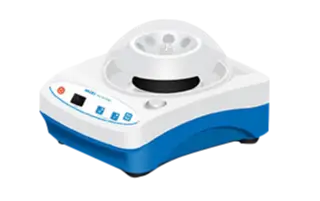
For example, a typical mini centrifuge like the Mini Centrifuge from TENCAN operates at 6,000 rpm and delivers 2,000 × g, sufficient for routine applications such as spinning down PCR reaction mixtures or collecting liquid from tube walls.
Types and Key Features
Standard-Speed Mini Centrifuge (6,000–7,000 rpm)
This is the most common type, offering a balance between speed and sample integrity. It is ideal for routine tasks like quick spin-downs, cell pelleting, and reagent mixing. Models typically include two rotors: a 6-place angle rotor for 1.5/2.0 mL tubes and a strip rotor for 8×0.2 mL PCR strips. Adapters for 0.5 mL and 0.2 mL tubes are usually included. Noise level is low (≤ 55 dB).
High-Speed Mini Centrifuge (12,000–15,000 rpm)
For applications requiring higher centrifugal force, such as microfilter cell separation, DNA extraction, and HPLC sample preparation. These models produce RCF up to 9,800 × g and often include digital timers and RPM/RCF displays. They are slightly larger but still benchtop-friendly. Examples include the mySPIN 12 from Thermo Scientific.
Portable/Kits
Some mini centrifuges come in a portable kit with a carrying case, battery option, or DC power adapter, making them suitable for field work or point-of-care testing. The mySPIN 6 Portable Kit is a good example, packaged in a transparent PC transport box.
Key Performance Indicators and Selection Criteria
When selecting a mini centrifuge for your lab, consider the following specifications:
- Maximum Speed (rpm) and RCF (× g): Higher speeds enable faster pelleting but may heat the sample. For most PCR and routine work, 6,000 rpm is sufficient. For microfilter applications, 12,000 rpm is recommended.
- Capacity and Rotor Compatibility: Check the number of tubes per run (e.g., 6×1.5/2.0 mL, 16×0.2 mL tubes, or 2×8 PCR strips). Ensure adapters for 0.2 mL, 0.5 mL tubes are included.
- Noise Level: Most mini centrifuges operate ≤ 55 dB, but some high-speed models may be louder. Quiet operation is important for shared lab spaces.
- Safety Features: Lid lock when running, imbalance detection, and auto-stop when lid is opened are essential for user safety.
- Ease of Use: Tool-free rotor exchange, one-button operation, and programmable timers enhance workflow efficiency.
- Power Supply: Universal voltage (100–240 V) with interchangeable plugs for global use.
- Weight and Dimensions: Typically 0.7–1.8 kg and footprint around 15×15×11 cm, ideal for crowded benchtops.
Applications and Selection Advice
Mini centrifuges are indispensable in a wide range of laboratory settings:
- Molecular Biology: Spinning down PCR tubes after thermal cycling, collecting droplets from tube walls, pelleting bacteria or yeast cells.
- Clinical Diagnostics: Separating plasma from whole blood samples, microfilter cell separation.
- Biochemistry: Microcentrifuge filtration for HPLC sample preparation, protein precipitation.
- Education: Teaching labs for basic centrifugation techniques.
For routine PCR work, a standard 6,000 rpm model is adequate. For high-throughput or microfilter applications, choose a high-speed model (12,000 rpm). If portability is needed (e.g., field sampling), select a portable kit. Always check that the rotor and adapters match your tube types (0.2, 0.5, 1.5, 2.0 mL).
Reference
Related Products
Get In Touch
Our professional team will reply to you within one business day. Please feel free to contact us!