

What is a Micro Airflow Pulverizer? A Jet Milling System for Ultrafine Powder Processing
What is a Micro Airflow Pulverizer? A Jet Milling System for Ultrafine Powder Processing
At its core, a micro airflow pulverizer is a specialized jet milling device used in the pharmaceutical, chemical, and advanced materials industries to transform coarse granular materials into ultra-fine powders, typically ranging from a few microns down to sub-micron levels. Unlike traditional mechanical grinding methods that rely on direct impact or shear, this equipment harnesses the kinetic energy of high-speed compressed air or inert gas to achieve particle size reduction through inter-particle collision and attrition.
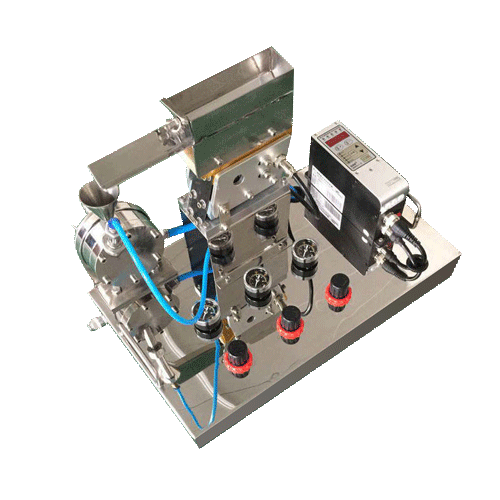
Core Function and Working Principle
The fundamental function of a micro airflow pulverizer is to convert bulk solid materials from a coarse feed state (typically 100-2000 microns) into a finely dispersed powder product. The operation begins when compressed gas, after being filtered and dried, is introduced through specially designed Laval or supersonic nozzles. These nozzles accelerate the gas stream to supersonic speeds (often 300-500 m/s or higher), creating a high-velocity jet within the milling chamber.
Material is fed into this jet stream, either through a venturi feeder or a screw feeder, where particles are immediately accelerated. The key mechanism is inter-particle collision: as particles travel at different velocities within the turbulent gas flow, they impact one another with tremendous force, causing fracture and size reduction. A built-in centrifugal classifier, operating on the principle of aerodynamic separation, continuously sorts the milled powder. Particles that have reached the target fineness are carried by the exhaust gas to a collection system (cyclone or filter), while oversized particles are returned to the milling zone for further reduction. This integrated classification system ensures a steep particle size distribution with minimal oversize content.
Critical process parameters include the grinding gas pressure (typically 6-10 bar), gas temperature, feed rate, and classifier wheel speed. Adjusting these parameters allows precise control over the final particle size and distribution width. The absence of moving parts in the milling zone makes this technology particularly well-suited for heat-sensitive, abrasive, or high-purity materials, as there is minimal heat generation or metallic contamination during the process.
Core Components and Key Technology
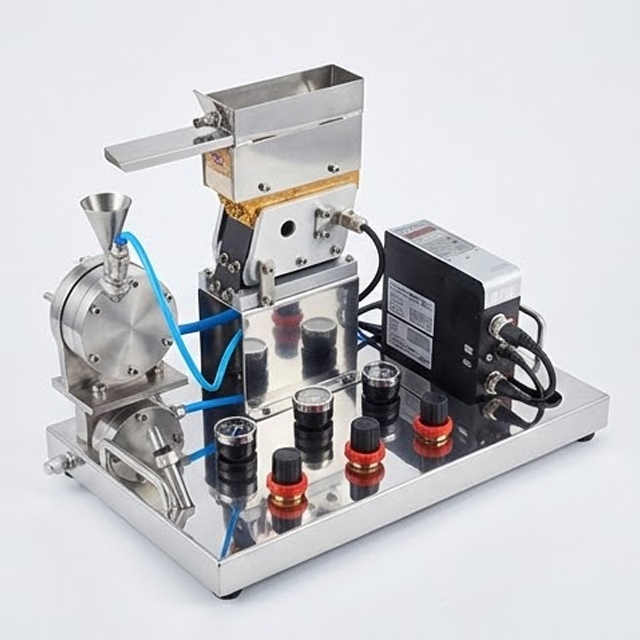
While a micro airflow pulverizer has a relatively simple layout, its performance relies on several critical components:
- Grinding Chamber and Nozzle Array: The chamber is typically a flat, disc-shaped cavity or a cylindrical fluidized bed. The arrangement of multiple nozzles—from two to several dozen—determines the collision geometry and energy distribution within the mill.
- Supersonic (Laval) Nozzles: These nozzles convert the potential energy of compressed gas into kinetic energy, creating the high-speed jet. Their precise design is crucial for achieving optimal acceleration and efficient grinding.
- Dynamic Classifier (Wheel): This rotating turbine, mounted at the top of the mill, acts as the grading stage. Its rotational speed sets the cut point: higher speeds retain smaller particles in the mill, producing a finer product.
- Product Collection System: High-efficiency cyclones and pulse-jet cartridge filters are used to separate the finished powder from the exhaust air stream.
- Control System: Modern units feature PLC-based controls that manage gas pressure, feed rate, and classifier speed, allowing for reproducible, automated batch or continuous processing.
Key Performance Indicators and Selection Criteria
When evaluating a micro airflow pulverizer for a specific application, the following performance indicators are critical:
Throughput and Capacity
Capacity is highly dependent on material properties (hardness, brittleness) and target fineness. Lab-scale units may handle grams per hour, while production models can achieve tens to hundreds of kilograms per hour. For applications like pharmaceutical micronization (e.g., inhaled drug powders), throughput is often secondary to precision and yield.
Fineness and Particle Size Distribution (PSD)
The standout capability of this technology is its ability to produce powders with a d50 (median particle size) of 1-10 microns, often with a narrow distribution. The integrated classifier ensures a sharp cut, minimizing the fine tail and coarse fraction.
Energy Efficiency
Jet mills are inherently energy-intensive due to the compression of gas. However, the efficiency of the mill is measured by how much energy is transferred from the gas to the particle collision event, versus waste heat or noise. Modern designs with optimized nozzle geometries are significantly more efficient.
Automation and Process Control
Full-featured units offer programmable logic control (PLC) with a touchscreen interface. Automation allows for recipe storage, consistent product quality across batches, and data logging for quality assurance in regulated industries like pharmaceuticals.
Maintenance and Cleaning
For industries requiring frequent product changes (e.g., contract manufacturing), ease of cleaning is paramount. The absence of internal moving parts simplifies cleaning, but the classifier wheel and seals must be easy to access and change. Units with FDA-approved or sanitary surface finishes are available for food and drug applications.
Applications and Selection Guidance
The micro airflow pulverizer is the equipment of choice for pharmaceutical micronization (active pharmaceutical ingredients for inhalers), fine chemicals (pigments, toners, catalysts), advanced ceramics (nano-powders), and food and nutraceuticals (spices, herbal extracts). For applications requiring narrow particle size distribution and contamination-free processing, the jet mill is often the only viable option.
For R&D and laboratory use, a compact, benchtop micro airflow pulverizer with a small batch capacity (10-100 grams) is ideal for developing formulations and optimizing process parameters. For production-scale manufacturing, larger industrial jet mills with automated feeding, collection, and CIP (Clean-in-Place) capabilities are required. When selecting a model, carefully evaluate your material's hardness, moisture sensitivity, and target fineness, and request a trial run to confirm the achievable throughput and particle size distribution.
Reference
Micro Airflow Pulverizer product page: https://www.planetaryballmills.com/products/grinding-series/other-grinding-equipment/micro-airflow-pulverizer.html
Related Products
Get In Touch
Our professional team will reply to you within one business day. Please feel free to contact us!