

What is a Lab Disperser? A High-Speed Dispersion Device Used for Laboratory Fluid Mixing and Emulsification
Opening Definition
At its core, a Lab disperser is a specialized piece of laboratory equipment designed for the rapid blending, emulsification, and homogenization of liquid and liquid-solid mixtures. Researchers and process engineers rely on this device to conduct small-scale trials, validating whether a specific formulation meets design specifications before committing to full-scale industrial manufacturing. Its compact footprint, modular architecture, and adaptable drive systems make it an indispensable asset for fluid dynamics research, pilot testing, and early-stage product development.
Core Functions and Working Principles
The fundamental purpose of a lab disperser is to convert segregated, immiscible phases into a highly uniform and stable suspension or emulsion. This transformation is driven by a high-speed rotating impeller or serrated dispersing disc mounted on a vertical drive shaft. As the rotor accelerates to speeds typically ranging from 3,000 to over 20,000 RPM, it generates intense centrifugal force, drawing material downward into a powerful vortex. Within this turbulent zone, the fluid experiences extreme mechanical shear, hydraulic friction, impact, and micro-turbulence.
The sharp geometry of the dispersing head forces particles through narrow stator-rotor gaps, effectively breaking down agglomerates, reducing particle size, and accelerating wetting and dissolution rates. The intensity of the shear field is quantified by the tip speed of the dispersing disc, which directly correlates with the energy input per unit volume. Higher tip speeds generate greater turbulent eddies, enhancing droplet breakup in emulsions and deagglomeration in suspensions. However, excessive shear can induce unwanted heating or alter the molecular structure of polymers, necessitating careful parameter optimization. Modern iterations often feature integrated cooling jackets or digital temperature monitoring to prevent thermal degradation of sensitive compounds during high-energy mixing cycles.
Main Configurations and Variants
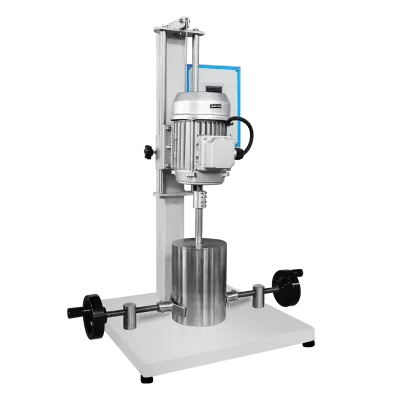
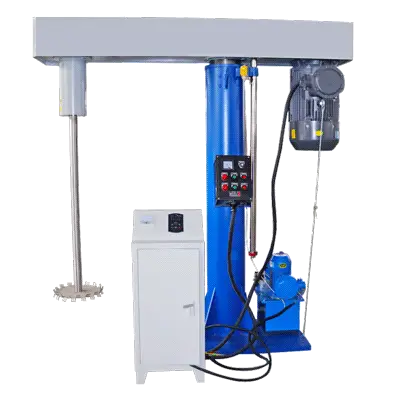
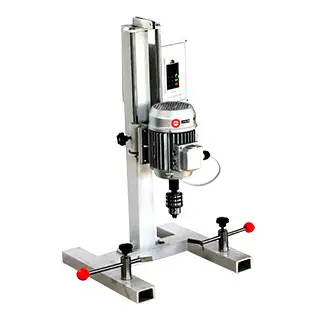
Lab dispersers are engineered in several distinct configurations to accommodate varying experimental demands. The most prevalent categories include manual lifting models, which prioritize portability and cost-effectiveness for routine blending and low-viscosity applications; hydraulic lifting systems, which deliver smooth, precise vertical travel for larger reaction vessels and continuous inline processing; and High speed dispersing homogenizers, which utilize precision-machined stator-rotor assemblies to achieve micron-level particle reduction and nano-emulsification.
Additionally, dual-function grinding-dispersing machines combine a conventional dispersing impeller with a bead mill or sand mill chamber, enabling simultaneous macroscopic mixing and microscopic grinding within a single closed loop. This integration minimizes material transfer losses and cross-contamination, making it ideal for high-value pharmaceuticals and advanced material synthesis. Selection among these variants hinges on target viscosity, required fineness, and whether the workflow emphasizes batch experimentation or continuous process simulation.
Key Performance Indicators and Selection Criteria
When evaluating a lab disperser for procurement, several critical performance metrics must be aligned with your research objectives. First, assess the processing capacity and motor power. Benchtop units generally handle volumes from 50 mL to 20 L, with drive motors ranging from 0.5 kW to 3 kW. Adequate power ensures consistent torque delivery when processing highly viscous pastes, concentrated slurries, or thermoplastic resins without stalling. Second, examine the speed control architecture and data acquisition capabilities. Variable frequency drives (VFD) or electromagnetic systems enable stepless, precise speed regulation, typically accompanied by digital RPM displays. Advanced models offer real-time logging of torque, temperature, and pressure, which are essential for experiment reproducibility and successful scale-up calculations.
Third, verify material compatibility and serviceability. All wetted components should be fabricated from corrosion-resistant alloys such as SUS304 or SUS316L stainless steel, with optional PTFE or ceramic linings for aggressive chemical environments. Modular architectures that permit rapid head interchange without specialized tools significantly reduce downtime and streamline cleaning protocols between experimental runs. Scalability is another paramount consideration. The geometric similarity between laboratory and industrial units, along with constant tip speed or power-per-volume ratios, dictates how well lab results translate to production lines. Selecting a disperser with standardized head geometries and documented performance curves facilitates smoother technology transfer.
Application Domains and Procurement Guidance
These dispersion systems find extensive utility across numerous sectors, including pharmaceuticals, cosmetics, food processing, protective coatings, adhesives, and emerging fields like battery electrode slurries and nanomaterial synthesis. For academic laboratories focused on initial formulation screening, a compact, manually operated unit with interchangeable heads typically provides sufficient flexibility and throughput. In contrast, pilot plant engineers and process developers preparing for commercial scale-up should invest in hydraulic lifting configurations equipped with robust data logging, temperature control, and safety interlocks.
Ultimately, matching the disperser’s hydrodynamic profile to your material’s rheological properties will optimize energy efficiency and product quality. Consulting comprehensive technical documentation and leveraging manufacturer engineering support ensures the selected system aligns precisely with your fluid processing requirements. For related mixing solutions, exploring complementary equipment such as Shear emulsifiers or multi-dimensional mixers can further expand your laboratory's processing capabilities.
References
Related Products
Get In Touch
Our professional team will reply to you within one business day. Please feel free to contact us!