
What is a Lab Air Jet Mill? An Ultrafine Grinding Device for Laboratory-Scale Particle Size Reduction

Introduction
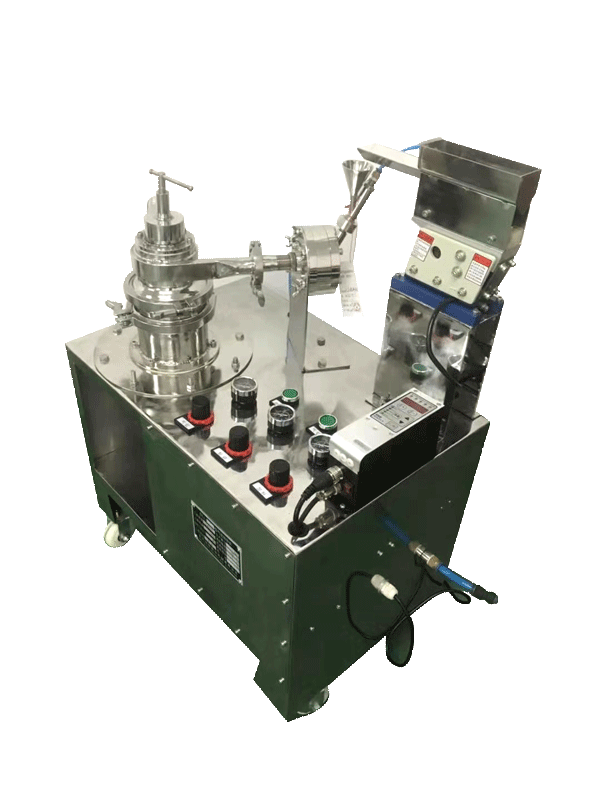
At its core, a lab air jet mill is a specialized grinding device that uses high-velocity compressed gas (air or inert gas) to reduce solid particles to ultrafine powders. Unlike traditional ball mills or hammer mills, it operates without any mechanical moving parts in the grinding chamber, relying entirely on particle-to-particle collisions. This makes it the preferred choice for laboratories and small-scale production requiring contamination-free, high-purity grinding with precise control over particle size distribution.
Core Function and Working Principle
The lab air jet mill transforms coarse feed material (typically <1 mm) into fine powders with D90 as low as 2 microns. The process begins when compressed air or nitrogen is introduced through a Venturi nozzle, creating a jet that draws the feed material into the grinding chamber at subsonic speed (~50 m/s). Once inside, the particles encounter a series of high-velocity gas jets from peripheral nozzles, which accelerate them to supersonic speeds (~350 m/s) along a spiral path.
As particles travel in this spiral trajectory, slower-moving particles collide with faster ones, generating intense impact forces that cause fragmentation. The centrifugal force keeps larger particles near the chamber wall for further grinding, while fine particles are carried by the gas stream toward the central outlet. A built-in classifier ensures that only particles meeting the target size exit the chamber, while oversized particles are recirculated for additional grinding. The entire process is exothermic-neutral (often slightly endothermic), maintaining a constant temperature—ideal for heat-sensitive materials.
Key parameters influencing the final particle size include gas pressure (typically 6–10 bar), nozzle geometry, feed rate, and classifier speed. The system operates in a closed loop with a cyclone separator and filter bag to collect the product, achieving near 100% yield with minimal product loss.
Key Components and Design Features
Although the lab air jet mill has a simple overall structure, its design incorporates several critical elements:
- Grinding Chamber: A flat, cylindrical chamber made of stainless steel (316L for contact parts) or ceramic to minimize contamination. The chamber geometry is optimized for efficient particle acceleration and collision.
- Venturi Feeder: Uses a converging-diverging nozzle to create a vacuum that draws powder into the gas stream, ensuring uniform feed without clogging, even for sticky materials.
- Peripheral Nozzles: Specially designed laminar-flow nozzles that direct gas jets at precise angles to create the spiral flow pattern. The nozzle design can be customized for different material properties.
- Static Classifier: An integral part of the chamber that separates coarse from fine particles based on centrifugal force and gas drag. No moving parts mean minimal maintenance.
- Product Collection System: Typically includes a cyclone separator for bulk collection followed by a pulse-jet filter bag (anti-static polyester) for capturing ultrafine particles. The system ensures single-point collection with high efficiency.
These components work together to eliminate issues like caking, back-blowing, and excessive wear, making the lab air jet mill suitable for a wide range of materials, including abrasive and heat-sensitive compounds.
Key Performance Indicators and Selection Criteria
When selecting a lab air jet mill, consider the following performance metrics:
- Processing Capacity: Laboratory models typically handle 2 g to 500 g per batch, while some pilot-scale units can process up to 5 kg/hr. Choose based on your sample size requirements.
- Particle Size Control: The ability to achieve D90 < 2 µm is common. Look for models with adjustable classifier cut points and consistent Gaussian-like particle size distributions.
- Gas Consumption: Efficient nozzle designs minimize compressed air or nitrogen usage. Lower consumption reduces operating costs, especially when using inert gases for oxygen-sensitive materials.
- Material of Construction: For pharmaceutical applications, 316L stainless steel with electropolished surfaces is essential. For abrasive materials, ceramic-lined chambers reduce wear and contamination.
- Cleanability and Validation: Quick disassembly, minimal contact surfaces, and smooth finishes facilitate cleaning between batches—critical for multi-product labs and GMP compliance.
- Automation and Control: Advanced models feature pneumatic control systems (no electrical power required in the grinding zone) for explosion-proof operation, with programmable logic controllers for precise parameter repeatability.
Additionally, consider the scalability: if you plan to scale up to production, choose a mill whose design can be linearly scaled (e.g., same chamber geometry and nozzle arrangement) to ensure consistent results from lab to production.
Application Areas and Selection Advice
The lab air jet mill finds extensive use in:
- Pharmaceuticals: Micronization of active pharmaceutical ingredients (APIs) for inhalation, poor solubility enhancement, and controlled release. It is particularly suited for heat-sensitive and sterile products.
- Chemicals: Fine grinding of pigments, dyes, catalysts, and agrochemicals where narrow particle size distribution improves product performance.
- Materials Science: Preparation of advanced ceramics, battery materials, and rare earth oxides with controlled particle morphology.
- Cosmetics and Food: Ultrafine powder production for formulations requiring smooth texture and high bioavailability.
For researchers working with small quantities (<100 g), a benchtop model with a 2 L hopper and manual cleaning is sufficient. For pilot-scale studies or small-batch production, choose a model with automated feeding and collection systems. Always confirm that the mill can handle your material’s hardness, abrasiveness, and moisture content. If the material is explosive or oxygen-sensitive, opt for inert gas operation and anti-static filter bags.
References
Related Products
Get In Touch
Our professional team will reply to you within one business day. Please feel free to contact us!