

What Is a Horizontal Tube Furnace? A High-Temperature Thermal Processing System
What Is a Horizontal Tube Furnace?
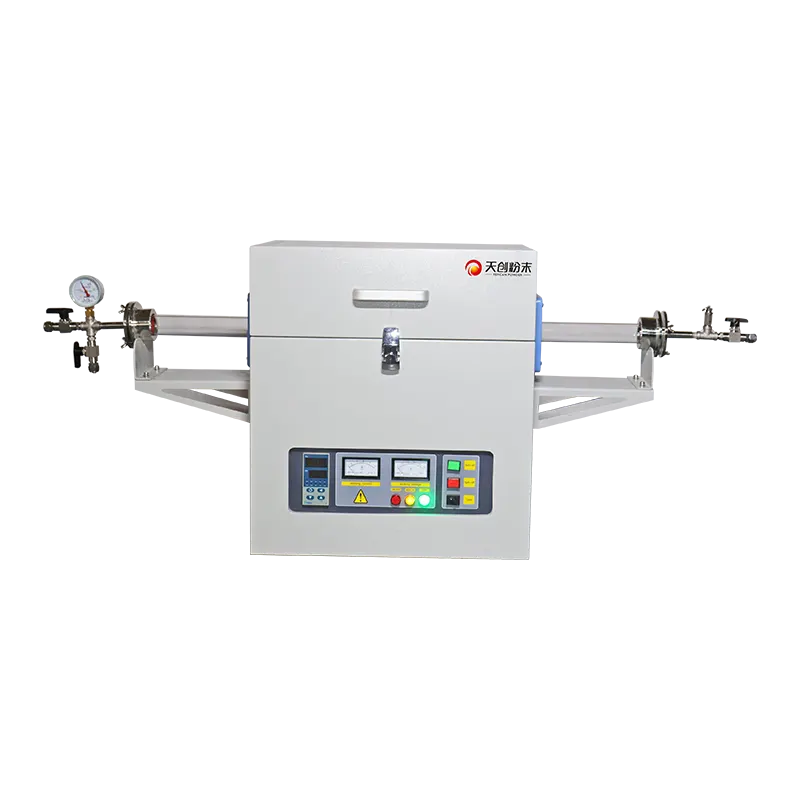
In simple terms, a horizontal tube furnace is a high-temperature thermal processing system built around a straight work tube that is mounted horizontally inside a heated chamber. Laboratories, pilot plants and specialised production cells use it to heat materials to a precisely controlled temperature — often under a controlled gas atmosphere, a reactive gas flow or vacuum — so that the material's structure, density, purity or surface chemistry changes in a predictable, repeatable way.
The geometry is what defines the equipment. Because the work tube is open at both ends, an operator can connect gas lines, vacuum pumps, bubblers or sealed flanges to either side, and a sample can be loaded from one end and pushed into the hot zone on a boat or tray. That accessibility separates a tube furnace from a closed-chamber muffle furnace, and it is the reason the design is so widely used wherever the atmosphere around a sample matters as much as the temperature itself.
How Does a Horizontal Tube Furnace Work?
From a Cold, Loaded Sample to a Treated Product
Every heating cycle follows the same basic sequence. First, the sample is placed in a crucible, boat or tray made of a material that will not react with it, and the boat is positioned at the centre of the heated zone — the part of the tube where temperature is most uniform. Second, the tube is closed and purged: air is displaced by the process gas, or the tube is evacuated, so that the atmosphere inside is known before heating begins. Third, the controller runs the programmed heating profile, holding the sample at set temperatures for set periods. Finally, the furnace cools at a controlled rate, and the sample is withdrawn once it is cool enough to expose to air without oxidation or thermal shock.
Each of these steps leaves a fingerprint on the final product. An incomplete purge leaves residual oxygen that can oxidise a metal powder or discolour a ceramic. A ramp that is too fast can crack a substrate or trap porosity. A cooling rate that is too slow can allow unwanted phases to grow. The furnace itself does not decide the result; it simply has to reproduce the same thermal and atmospheric conditions, cycle after cycle, with as little variation as possible.
The Heating Mechanism and the Uniform Hot Zone
Heat is generated electrically. Resistance heating elements — metallic wire alloys at moderate temperatures, silicon carbide or molybdenum disilicide elements at higher ones — are arranged around the work tube, separated from it by insulating material. At operating temperature, most of the energy reaches the sample by radiation from the tube wall; at lower temperatures, convection and conduction through the boat and the tube wall play a larger role.
No tube furnace is equally hot along its whole length. Temperature rises from the cold ends toward the middle and then flattens into a plateau — the uniform hot zone — before falling again on the other side. Good practice is to keep the sample entirely inside that plateau, and to check its length against the sample dimensions. A long boat that extends into the cooler ends will develop a temperature gradient across itself, which is a common and often invisible cause of inconsistent results.
Atmosphere Control: From Air to Vacuum
The atmosphere is managed through the end fittings. A typical setup uses sealed flanges with gas inlet and outlet ports, a flow meter or mass flow controller to meter the process gas, a bubbler or gas mixer when a specific gas composition is required, and an exhaust line that safely carries away reaction products. For oxygen-sensitive work, the same ports connect to a vacuum pump, and the tube is evacuated and backfilled before the run begins.
Sealing quality determines how well this works. Even small leaks allow oxygen and moisture to enter, which is why a slightly positive internal pressure is often maintained during processing, and why elastomer seals, tube end preparation and flange condition deserve attention. Pressure limits depend on the tube material and the fittings: a quartz tube under vacuum is subject to different mechanical stresses than a metal tube under slight overpressure.
Process Parameters That Shape the Result
Four parameters dominate: the maximum temperature, the dwell time at that temperature, the heating and cooling rates, and the gas composition and flow. Temperature governs which reactions and diffusion processes can occur at all; dwell time governs how far they proceed; ramp rate affects uniformity within the sample and the risk of cracking; and the gas determines whether the environment is oxidising, inert, reducing or reactive. Sample mass, particle size, packing density and boat material are secondary variables that often matter just as much, because they change how quickly the sample itself reaches and leaves the set temperature.
Core Components and Common Configurations
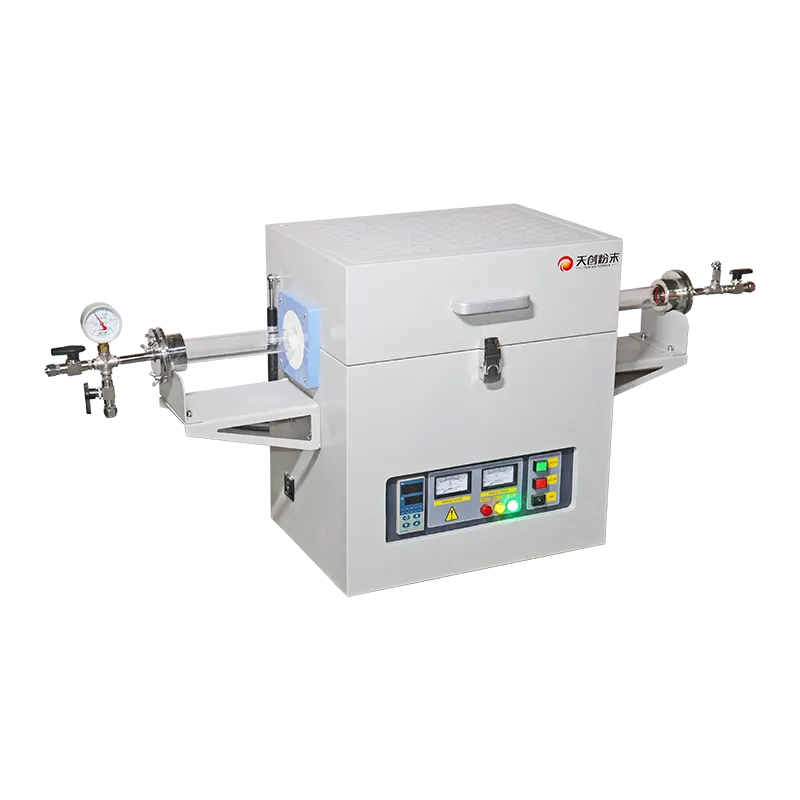
The Work Tube
The tube is the component that interacts most directly with the process, and its material sets hard limits on what the furnace can do. Quartz and high-silica glass are transparent, chemically clean and inexpensive, but they soften at high temperatures and are sensitive to thermal shock and to certain alkaline and metallic vapours. Alumina and mullite tubes tolerate much higher temperatures and are mechanically robust, at the cost of thermal shock resistance and a slower warm-up. Metal tubes, often water-cooled at the flanges, are chosen for vacuum work, reducing atmospheres and mechanical durability. Choosing the wrong tube is one of the most common and most expensive mistakes in furnace selection.
Heating Elements, Insulation and the Hot Zone
Elements are selected to match the required maximum temperature and atmosphere. Alloy wire elements work well in air up to moderate temperatures; silicon carbide and molybdenum disilicide elements extend the range considerably, but some grades require protective atmospheres or careful handling at low temperatures. Insulation — typically ceramic fibre board or shaped refractory — keeps the heat where it is needed, shortens heat-up time and protects the outer shell. The thickness and quality of that insulation also influence how quickly the furnace can cool, which matters when a fast turnaround between experiments is required.
Temperature Control and Atmosphere Hardware
A thermocouple positioned close to the work tube feeds a PID controller, which adjusts power to hold the setpoint. Multi-segment programmable controllers store complete profiles — ramp, dwell, repeat — so a laboratory protocol can be replayed exactly. Independent over-temperature protection, door interlocks and cooling-water monitoring are standard safety features on well-equipped units. On the atmosphere side, the usual accessories are gas flow meters or mass flow controllers, vacuum gauges, sealed flanges and, in more advanced setups, gas mixing panels that blend two or three gases to a target composition.
Single-Zone, Multi-Zone, Rotating and Vertical Variants
Single-zone furnaces have one controlled hot zone and suit most sintering, annealing and calcination work. Multi-zone versions divide the tube into separately controlled segments, which allows a deliberate temperature gradient — useful for chemical vapour deposition, where different reactions must happen at different points along the tube, or for studying diffusion between two materials. Rotating tube furnaces turn the tube slowly so that powders and granules are continuously tumbled, improving heat transfer and preventing agglomeration during calcination. Vertical tube furnaces, the counterpart of the horizontal design, are often chosen when samples must be dropped into or quenched from the hot zone quickly, or when gas should flow upward through a bed of powder.
Within the horizontal category itself, the practical distinctions are simpler: tube diameter and length, maximum temperature, element type, number of zones, and the level of atmosphere and vacuum hardware supplied. A furnace bought for air-based annealing and later needed for reducing-atmosphere sintering may require not just new fittings but a different tube entirely.
Key Performance Indicators and Selection Points
Temperature Range and Uniformity
Start with the maximum continuous working temperature, and treat it as a ceiling rather than a target — running an element or tube at its limit shortens service life. Ask for the length of the uniform hot zone, not just the tube length, because that figure determines the largest sample that can be processed reliably. If the work requires reproducibility across batches, the controller's accuracy and the thermocouple's placement matter as much as the headline temperature figure.
Tube Material, Diameter and Atmosphere Compatibility
Match the tube to the chemistry of the process. Inert and mildly oxidising atmospheres are relatively easy; reducing gases, halogens, alkaline vapours and high vacuum are not, and they frequently call for alumina or metal tubes rather than glass. Tube diameter is a trade-off between sample capacity and heating speed: a larger tube accepts bigger boats but takes longer to purge and to change temperature. Confirm that all seals, flanges and gas lines are rated for the intended atmosphere and pressure range before ordering.
Ramp Rate, Throughput and Automation
Heating and cooling rates determine cycle time and therefore throughput. A small tube with low thermal mass can complete a cycle much faster than a large one, so a lab running many short experiments may be better served by a compact furnace than by a high-capacity unit that sits idle while it cools. Programmable multi-step control, data logging and recipe storage reduce operator error and make results traceable — increasingly important where quality documentation is required.
Maintenance, Consumables and Safety
Consumables should be assessed over the life of the equipment: tubes, thermocouples, seals and heating elements all wear, and the cost and availability of replacements affect the real operating cost. Check the ease of tube replacement, the accessibility of the heating chamber, and the availability of spares. On safety, verify over-temperature protection, earth leakage protection, safe exhaust routing for toxic or flammable gases, and adequate ventilation for the gases used.
Typical Applications and How to Choose
Horizontal tube furnaces appear wherever a small or medium sample must be heated precisely in a defined atmosphere: sintering of ceramics and metal powders, annealing and stress relief of alloys, calcination of catalysts and inorganic pigments, carbonisation and graphitisation of precursors, purification of materials under reactive gas, growth of thin films and nanowires by chemical vapour deposition, and thermal testing of battery materials, glasses and composites. University and industrial research laboratories use them for method development; pilot lines use scaled versions to bridge the gap between a laboratory recipe and production.
As a rough guide: for general annealing and sintering in air or inert gas, a single-zone furnace with a quartz or alumina tube and a programmable controller covers most needs. For work involving corrosive vapours, high vacuum or high temperature, prioritise tube and element material above all else. For CVD, gradient studies or multi-stage reactions, choose a multi-zone model. For loose powders that tend to agglomerate, a rotating configuration is worth considering. And where the same furnace must serve several groups with different requirements, favour a modular design with interchangeable tubes and easily upgraded gas hardware.
Where to Learn More
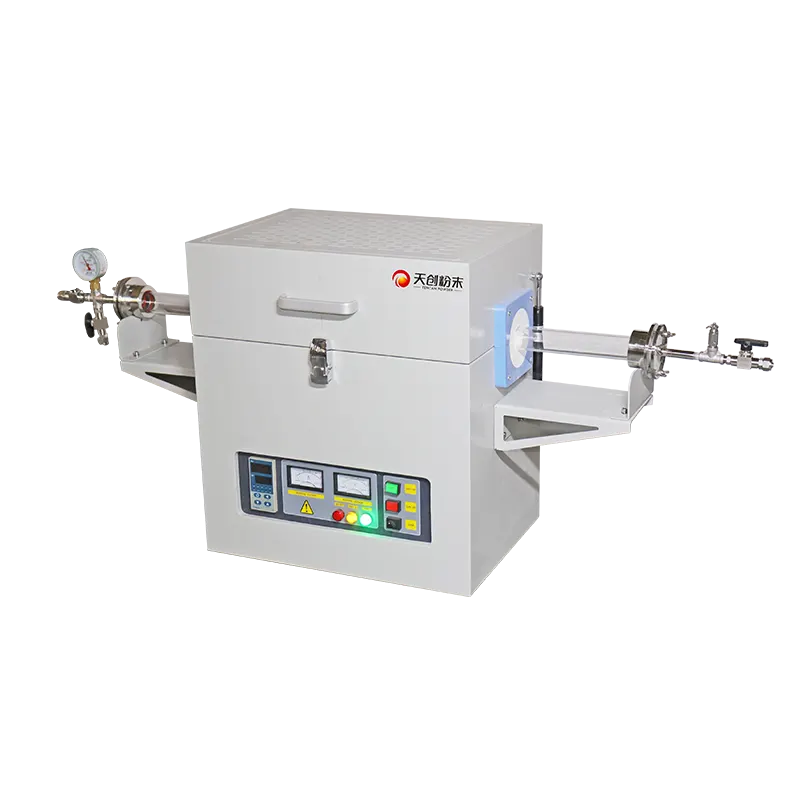
The general principles above apply to almost any horizontal tube furnace, but the details — tube dimensions, element type, controller specification and available atmosphere accessories — vary between models. The horizontal tube furnace in the TENCAN sintering series is one example of the configuration described here, and its product page lists the available options. Buyers comparing suppliers should request the hot-zone length, the recommended tube material for their specific process gas, and the safe operating limits for vacuum and pressure. Reviewing the full specification against a clearly written heating protocol is the most reliable way to avoid a furnace that looks suitable on paper but cannot reproduce the conditions a process actually needs, and it is worth doing before rather than after the equipment is installed.
Related Products
Get In Touch
Our professional team will reply to you within one business day. Please feel free to contact us!