

What is a Horizontal Screw Belt Mixer? A High-Efficiency Mixing Equipment for Powders, Granules, and Pastes
What is a Horizontal Screw Belt Mixer?
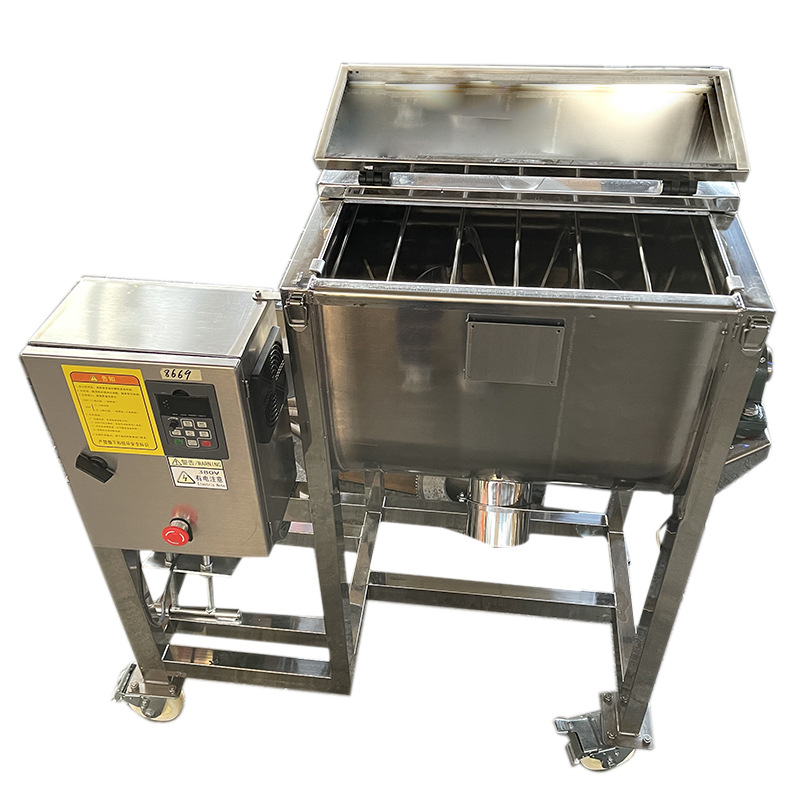
At its core, a horizontal screw belt mixer is a professional mixing equipment used in industries such as chemicals, battery materials, food, pharmaceuticals, and building materials to blend powders, granules, and pastes into a homogeneous mixture. The machine is characterized by a U-shaped horizontal trough and a rotating screw or ribbon agitation system that generates a gentle yet thorough mixing action.
Core Function and Working Principle
The horizontal screw belt mixer transforms raw materials from separate, non-uniform batches into a consistent, uniform blend. The core working part is a horizontal U-shaped container that houses one or two layers of helical ribbons (screw belts). The outer spiral moves materials from the ends toward the center, while the inner spiral (or reverse pitch) pushes materials from the center outward, creating a convective mixing pattern. This dual-direction flow ensures that all particles are continuously circulated and interchanged, achieving high homogeneity in a relatively short mixing time.
Key process parameters include the rotation speed (typically 30–39 rpm for heavy-duty models), the pitch of the ribbons, and the mixing duration (often 8–15 minutes for a batch). The design minimizes shear stress, making it ideal for fragile or cohesive materials that cannot tolerate high-impact mixing.
Key Components and Critical Technologies
Although the horizontal screw belt mixer is a single type of equipment, several critical components determine its performance:
U-Shaped Trough and Cover
The trough is typically made of stainless steel (304 or 316L) for corrosion resistance and easy cleaning. The cover can be fully opened for quick access during maintenance or product changeover, reducing cross-contamination between batches.
Ribbon Agitator
The agitator consists of inner and outer helical ribbons. In some designs, the ribbons are segmented (broken ribbons) to create additional shear zones and vortexes, accelerating mixing and improving uniformity. The agitator shaft is connected to the drive via a flange for easy removal.
Drive System
Most standard models use a belt-driven cycloidal reducer, which provides overload protection through elastic belt slip. This design is cost-effective and protects the transmission from damage when the mixer is jammed.
Discharge Valve
The common discharge method is a pneumatic or manually operated flap valve. The arc-shaped valve fits flush with the inner wall of the trough, eliminating dead zones and preventing material accumulation, ensuring no leakage during frequent cycling.
Key Performance Indicators and Selection Criteria
When selecting a horizontal screw belt mixer, consider the following metrics:
- Working Capacity: Typically 60–80% of the total volume. Models range from 0.1 m³ to 20 m³ per batch, corresponding to power from 5.5 kW to 110 kW.
- Material of Construction: Stainless steel (SS304, SS316L) is standard for food, pharmaceutical, and chemical applications. Carbon steel may be used for less demanding environments.
- Mixing Time and Uniformity: Most mixers achieve homogeneous blending within 8–15 minutes. The coefficient of variation (CV) can be as low as 3–5% for free-flowing powders.
- Automation: Models can be equipped with timers, variable frequency drives, and PLC control for precise batch management.
- Maintenance: Look for easy-to-clean designs with fully openable covers and flush-mounted discharge valves.
Application Areas and Selection Advice
The horizontal screw belt mixer is widely used in:
- Chemical Industry: mixing dry powders, pigments, and additives.
- Battery Materials: blending cathode/anode powders and conductive agents.
- Food & Pharmaceuticals: mixing dry milk powder, spices, sugar, and pharmaceutical granules.
- Building Materials: dry mortar, putty, and refractory mixes.
For small-scale laboratory or pilot production, choose a compact model with a working volume of 0.1–0.5 m³. For large-scale industrial production, select a heavy-duty model with a capacity of 1–20 m³, preferably with stainless steel construction and automated discharge.
References
Related Products
Get In Touch
Our professional team will reply to you within one business day. Please feel free to contact us!