

What is a Horizontal Screw Belt Mixer? A Blender for Uniform Dry Powder Mixing
What Is a Horizontal Screw Belt Mixer?
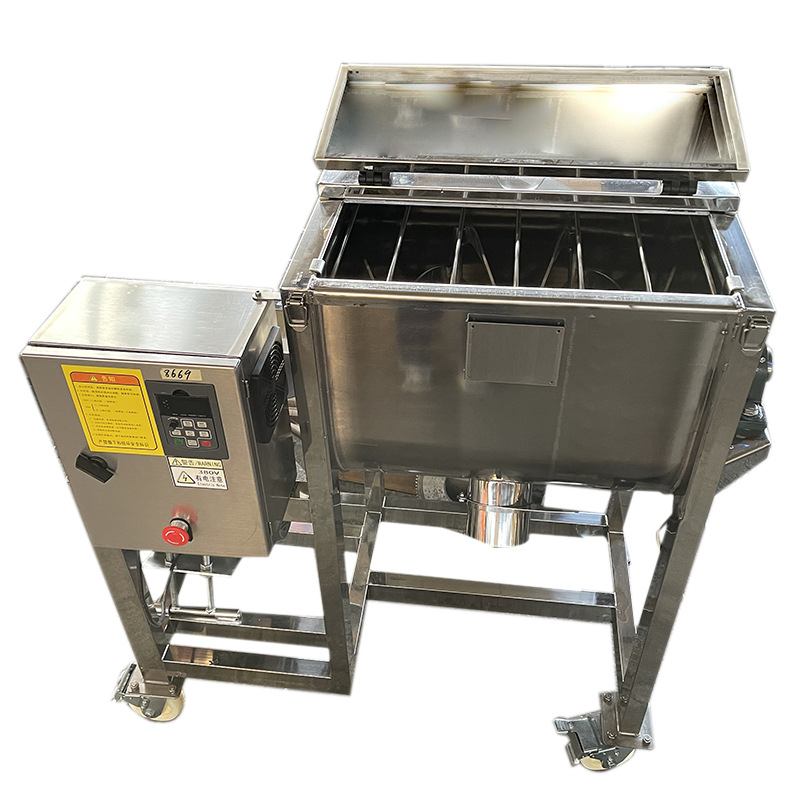
From its core, a horizontal screw belt mixer is a blending machine used to turn separate dry powders and granules into a uniform batch. It suits powder operations where consistent ingredient distribution, not size reduction, is the goal. Typical uses include recipe blending, additive dispersion, and pre-production homogenization.
Core Function and Working Principle
The mixer moves material through a horizontal chamber while a rotating screw-belt agitator lifts, folds, and exchanges powder across the bed. The screw section transports material along the axis; the outer belt promotes counter-flow. This repeated dividing and recombining reduces segregation and creates a repeatable blend.
From separate ingredients to a uniform blend
Ingredients may be loaded in layers. As the agitator turns, material from different feed points is circulated and folded together. The action is generally gentle, but results depend on particle size, shape, density, and flowability.
Process variables that affect quality
Batch size, loading pattern, agitator speed, mixing time, and discharge method affect uniformity. Simple formulations may need short cycles; powders with large density differences may need longer blending. Overmixing can add heat or wear, so set the cycle through trial batches and sample checks.
Core Components and Configuration Choices
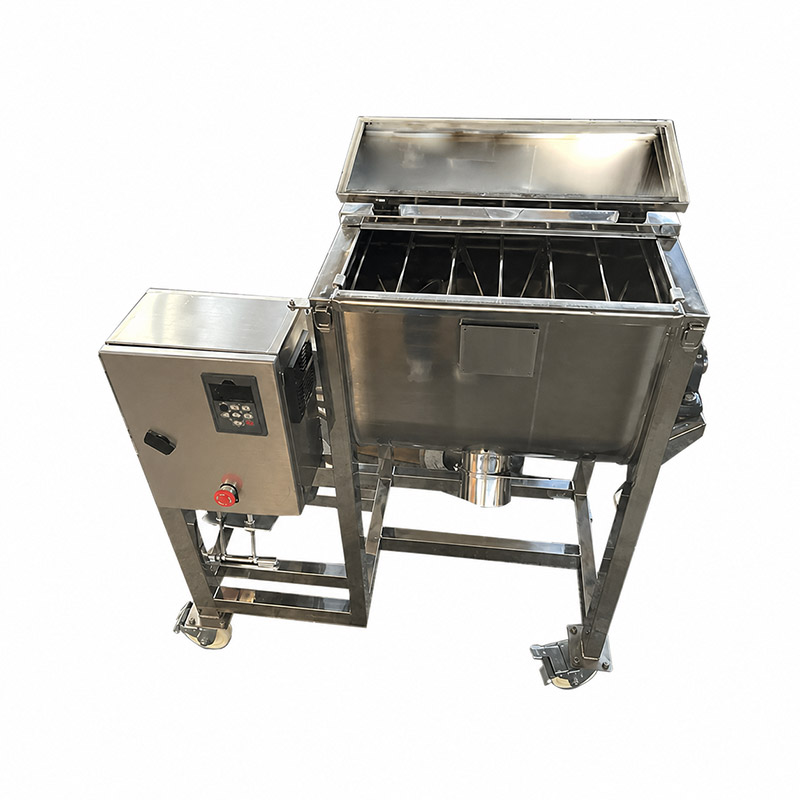
Because the equipment is configured around the process, practical choices include chamber volume, agitator geometry, construction material, discharge arrangement, and cleaning access. These details affect batch fit, maintenance, and line integration.
Mixing chamber and agitator
The chamber holds the batch, while the screw-belt agitator provides axial transport and cross-batch folding. A well-matched geometry limits dead zones near the ends and floor. Discharge design affects recovery and changeover time; good cleaning access matters when recipes change often.
Controls and material compatibility
Controls may range from simple operation to programmable sequences. Selection should reflect repeatability, traceability, and operator skill. Contact-part materials and finishes should match the powder, cleaning routine, and site safety rules.
Key Performance Indicators and Selection Points
Compare batch capacity, achievable uniformity, cycle time, material compatibility, and cleaning convenience. Capacity should be judged by working volume, not chamber size alone. Uniformity should be tested with the actual formulation because similar powders can behave differently.
Energy use, wear, maintenance access, and discharge efficiency also matter. A gentle action may protect fragile granules but require longer mixing. If automation is needed, confirm recipe storage, interlocks, and production records.
Applications and Selection Advice
These mixers are used in chemical processing, ceramics and minerals, food and feed ingredients, and general industrial blending. For fragile granules, use gentle mixing and controlled cycle time; for dense or cohesive powders, confirm loading and discharge during testing.
Start with formulation, batch size, bulk density, and discharge needs, then verify the configuration with the supplier. See the Horizontal Screw Belt Mixer product page for the available equipment, and base the final choice on material trials and site requirements rather than headline capacity alone.
Related Products
Get In Touch
Our professional team will reply to you within one business day. Please feel free to contact us!