
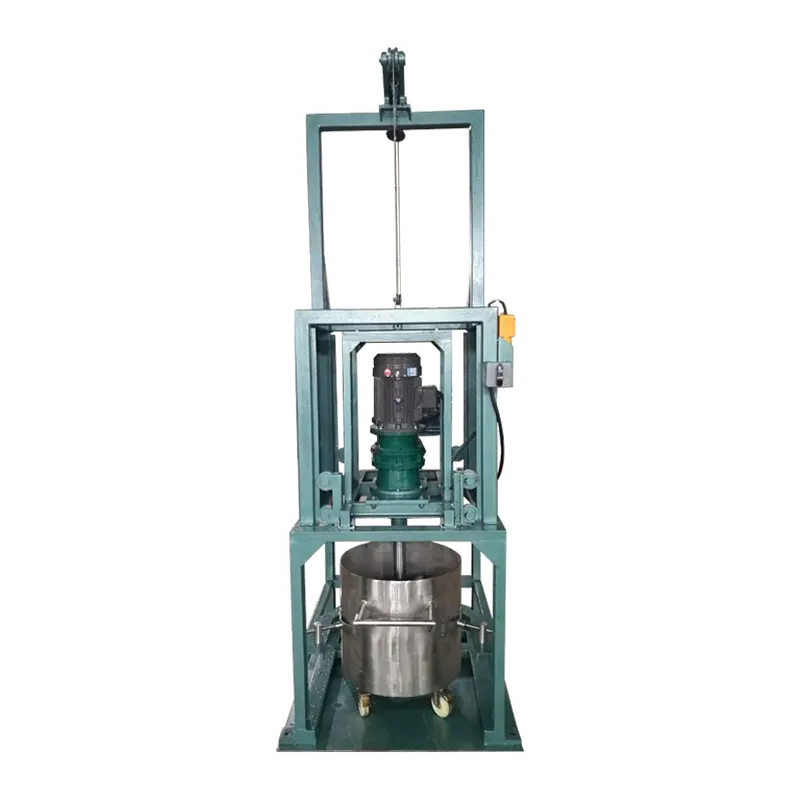
What is a High-Speed Simple Disperser? An Efficient Mixing and Dispersing Equipment for Liquid and Powder Materials

What is a High-Speed Simple Disperser?
At its core, a high-speed simple disperser is a specialized mixing and dispersing equipment used in industries such as coatings, inks, adhesives, cosmetics, pharmaceuticals, and food processing to efficiently break down agglomerates, disperse solid particles into liquid phases, and create uniform suspensions or emulsions. Unlike complex multi-shaft mixers, the high-speed simple disperser offers a straightforward, cost-effective solution for achieving high-quality dispersion in a wide range of applications.
Core Function and Working Principle
The primary function of a high-speed simple disperser is to transform coarse mixtures of liquids and powders into finely dispersed, homogeneous products. The key component is a rotating dispersing blade (often a toothed disc) mounted on a shaft. When the blade rotates at high speeds – typically with a peripheral tip speed of 20–30 m/s – it creates a powerful suction effect, drawing material from the top and bottom of the mixing vessel into the blade area.
In this zone, the material undergoes intense mechanical shear, impact, and collision between the blade teeth and the surrounding liquid. The high kinetic energy breaks down particle agglomerates and disperses them uniformly throughout the liquid. The turbulence generated by the blade also ensures continuous circulation, eliminating dead zones and achieving consistent results. The final particle size can reach as low as 0.1 micron, making the disperser comparable to high-pressure homogenizers in terms of dispersion quality, but with a much simpler and more economical design.
Key process parameters that influence the dispersion outcome include blade speed (often variable from 100 to 1500 rpm), blade geometry, dwell time, and the viscosity of the mixture. For optimal performance, the disperser is often used in conjunction with a hydraulic lift system that allows easy raising and lowering of the shaft for vessel change and cleaning.
Key Components and Technical Features
The high-speed simple disperser is characterized by its simple yet robust construction. The main components include:
- Dispersing blade: Usually a toothed disc made of stainless steel or hardened alloy, designed to generate high shear forces.
- Drive motor: Explosion-proof or standard motors from 2.2 kW to 55 kW, providing variable speed control for different material viscosities.
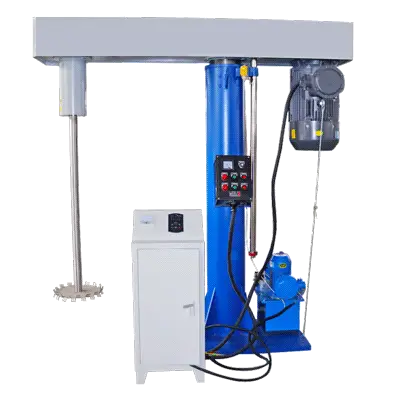
- Hydraulic lifting system: Allows easy vertical movement of the shaft to accommodate different vessel sizes and facilitate cleaning.
- Control panel: Equipped with frequency inverter for speed adjustment, timer, and emergency stop.
- Optional vacuum system: For deaeration of materials to prevent bubble formation during dispersion.
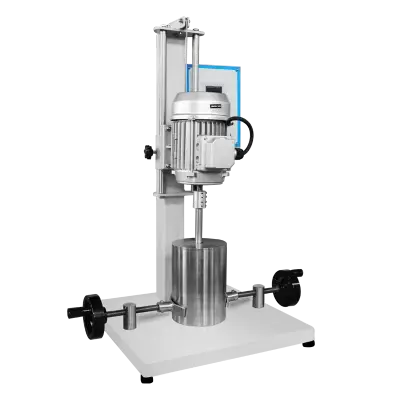
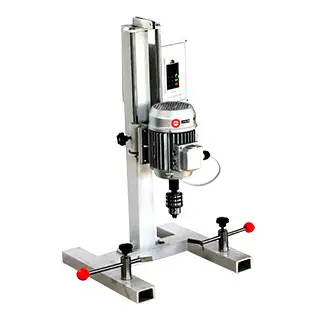
The stand-type and platform-type configurations are available. Stand-type models are compact and suitable for mobile operation, while platform-type models are fixed and handle larger batches. All models are designed for easy maintenance and long service life.
Key Performance Indicators and Selection Criteria
When selecting a high-speed simple disperser, consider the following factors:
- Processing capacity: Typically measured in liters per batch. Common models range from 200 L to 1000 L, with larger capacities available.
- Motor power: Higher power (e.g., 30 kW) enables processing of higher viscosity materials. The relationship between power and capacity should be matched to your production needs.
- Speed range: Variable speed control (e.g., 100–1400 rpm) provides flexibility for different materials. Lower speeds are used for gentle mixing, while higher speeds are needed for intense dispersion.
- Material of construction: Stainless steel (SS304 or SS316) is standard for corrosion resistance and hygiene, especially in food and pharmaceutical applications.
- Automation level: Basic models have manual speed control, while advanced versions offer PLC control with touch screen for recipe storage and repeatability.
- Safety features: Explosion-proof designs are available for flammable solvents. Emergency stop and overload protection are standard.
For laboratory R&D, smaller lab disperser models are suitable, while for production scale, the high-speed simple disperser offers a balance of efficiency and simplicity.
Application Areas and Selection Advice
The high-speed simple disperser is widely used in:
- Coatings and paints: Dispersing pigments and fillers into binders to achieve color consistency and stability.
- Inks and printing: Homogenizing carbon black, dyes, and resins for high-quality printing inks.
- Adhesives and sealants: Mixing fillers and additives into adhesive base polymers.
- Cosmetics and personal care: Dispersing pigments, powders, and active ingredients into creams, lotions, and foundations.
- Pharmaceuticals: Preparing suspensions and ointments with uniform particle size distribution.
- Food processing: Mixing powders into liquids for sauces, beverages, and confectionery.
- Chemical industry: Dispersing catalysts, additives, and other solid-liquid mixtures.
For users who need to handle highly viscous pastes or require simultaneous mixing and deaeration, a hydraulic single axis disperser or a vacuum disperser may be more appropriate. However, for most standard dispersion tasks with medium to low viscosity, the high-speed simple disperser offers the best value in terms of cost, efficiency, and ease of operation.
References
Product page: High-speed simple disperser - TENCAN
Related Products
Get In Touch
Our professional team will reply to you within one business day. Please feel free to contact us!