

What is a High-Speed Simple Disperser? A Core Mixing and Dispersion Device for Rapid Particle Size Reduction and Homogenization
At its core, a High-Speed Simple Disperser is a specialized mixing device that industries like coatings, inks, adhesives, cosmetics, and pharmaceuticals use to rapidly homogenize, dissolve, and disperse solid powders into liquid matrices. This machine transforms a rough mixture of agglomerated particles and liquid vehicle into a stable, uniform suspension, significantly reducing particle size through intense mechanical force.
Core Functions and Working Principle
The fundamental operation of a High-Speed Simple Disperser is the efficient conversion of a coarse, lumpy mixture into a fine, homogeneous slurry. The heart of the machine is a high-speed rotating shaft terminated by a specially designed toothed disc (often called an impeller).
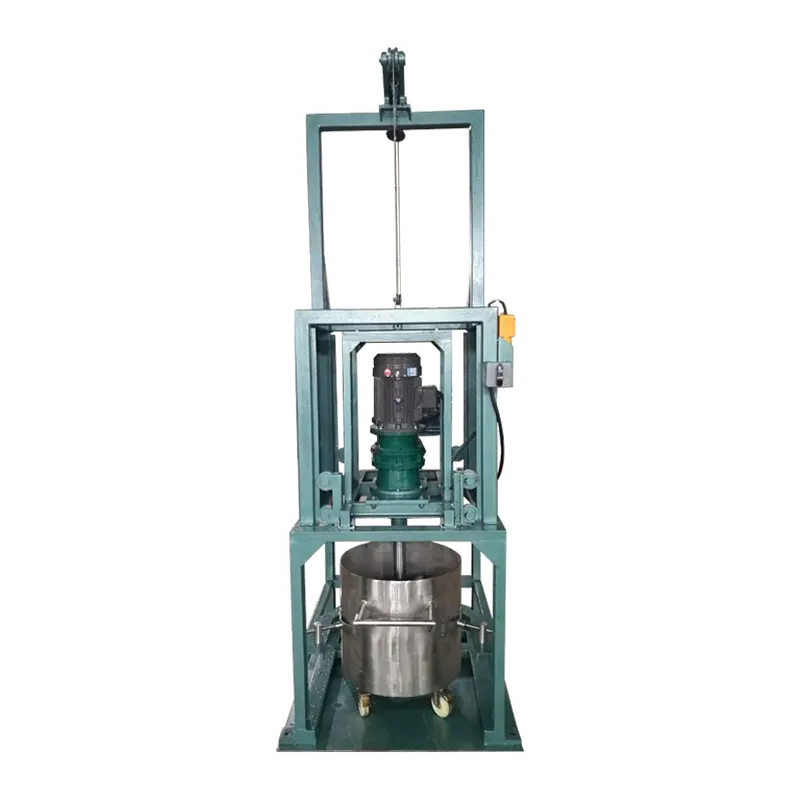
When the toothed disc rotates at high peripheral tip speeds, two key mechanisms occur: Shear and Impact. The high-velocity disc creates a powerful suction that draws liquid and powder into the blade zone. Here, particles are crushed and broken apart by three forces: the shearing action between the edge of the teeth and the surrounding liquid, the impact of particles hitting the teeth, and the friction generated as material flows across the blade surface. A critical advantage is the minimal air suction into the mixture during operation. This ensures that the dispersion and homogenization process is highly effective without introducing unwanted bubbles, which is essential for the quality of high-viscosity products like paints.
Key Control Parameters
- Shaft Speed: Adjustable via a variable frequency drive, this directly determines the peripheral tip speed and, consequently, the intensity of the shear forces. Higher speeds provide finer dispersion but may require better cooling.
- Operating Time: The duration of dispersion directly influences the final particle size distribution. Over-processing can lead to heat buildup or re-agglomeration.
- Material Viscosity: While versatile, the optimal performance is achieved within a specific viscosity range for each disc design, ensuring the "doughnut" flow pattern is maintained for maximum efficiency.
Core Components and Technological Features
The High-Speed Simple Disperser is designed with a focus on simplicity, efficiency, and ease of maintenance. Its robust construction typically includes:
- Powerful Motor: Ranging from 2.2 kW to 55 kW, providing the necessary torque for processing medium to high-viscosity materials in batch sizes from 1 to 2000 liters.
- Hydraulic Lifting System: A common and essential feature. The entire dispersion head is mounted on a hydraulic column, allowing it to be easily raised and lowered in and out of the mixing vessel. This simplifies cleaning, vessel changes, and operational workflow.
- Toothed Dispersion Disc: The main work tool. Typically made from stainless steel or specially hardened steel for durability, the disc is engineered to create the high shear field necessary for efficient dispersion.
Key Performance Indicators and Selection Guide
When selecting a High-Speed Simple Disperser, professionals must consider several critical parameters to ensure it meets their specific processing requirements.
- Processing Capacity and Power: This is the most fundamental choice. For laboratory or small-scale pilot work, models with 2.2 kW to 5.5 kW handling 5 to 50 liters are sufficient. For production lines, models up to 55 kW handling 500 to 2000 liters are available. The power must match the viscosity of the material; thicker materials require higher torque and power.
- Dispersion Precision and Particle Size: While a simple disperser does not achieve the nanometer-level fineness of a bead mill, it excels at breaking down soft and medium-hard agglomerates to a typical fineness of 10-50 micrometers. It is not suitable for true grinding of hard, crystalline particles.
- Automation and Control: Advanced models feature digital speed displays, programmable logic controllers (PLCs), and even vacuum systems for degassing. This is critical for processes requiring high repeatability and quality control.
- Maintenance and Cleaning: Models with simple hydraulic lifting and easy-to-clean dispersion discs are preferred in industries where color changes are frequent to minimize downtime.
Application Areas and Selection Suggestion
The High-Speed Simple Disperser is a workhorse across a broad spectrum of industries. Its primary applications include:
- Coatings and Paints: Pre-dispersing pigments like titanium dioxide, carbon black, and colored pigments before fine grinding.
- Inks and Printing: Dispersing dyes and extenders into varnishes and binders.
- Adhesives and Sealants: Incorporating fillers (e.g., calcium carbonate, talc) and additives into resin bases.
- Cosmetics and Pharmaceuticals: Homogenizing creams, ointments, and suspensions where gentle yet effective mixing is required.
For users who need a robust, easy-to-operate machine for pre-mixing or intermediate dispersion tasks in a production environment, a stand-alone hydraulic single-axis disperser is an excellent choice. For laboratory R&D or small batch production, a compact lab disperser offers flexibility and precision at a lower cost. If you are starting with a pre-mixed blend and require powerful disagglomeration, the High-Speed Simple Disperser is the ideal first step in your powder processing line.
Related Products
Get In Touch
Our professional team will reply to you within one business day. Please feel free to contact us!